Why Study in Georgia?
Georgia, the ancient Caucasian nation nestled at the crossroads of Europe and Asia, is rapidly emerging as one of the most exciting and affordable study abroad destinations for international students. For Indian students seeking high-quality, English-medium education at genuinely low costs outside the traditional European mainstream, the opportunity to study in Georgia offers a compelling and increasingly popular pathway. With a welcoming culture, a modernizing economy, and a growing higher education sector, Georgia deserves serious consideration from any student exploring international study options.
Overview
of Georgia as a Study Destination
Situated at the intersection of Eastern Europe and Western Asia, Georgia is a
sovereign nation bordered by Russia, Turkey, Armenia, and Azerbaijan, with a
Black Sea coastline to the west. While not an EU member state, Georgia holds EU
candidate country status and maintains strong academic and cultural ties with
Europe. The country's higher education system is regulated by the National
Center for Educational Quality Enhancement (NCEQE) and comprises over 60
accredited universities and higher education institutions. Tbilisi, Georgia's
vibrant capital city, is home to the majority of the country's leading
universities and hosts a rapidly growing international student community.
Georgia currently welcomes over 15,000 international students annually, with
Indian students forming one of the largest and fastest-growing international
student groups in the country.
Academic
Excellence
Georgian universities have invested significantly in academic quality
improvement over the past decade, driven by the country's ambition to align its
higher education system with European standards. Tbilisi State University,
founded in 1918 and the oldest university in the Caucasus region, is Georgia's
flagship research institution, recognized internationally for its programs in
natural sciences, humanities, law, and social sciences. The University of
Georgia (Tbilisi), Ilia State University, and Georgian National University
(SEU) have all established strong reputations for English-medium instruction,
modern research facilities, and internationally collaborative faculty.
Georgia's medical universities, including Tbilisi State Medical University and
David Tvildiani Medical University, are particularly well-regarded among Indian
students, offering WHO-listed, NMC-recognized medical degrees at highly
competitive tuition rates. Academic programs across Georgia increasingly
incorporate international research partnerships, European exchange programs,
and industry-relevant curricula that prepare graduates for competitive global
careers.
Affordable
Tuition Fees
One of the most powerful draws for Indian students who choose to study in
Georgia is the remarkably low cost of tuition. Annual tuition fees at
Georgian universities for undergraduate programs range from as low as $3,000 to
$8,000 per year, depending on the institution and discipline. Medical programs, which attract the highest number of Indian students, are available for
$4,000 to $8,000 per year, representing extraordinary value compared to
equivalent programs in the UK ($30,000+), Australia ($25,000+), or even Eastern
European countries like Poland or the Czech Republic ($8,000–$14,000). Business,
computer science, and engineering programs are available for $2,500 to $6,000
per year at accredited institutions. This exceptional affordability, combined
with internationally recognized degree outcomes, makes higher education in
Georgia one of the strongest value propositions available to Indian students
globally.
International
Student Environment
Georgia's international student community has grown rapidly over the past
decade, driven primarily by the country's affordable medical education and
English-medium programs. Students from India, Iran, Iraq, Nigeria, Egypt, and numerous other countries choose Georgia for higher education every
year, creating genuinely diverse and multicultural campus environments, particularly in Tbilisi. Georgian universities have responded to this growth by
expanding dedicated international student support services, English-language
orientation programs, dedicated international affairs offices, and student
buddy systems designed to help newcomers settle comfortably into Georgian
academic and social life. Indian students in Georgia benefit from
well-established Indian communities, Indian restaurants, grocery stores
stocking familiar products, and active Indian student associations in Tbilisi
and Batumi.
Recognition
of Degrees Worldwide
Degrees from accredited Georgian universities carry significant international
recognition. Medical degrees from WHO-listed Georgian medical universities are
recognized by the National Medical Commission of India (NMC), making Georgian
medical graduates eligible to appear for the Foreign Medical Graduate
Examination (FMGE/NExT) in India. Georgian degrees are also recognized by the
European Medical Association, the General Medical Council (GMC) of the UK, and
medical licensing bodies in the USA (USMLE) and Canada. For non-medical
disciplines, degrees from accredited Georgian universities are recognized by
the European Higher Education Area (EHEA) framework and are respected by
employers and academic institutions across Europe, the Middle East, and Asia.
Georgia's ongoing EU integration process is progressively strengthening the
international standing of its academic qualifications.
Ready to explore your options to study in Georgia? Contact Your Global Mentors today for a free consultation with our Georgia education specialists.
Facts About Georgia
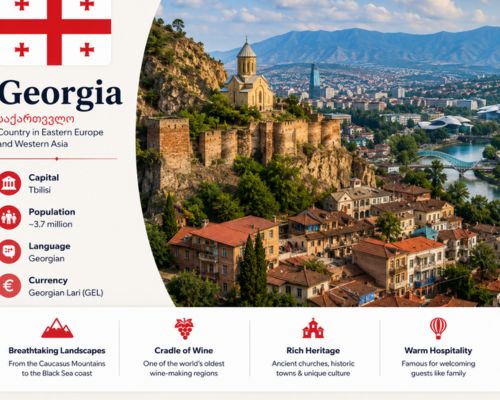
1. Georgia is located at the crossroads of Europe and Asia.
2. The capital city of Georgia is Tbilisi.
3. Georgian is the country's official language.
4. Georgia has its own unique writing system, the Georgian alphabet.
5. The country is considered one of the oldest wine-producing regions in the world.
6. Georgia gained independence from the Soviet Union in 1991.
7. The national currency is the Georgian Lari (GEL).
8. The Caucasus Mountains run through northern Georgia.
9. Georgia is famous for its hospitality, traditional cuisine, and folk music.
10. The country's highest peak is Mount Shkhara at 5,193 meters (17,037 feet).Living cost
|
Expense Category |
Average Monthly Cost (US DOLLARS) |
Average Monthly Cost (INR) |
|
Accommodation |
$150 - $350 |
14,179.40 – 33,085.27 |
|
Food & Groceries |
$100 - $200 |
9,452.94 – 18,905.87 |
|
Transportation |
$15 - $30 |
1,417.94 – 2,835.88 |
|
Health Insurance |
$20 - $50 |
1,890.59 – 4,726.47 |
|
Mobile & Internet |
$10 - $20 |
945.29 – 1,890.59 |
|
Personal & Lifestyle |
$60 - $150 |
5,671.76 – 14,179.40 |
|
Total Monthly Cost |
$400 - $700 |
37,811.74 – 66,170.55 |
Accommodation - $150 to $350/month
Accommodation in Georgia is remarkably affordable by international standards.
Students living in university dormitories in Tbilisi can find rooms for as low
as $100 to $200 per month, while shared private apartments in central Tbilisi
typically cost $150 to $350 per month, depending on location, size, and
amenities. Private studio apartments are available for $250 to $450 per month.
In Batumi, Georgia's second major university city on the Black Sea coast,
rental costs are broadly comparable to Tbilisi. Overall, Georgia's
accommodation costs are among the lowest of any international study
destination, allowing students to live comfortably without financial strain.
Food &
Groceries - $100 to $200/month
Georgia is celebrated for its rich and diverse culinary tradition, and food is
extremely affordable for students. Students who cook at home regularly spend
just $100 to $150 per month on groceries from local markets and supermarkets
such as Carrefour, Goodwill, and Smart. Georgian cuisine, featuring dishes like
khachapuri (cheese bread), khinkali (dumplings), and fresh salads, is widely
available at local restaurants and canteens for $3 to $6 per meal. Students
following a mixed pattern of home cooking and occasional dining out can
comfortably keep their total monthly food expenditure within $150 to $200.
Transportation - $15 to $30/month
Getting around Tbilisi and other Georgian cities is extremely inexpensive.
Tbilisi's integrated public transport network, comprising metro, buses, and
minibuses, charges a flat fare of just $0.20 per journey. Monthly transport
expenses for students rarely exceed $15 to $30, even with daily commuting.
Tbilisi's metro system efficiently connects major university campuses to
residential areas and city center destinations, making private transport
entirely unnecessary for most students.
Health
Insurance - $20 to $50/month
Georgia requires international students to hold valid health insurance during
their period of study. Affordable student health insurance plans are available
from Georgian insurance providers for as low as $20 to $50 per month, providing
coverage for medical consultations, hospitalization, and emergency treatment.
Many Georgian universities assist international students in arranging group
health insurance at further reduced rates. India's robust Indian community in
Georgia and the country's improving healthcare infrastructure ensure that
students have access to adequate medical support throughout their studies.
Mobile
& Internet - $10 to $20/month
Mobile connectivity in Georgia is affordable and reliable. Georgian mobile
operators, including Magti, Geocell (Silknet), and Beeline, offer prepaid and
monthly plans with generous data packages, unlimited domestic calls, and SMS
for just $10 to $20 per month. Georgia has achieved excellent 4G coverage
across Tbilisi and major cities, and 5G rollout is underway in urban areas.
Most university dormitories and student apartments include Wi-Fi, further
reducing connectivity costs for students.
Personal
& Lifestyle - $60 to $150/month
Personal and lifestyle expenses cover toiletries, clothing, entertainment, and
social activities. Georgia's affordable retail environment, with local markets,
bazaars, and budget retail stores, keeps these costs well under control.
Tbilisi's vibrant cultural scene, including museums, galleries, theatres, and
music venues, offers outstanding entertainment value at very low prices.
Students who enjoy outdoor activities, hiking in Georgia's stunning Caucasus
mountains, visiting historic monasteries, or relaxing on Black Sea beaches find that Georgia offers extraordinary lifestyle experiences at minimal cost.
Total
Monthly Cost - $400 to $700/month
Combining all expense categories, international students in Georgia can plan
for a total monthly budget of just $400 to $700, making Georgia one of the most
affordable internationally recognized study destinations in the world. This is
dramatically lower than Poland ($500 - $800), Spain ($750 - $1,100), Germany
($850 - $1,200), or the UK ($1,500 - $2,200), positioning Georgia as an outstanding
value proposition for budget-conscious Indian students seeking quality higher
education.
*Note: All the costs mentioned are estimates and are subject to change.
Contact Your Global Mentors for a personalized budget plan tailored to your chosen university and program in Georgia.
Benefits of Studying in Georgia
Choosing to study in Georgia offers a unique combination of academic quality, affordability, cultural richness, and strategic career positioning that makes it an increasingly attractive choice for Indian students. Georgia's distinctive advantages go well beyond its low tuition fees and living costs; the country offers a genuinely rewarding and transformative study abroad experience.
Quality
Education
Georgia's higher
education institutions have undergone significant quality improvement reforms
over the past decade, supported by EU integration initiatives and international
accreditation partnerships. Georgian universities maintain strong academic standards
across medicine, engineering, business, law, and technology, with faculty
members increasingly holding international research credentials and
postdoctoral training from European and American institutions. Programs are
designed to meet global industry requirements, with a growing emphasis on
practical application, research skills, and professional competency development
that prepares graduates for competitive international careers.
Internationally
Recognized Degrees
Medical degrees from
WHO-listed Georgian universities are recognized by the NMC India, GMC UK, USMLE
(USA), and the European Medical Association, providing Indian medical
graduates from Georgia with outstanding global career mobility. For non-medical
disciplines, Georgian degrees recognized under the EHEA framework carry
credibility with employers and academic institutions across Europe and beyond.
Georgia's EU candidate status is progressively strengthening the international
standing of all Georgian academic qualifications, making a Georgian degree an
increasingly valuable international credential.
Cultural
Diversity
Georgia's ancient
culture, spanning over 3,000 years of recorded history, creates an
extraordinarily rich and stimulating environment for international students.
The country's unique position at the crossroads of European and Asian
civilizations gives Georgian society a fascinating multicultural character.
Students who study in Georgia experience a culture deeply rooted in
hospitality, artistic expression, culinary tradition, and religious heritage, enriching their personal development and cross-cultural competencies in ways
that extend far beyond the classroom.
Safety and
Student-Friendly Environment
Georgia is widely
recognized as one of the safest countries in the Caucasus and Eastern Europe
region. Tbilisi is a notably safe capital city with low violent crime rates,
friendly locals, and a well-established tradition of hospitality toward
foreigners, known in Georgian culture as "Magharo" (the spirit of
generous welcome). Georgian universities provide dedicated international
student support offices, orientation programs, and welfare services that help
Indian students settle comfortably and confidently into their new academic
environment.
Travel
Opportunities
Georgia's location at
the crossroads of Europe and Asia makes it a fascinating base for regional
exploration. Students can easily visit neighboring countries, including Turkey,
Armenia, and Azerbaijan, while the country's own extraordinary landscapes, the
high Caucasus mountains, ancient cave cities, medieval monasteries, and Black
Sea coastline, offer outstanding domestic travel experiences. Budget airlines
operating from Tbilisi International Airport also provide affordable access to
European cities, making broader European travel accessible during academic
breaks.
Research
and Innovation Opportunities
Georgia is actively
investing in research and innovation as part of its EU integration agenda, with
growing funding for science, technology, and digital transformation projects.
International students have access to research programs, innovation centers,
and technology hubs emerging in Tbilisi's rapidly developing tech ecosystem.
Georgia's government has identified technology, tourism, agriculture, and
healthcare as strategic growth sectors, creating expanding research and career
opportunities for internationally trained graduates.
Studying in Georgia means accessing quality international education at an extraordinary value. Contact Your Global Mentors today to explore the programs and universities that best match your academic and career goals.
No universities listed for Georgia yet.
No scholarships available right now.
Program Duration in Georgia
Understanding the structure and duration of academic programs is essential when planning to study in Georgia. Georgian universities follow a combination of traditional and Bologna-aligned program structures, offering internationally recognized qualification levels across undergraduate, postgraduate, and doctoral levels.
Bachelor's
Programs (4 Years)
Bachelor's degree programs in Georgia typically span 4 years (8 semesters)
across most disciplines, including business, computer science, law, social
sciences, and engineering. Medical bachelor's programs follow a different
structure. The MBBS (MD) program in Georgia is a 6-year integrated degree
combining preclinical and clinical training, making it one of the most
comprehensive and globally recognized medical qualifications available at
Georgian institutions. English-medium bachelor's programs are widely available,
particularly in medicine, dentistry, pharmacy, business management, and
computer science, making study in Georgia fully accessible for Indian students
without Georgian language proficiency.
Master's
Programs (2 Years)
Master's degree programs in Georgia generally require 2 years of full-time
study (4 semesters). Programs are available across a wide range of disciplines, including business administration, public administration, computer science,
engineering, law, and international relations. English-medium master's programs
are growing in availability, particularly in business and technology fields, at
major Tbilisi institutions. Tuition fees for master's programs at Georgian
universities range from $2,500 to $6,000 per year, representing exceptional
value for internationally recognized postgraduate qualifications.
MBA
Programs (1-2 Years)
MBA programs at Georgian business schools and universities are gaining growing
recognition within the regional business community. Full-time MBA programs
typically last 12 to 18 months, while part-time and executive formats extend to
2 years. Georgian MBA programs maintain connections with regional business
networks, international partner institutions, and the country's growing
entrepreneurial ecosystem, providing graduates with relevant and regionally
applicable business expertise. Several Georgian institutions offer
internationally accredited MBA programs in English, attracting students from
across the Caucasus, the Middle East, and South Asia.
PhD
Programs (3-4 Years)
Doctoral programs in Georgia are structured as 3- to 4-year research-focused
degrees conducted under the supervision of experienced academic mentors. PhD
programs are available across medicine, natural sciences, social sciences,
humanities, engineering, and law. International PhD candidates are eligible to
apply for research grants through the Shota Rustaveli National Science
Foundation of Georgia (SRNSFG), which funds doctoral and postdoctoral research
projects across all major disciplines. PhD programs at Georgian medical
universities are particularly popular among international graduates seeking
advanced clinical research qualifications.
Academic
Intake Periods
Georgian universities generally operate on two primary intake periods:
Medical programs at Georgian universities predominantly operate on a single September intake, with applications often closing by July due to high demand from international applicants. Let Your Global Mentors guide you through Georgia's application timelines, university selection, and intake planning. Contact our advisors today for a personalized academic roadmap.
Work Opportunities in Georgia
Work opportunities in Georgia for international students are developing alongside the country's rapidly growing economy and expanding service sectors. For Indian students who choose to study in Georgia, the ability to gain local work experience, even on a part-time basis, adds meaningful professional value to their academic journey and helps offset living costs.
International students in Georgia are generally permitted to work part-time while enrolled in full-time academic programs, subject to their residence permit conditions. Georgia's labor market, while smaller than Western European economies, offers growing opportunities in technology, hospitality, education, business services, and healthcare, sectors experiencing significant expansion driven by foreign investment and tourism growth.
A. Most Demanded Careers in Georgia
IT and
Software Development
Georgia's technology sector has emerged as one of the fastest-growing segments
of the national economy, supported by government investment in digital
infrastructure and a growing startup ecosystem in Tbilisi. Software developers,
web designers, mobile application developers, and cybersecurity professionals
are in increasing demand as Georgian companies and international firms
operating in Georgia accelerate their digital transformation agendas. Tbilisi's
evolving tech hub, with co-working spaces, accelerators, and international
tech company offices, creates expanding employment opportunities for IT
graduates.
Engineering
Georgia's ambitious infrastructure development program, including road
construction, energy projects, and urban development, creates consistent
demand for civil, structural, and construction engineers. The country's
significant hydropower resources and renewable energy development plans
generate additional demand for electrical and energy engineering professionals.
International engineering graduates from Georgian universities find
opportunities both within Georgia and in neighboring regional markets, including
Turkey, Azerbaijan, and Armenia.
Business
and Finance
Georgia's open, market-oriented economy and its status as a regional financial
services center create consistent demand for business analysts, accountants,
financial advisors, and management professionals. Tbilisi hosts the
headquarters of numerous regional banks, insurance companies, and international
corporations, providing graduate employment opportunities across finance,
consulting, marketing, and business development functions. Georgia's growing
fintech sector is also creating new career pathways for business and finance
graduates with digital skills.
Healthcare
Georgia's healthcare sector is experiencing significant growth and
modernization, supported by government investment and international health
organizations. Medical doctors, dentists, pharmacists, nurses, and allied
health professionals are in consistent demand across Georgia's expanding
network of public and private healthcare facilities. Medical graduates from
Georgian universities who complete the NMC licensing process are equipped to
practice in India, while those who choose to remain in Georgia or pursue
careers in Europe benefit from the international recognition of their Georgian
medical degrees.
Logistics
and Supply Chain
Georgia's strategic position as a transit corridor between Europe and Asia, on
the historic Silk Road route, makes it an important logistics and supply chain
hub for the broader Caucasus and Central Asian region. Supply chain managers,
logistics coordinators, customs specialists, and port operations professionals
are in demand as Georgia continues to develop its role as a regional trade and
transit gateway.
Data
Science and Artificial Intelligence
Georgia is in the early stages of developing its AI and data analytics
capabilities, with growing investment from both the government and the private
sector. Data analysts, business intelligence professionals, and technology
specialists are increasingly sought after as Georgian companies begin adopting
data-driven decision-making approaches. International graduates with strong
data science and AI skills bring valuable expertise to Georgia's developing
technology market and are well-positioned for career opportunities both
domestically and in broader European markets.
B. Popular Courses in Georgia
Students who choose to study in Georgia have access to a focused range of internationally recognized programs, particularly aligned with the country's key employment and development sectors:
Computer
Science
Growing technology programs offer strong foundations in programming,
software development, networks, and systems design. Graduates are employable
across Georgia's expanding IT sector and internationally.
Engineering
Civil, electrical, mechanical, and construction engineering programs are aligned
with Georgia's infrastructure development priorities. Graduates find
opportunities in Georgia's growing construction and energy sectors.
Business
Management
One of the most popular programs for Indian students studying in Georgia covers management, marketing, entrepreneurship, and international business.
Programs provide strong foundations for careers in Georgia's dynamic private
sector.
Finance
and Accounting
Programs providing strong foundations in financial management, accounting
principles, and business analytics are aligned with Georgia's growing financial
services sector and regional banking industry.
Medicine
(MBBS/MD)
By far the most popular course for Indian students in Georgia, the 6-year
English-medium MBBS/MD program offers WHO-listed, NMC-recognized medical
qualifications at highly affordable tuition rates. Georgian medical
universities produce thousands of internationally licensed medical graduates
annually.
Hospitality
and Tourism
Georgia's booming tourism industry, with visitor numbers growing exponentially
year on year, supports strong demand for hospitality and tourism management
graduates. Programs offer direct industry exposure through partnerships with
Tbilisi's growing hotel, restaurant, and tourism sectors.
Artificial
Intelligence
Emerging AI and technology programs at the Georgia Institute of Technology are
attracting internationally mobile students seeking careers in the rapidly
evolving field of artificial intelligence. Georgia's developing tech ecosystem
provides a growing platform for AI graduates to launch their careers.
Post-study work opportunities in Georgia are expanding as the country's economy grows and its labour market develops. Contact Your Global Mentors to identify the right program and career pathway aligned with your professional ambitions.
Frequently Asked Questions (FAQs)
Q1. What
are the requirements for a Georgia student visa for Indian students?
Indian students planning to study in Georgia must apply for a Georgian
Student Visa (Type D) from the Georgian embassy or consulate in India. Required
documents typically include a confirmed university admission letter, proof of
sufficient financial means, valid health insurance, proof of accommodation in
Georgia, a valid passport with at least 6 months' validity, academic
transcripts, and a completed visa application form. Georgia is known for its
relatively streamlined and student-friendly visa process compared to many other
international study destinations.
Q2. Are
scholarships available for international students in Georgia?
Yes. Scholarships in Georgia are available through the Georgian Government
Scholarship Program administered by the Georgian National Centre for
Educational Quality Enhancement (NCEQE), university-specific merit bursaries,
and grants from the Shota Rustaveli National Science Foundation (SRNSFG). Some
Georgian universities offer partial tuition fee waivers and merit-based
discounts for academically strong international applicants.
Q3. Are
programs in Georgia taught in English?
Yes. A large and growing number of programs at Georgian universities are fully
delivered in English, particularly in medicine, dentistry, pharmacy, business
management, computer science, and engineering. Georgia's medical universities, which attract the majority of Indian students, predominantly offer their
MBBS/MD programs in English, making studying in Georgia fully accessible for
Indian students without Georgian language proficiency. Some programs may
require basic Georgian language courses as part of the curriculum for
professional licensing purposes.
Q4. Can
international students work part-time while studying in Georgia?
International students in Georgia are generally permitted to engage in
part-time work subject to their residence permit conditions. Georgia's labor
market, while developing, offers growing part-time opportunities in
hospitality, retail, tutoring, IT support, and language instruction, particularly in Tbilisi and Batumi. Students interested in part-time work
should verify specific work authorization conditions with their university's international
student office or Georgian immigration authorities.
Q5. What
are the post-study work opportunities in Georgia?
After completing their studies, international graduates can apply to extend
their residence status in Georgia to seek employment. Medical graduates who
complete NMC licensing are primarily positioned for careers in India or
internationally, while graduates who choose to remain in Georgia find
opportunities in the country's growing technology, healthcare, hospitality, and
business sectors. Georgia's developing economy and strategic regional position
create expanding career opportunities for skilled international graduates,
particularly in technology, healthcare, and logistics sectors.
Your Global Mentors is a trusted study abroad consultancy dedicated to helping Indian students achieve their international education goals. From university shortlisting and application preparation to visa processing, scholarship guidance, and pre-departure support, we are with you at every step of your journey. If you are ready to study in Georgia and build a globally recognized academic and professional career, contact Your Global Mentors today for a free expert consultation.