

Top MBA Colleges in Latvia Fees, Admissions, and Career Opportunities
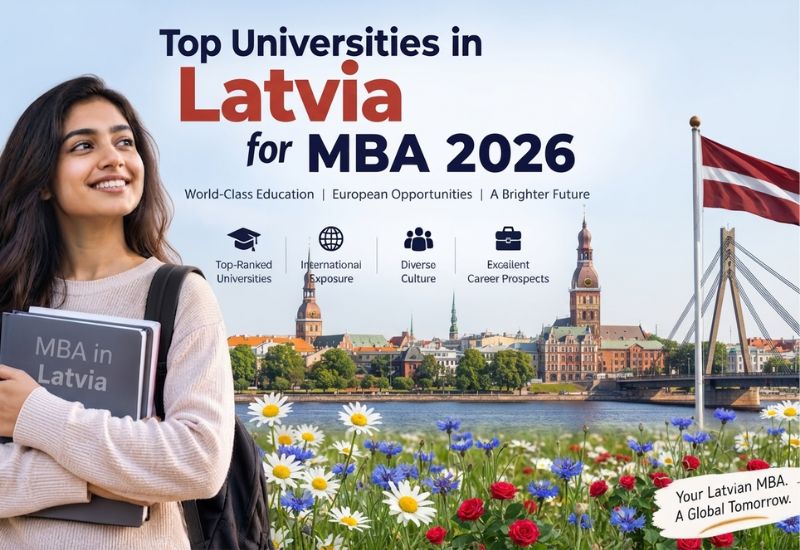
Table of Contents
Top MBA Colleges in Latvia: Highlights 2026
- Riga Business School (RBS): Founded in 1991 by Riga Technical University and SUNY Buffalo, with International Quality Assurance (IQA) accreditation. It now sits on RTU’s student campus in Riga and offers a flexible, pay-per-course Professional MBA starting at €850 per course
- Riga Technical University (RTU): Ranked 761-770 in the QS World University Rankings 2026, with a 2-year MBA and a reported 51% acceptance rate
- University of Latvia: Offers postgraduate business programs and Foundation Scholarships
- Liepaja University: Offers monthly stipends of €430-500 for Master’s students
- Fees: Standard MBA programs cost €2,000-8,000 per year. Executive MBA tracks are the exception, at up to €25,600 per year
- Cost advantage: Indian students typically spend ₹1.75-7 lakh on postgraduate programs in Latvia, versus ₹7-36 lakh for equivalent UK programs
- City concentration: Nearly all top MBA options are in Riga, the capital
Why Study MBA in Latvia?
- Low cost of study: Tuition is far below the UK, US, or Western Europe, and Latvia’s cost of living is about 29.5% lower than the US and 51.1% lower than the UK
- English-taught programs: Many MBA programs run fully in English, so Latvian is not needed for coursework
- Unrestricted work rights for Master’s students: Full-time Master’s students (which covers most MBA candidates) can work without hour limits, while bachelor’s students are capped at 20 hours/week. This helps offset an already low budget
- Flexible admissions: GMAT/GRE is often optional, and RTU takes a holistic view of your profile
- EU and Schengen access: Latvia is an EU, eurozone, and Schengen member, so it opens a path to Northern and Central European careers
- Strategic Baltic location: It sits between Eastern and Western European markets, with strong transport links through Riga’s port and airport
- Growing tech and startup scene: Riga hosts 400+ startups, and the IT sector is growing about 10% a year, which supports tech-adjacent management roles
- Recognized degrees: Latvian institutions belong to the European Higher Education Area (EHEA), and RTU sits in the QS top 1,000
List of Top MBA Colleges in Latvia 2026
- Riga Business School (RBS): Latvia’s most prestigious MBA. It offers General, Marketing, Finance, IT, and FinTech tracks, with local and international faculty (including professors from North America). Students take 2-4 courses per trimester and finish in 2-3 years
- Riga Technical University (RTU): A structured 2-year MBA that blends business management with RTU’s engineering and technology strengths. First-year tuition is about €3,900, and the application fee is €150
- University of Latvia: A solid choice for students who prioritise scholarship access
- Liepaja University: Stands out for its Master’s student stipends
- Selection tip: RBS suits those who want a prestige brand with a pay-as-you-go structure. RTU suits those who want a QS-ranked, technology-oriented MBA at a lower, fixed price
Best Universities for MBA in Latvia
- Best for prestige and international faculty: Riga Business School, with its SUNY Buffalo and University of Ottawa founding partnerships
- Best for ranking and value: Riga Technical University, which is QS-ranked and priced around €3,900 for the first year
- Best for scholarship access: University of Latvia, through its Foundation Scholarships
- Best for Master’s stipends: Liepaja University, at €430-500/month
- Best for flexibility: RBS, where the pay-per-course model lets you spread costs and pace your studies
- International environment: Latvia attracts students from around the world, so classrooms are multicultural and good for networking
MBA Eligibility Criteria in Latvia
- Bachelor’s degree: A recognized degree in any field is the baseline across nearly all programs
- RTU benchmark: A Bachelor’s in Social Sciences or equivalent, with at least 60% of the maximum possible results
- Test requirements: GMAT/GRE is compulsory only at some institutions depending on the course, and RTU’s graduate school sets no strict test-score minimum
- Work experience: Not mandatory for standard MBA tracks, though it strengthens your application. Executive MBA programs require significant professional experience
- English proficiency: Required unless your prior education was fully in English. RTU accepts IELTS 5.5+, TOEFL iBT 72+, PTE Academic 59+, Duolingo 95+, or Cambridge B2 First, and many universities also accept an MOI letter
- Other documents: CV, motivation letter, and letters of recommendation, alongside transcripts and diplomas
- Timeline: The main intake is September/October, with applications typically October to February. RTU’s autumn deadline has historically been mid-June, and some universities offer a February/March intake
Note: Fees, rankings, and entry requirements vary by university and change each intake. Please verify the latest 2026-27 details on the official websites (rbs.lv, rtu.lv, lu.lv) before publishing.
MBA Admission Requirements for International Students
- Bachelor’s degree: A recognised undergraduate degree in any field is the baseline across nearly all Latvian MBA programs
- RTU benchmark: A Bachelor’s in Social Sciences or equivalent, with at least 60% of the maximum possible results
- Work experience: Not mandatory for standard MBA tracks, though it strengthens your application. Executive MBA programs require significant professional experience
- English proficiency: Required unless your prior education was fully in English, which must be marked on your diploma/transcript or confirmed by a school certificate
- Application documents: CV, motivation letter (SOP),letters of recommendation, and official transcripts and diplomas
- Test scores: GMAT/GRE is needed only at some institutions, depending on the course
- Document handling: Documents usually need translation into English or Latvian, plus notarization or apostille depending on your country
MBA Admission Process in Latvia 2026
- Step 1, choose your track: Decide between General, Marketing, Finance, IT, or FinTech (the tracks offered at Riga Business School)
- Step 2, shortlist universities: Riga Business School, Riga Technical University (RTU), and University of Latvia are the main English-taught options
- Step 3, submit your application: Apply through the university’s portal with transcripts and degree certificates
- Step 4, add language proof: Submit IELTS, TOEFL, or an equivalent score, unless you are exempt
- Step 5, add test scores if required: GMAT/GRE only where your specific program asks for it
- Step 6, prepare your SOP and recommendations: Explain your motivation and career goals clearly
- Step 7, interview if required: Some programs assess communication skills, motivation, and fit
- Step 8, pay the application fee and submit before the deadline: RTU’s application fee is €150, and its autumn deadline has historically been mid-June
- Step 9, apply for your visa: After acceptance, apply for the Latvian long-stay student visa (Type D, about €60), then the temporary residence permit (about €100) after arrival
- Intakes: The main intake is September/October, and some universities offer a February/March intake
Entrance Exams Required for MBA in Latvia
- No universal national test: Most Latvian universities, including RTU’s graduate school, do not set a strict standardised-test minimum
- GMAT/GRE is course-dependent: Compulsory at some institutions for certain courses, but not a blanket requirement
- Holistic evaluation at RTU: Admission weighs your overall profile, including GPA and transcript strength, and the reported MBA acceptance rate is 51%
- Riga Business School: An entrance exam or interview “may be required” for most MBA programs, while the Executive MBA emphasises significant professional experience
- English proficiency is the more consistent requirement: IELTS or TOEFL (or an equivalent) is required far more often than GMAT
- Practical tip: Since tests are often optional, a strong GPA and transcript carry the most weight, so confirm the requirement for your specific program with the admissions office
English Language Requirements for MBA in Latvia
- RTU accepted tests and minimum scores:
- Exemption: No test needed if your previous studies were fully in English, with this noted on your diploma/transcript or confirmed by a certificate from your prior school
- MOI letter: A Medium of Instruction letter is accepted at several Latvian universities as an alternative to a standardized test
- Accessible threshold: RTU’s IELTS 5.5 minimum is notably lower than the 6.5-7.0 many Western European or UK programs expect
- Riga Business School: Lists proof of English proficiency (IELTS, TOEFL, or equivalent) as a standard requirement
MBA Fees in Latvia for International Students
- Standard MBA range : €2,000-8,000 per year
- Riga Business School: Pay-per-course model starting at €850 per course, so you can spread costs across the 2-3 year program
- Riga Technical University: First-year MBA tuition of about €3,900 (INR 3,59,936) for a 2-year program, plus a €150 application fee
- Executive MBA exception: Up to €25,600 per year (about ₹23 lakh)
- EU/EEA vs non-EU/EEA: EU/EEA students pay roughly €2,000-7,000 per year, and non-EU/EEA students (including Indians) typically pay somewhat more
- Overall comparison: Indian students spend about ₹1.75-7 lakh on Latvian postgraduate programs, versus ₹7-36 lakh for equivalent UK programs
- Other costs: Living costs run roughly €450-750 per month, and visa-related fees total about €160-165 combined
- Scholarships: Latvian State Scholarships (€500/month for Master’s students), Liepaja University stipends (€430-500/month), and university merit awards can reduce costs further
Cost of Living in Latvia for MBA Students
- Monthly range: About €300-850 depending on the source, city, and lifestyle. Most realistic budgets fall around €450-750
- Accommodation: Usually the biggest expense. RTU international student housing is a useful reference point at roughly €870 (about INR 80,512) for the period cited
- City variation: Riga is the most expensive. Living outside the capital, in places like Jelgava or Daugavpils, can be 10-20% cheaper
- Global comparison: Living costs are about 29.5% lower than the US, 51.1% lower than the UK, and 42.9% lower than Australia
- Baltic comparison: Latvia has among the lowest average monthly costs of the Baltic study destinations
- Work offset: Full-time Master’s students (which covers most MBA candidates) have unrestricted work rights, and typical student jobs pay about €3-5/hour, with tech or design work paying €6-8/hour
- Budgeting tip: Estimates vary widely, so plan toward the middle-to-higher end (around €600-700/month) and add health insurance and visa costs separately
Affordable MBA Colleges in Latvia
- Riga Technical University (RTU): First-year MBA tuition of about €3,900 (INR 3,59,936) for a 2-year program, at a QS-ranked (761-770) university
- Riga Business School (RBS): The Professional MBA is priced per course (starting at €850), with a listed total of about €13,650 over 30 months. That works out to roughly €5,500 a year, and you can spread payments as you progress
- University of Latvia: Offers scholarship access through its Foundation Scholarships. BA School of Business and Finance has also been part of the University of Latvia since September 2025, adding business-school options under one umbrella
- Public university baseline: Most Latvian public universities charge about €1,550-6,000 per year
- Biggest cost lever: Choosing a standard MBA over an Executive MBA. RBS’s Executive MBA is listed at about €33,000 over 20 months, so the track you choose matters more than the university
- Extra savings: Many Latvian universities accept an MOI letter instead of IELTS, which saves test fees and retake costs
MBA Scholarships in Latvia for International Students
- Latvian State Scholarships: €500/month for Bachelor’s and Master’s students and €700/month for PhD students
- Liepaja University: Monthly stipends of €430-500 for Master’s students
- University of Latvia Foundation Scholarships: Amounts and duration vary by scholarship
- Riga Technical University: Awards vary based on agreements and academic qualifications
- Merit awards: Many Latvian universities offer partial tuition waivers or aid for strong academic, leadership, or professional profiles. Apply directly through each school
- Erasmus+ and ICCR: Worth exploring for mobility and India-linked funding
- India-specific: The K.C. Mahindra Education Trust Scholarship (up to ₹10 lakh) can be used toward MBA study abroad, with deadlines typically around April
- Realistic expectation: Full funding is uncommon, so most students combine a partial award, part-time work, and savings or an education loan
Popular MBA Specialisations in Latvia
- General MBA (G): The broadest track, suited to candidates without a narrow focus
- Marketing (M): Prepares you to lead the full marketing process, from planning and research to strategy, implementation, and monitoring
- Finance (F): Covers financial markets, investment types, and analytical tools for sound financing and investment decisions
- Information Technology (IT): Built for managers in the IT sector and those running IT systems inside organizations
- FinTech: Includes an official credential in financial technology, with courses on FinTech business models, regulatory frameworks, and product development
- Other RTU options: RTU also lists related programs such as an MBA in Innovation and Entrepreneurship, plus MSc tracks in Business Finance, Entrepreneurship and Management, and Logistics and Supply Chain Management. Confirm current availability with the university
- Most tracks sit at RBS: If specialization depth matters, check RBS first, since it offers four named specializations alongside the general MBA
MBA Syllabus and Subjects in Latvia
- RBS Professional MBA structure: 15 courses (9 core and 6 electives) plus a Master Thesis. You register for courses based on each semester’s offer
- Pacing: Students take 2-4 courses per trimester and finish in 2-3 years, with a listed duration of about 30 months and intakes in January, May, and August
- Degree requirement: You need a cumulative grade average of 8.0 or higher to be awarded the MBA
- Course examples published by RBS:
- An AI course for non-IT professionals that bridges business and technology
- Modern Business Intelligence for data-driven decision-making (a 12-week course for managers and knowledge workers)
- A startup course where teams use AI tools to develop a launchable business plan
- Risk and its meaning for modern organizations
- FinTech Business Models and Strategy (for the Finance and IT/FinTech tracks)
- IT-concentration topics (older program description): Management of Innovations, Information Technology and Strategy, E-Business Solutions, and Information Legislation, Standards and Security
- RTU MBA: A 2-year program combining business management principles, strategic insights, and leadership skills, but I could not find a detailed public subject list, so check RTU’s current curriculum page
- Practical focus: Courses draw on practices of European and North American companies adapted to the Latvian business environment
Note: Fees, scholarship amounts, and course lists vary by source and change each intake. Please verify current 2026-27 details on the official websites (rbs.lv, rtu.lv, lu.lv) before publishing.
MBA Rankings and Accreditation in Latvia
- Riga Technical University (RTU): Ranked 761-770 in the QS World University Rankings 2026, which is the most visible global ranking for a Latvian MBA-offering university
- Riga Business School (RBS): Holds International Quality Assurance (IQA) accreditation, and Eduniversal has re-evaluated it and elevated it to 5 Palms of Excellence. It was founded in 1991 by RTU, SUNY Buffalo, and the University of Ottawa, and was the first Baltic institution to offer English-only MBA programs
- Degree conferral: RBS awards an internationally accredited MBA when you finish with a cumulative grade average of 8.0 or higher
- University of Latvia: BA School of Business and Finance has been part of the University of Latvia since September 2025, keeping its own brand and academic autonomy
- Ranking limits: In my searches I found no Latvian MBA in the flagship global MBA rankings, so rely on institutional QS rankings, Eduniversal ratings, and accreditation status rather than a single MBA-specific rank
- EHEA recognition: Latvian degrees follow the European Higher Education Area framework, which supports recognition across most of Europe
MBA Placements and Job Opportunities in Latvia
- Location advantage: Latvia is an EU, eurozone, Schengen, and NATO member, and Riga’s port and airport give graduates mobility across Northern Europe
- Digital economy: Latvia has one of Europe’s more advanced digital infrastructures. Riga hosts 400+ startups, and the IT sector has been growing about 10% a year, which helps tech-adjacent management roles
- Investment momentum: Latvia attracted over €1.01 billion in foreign direct investment through 31 major projects in 2025, with a further €1 billion target for 2026 in areas like smart energy, bioeconomy, and defense
- Demand for skilled labor: The country is openly seeking foreign workers, freelancers, and entrepreneurs to address skill shortages
- Riga concentration: Most corporate, consulting, and startup opportunities are in the capital
- Data caveat: Latvian business schools generally don’t publish MBA placement percentages the way larger markets do. Ask RBS or RTU for recent graduate outcomes before you commit, because role-level salary ranges are the more reliable data available
Average MBA Salary in Latvia
- Role-level ranges (per year):
- Management Consultant: €25,000-45,000
- Marketing Manager: €25,000-40,000
- HR Manager: €25,000-40,000
- Project Manager: €25,000-40,000
- Financial Analyst: €20,000-35,000
- Business Development Manager: €25,000+
- National average wage (2026): About €1,835 gross per month (roughly €22,000 a year), skewed upward by high earners in Riga. A gross €1,835 is roughly €1,360 net after tax
- Riga premium: Workers near Riga average about €2,400/month, versus about €1,700/month in surrounding regions
- IT/tech premium: Senior developers and leads earn €3,800-5,000+ per month, the strongest-paying sector
- Finance niche: Compliance officers and AML specialists earn about €2,500-3,500 per month
- Floor and tax: The minimum wage is €780/month as of January 2026, and personal income tax is progressive at roughly 20-31%
- Honest comparison: These salaries are well below US, UK, or Western European MBA outcomes, so Latvia’s case rests on low cost, not high pay
Top Recruiters After MBA in Latvia
- Named employers: I could not find a verified list of recruiters tied to Latvian MBA programs, and RBS and RTU don’t appear to publish one, so ask each school for its current employer list rather than relying on generic lists online
- IT and tech: The strongest sector, driven by Riga’s startup scene and tech-adjacent management hiring
- Finance and compliance: Banks and financial firms hire for compliance, AML, and analyst roles, which are in high demand
- Consulting and business services: Management consulting, project management, and business development roles are common MBA destinations
- Logistics and trade: Riga’s port and Baltic position support supply chain and trade-related management roles
- Startups: A growing ecosystem offers general management and product roles, often with more responsibility early on
- Regional reach: Graduates can also target employers in neighboring Baltic, Nordic, and Central European markets
Post-Study Work Opportunities in Latvia
- Initial job-search time: Master’s and doctoral graduates receive a residence permit for the study period plus an additional 4 months to look for a job or further study
- Possible extension: A further extension of up to 9 months can be requested specifically to find a job
- Work permit route: Long-term employment generally needs an employer willing to sign a contract, and salary thresholds depend on the sector. Check the Office of Citizenship and Migration Affairs (OCMA) rules for your target role
- Digital Nomad Visa: An alternative for remote workers employed by companies in OECD countries, with a minimum of 6 months’ work history and income above roughly 2.5x the national average (about €4,200 as of 2025)
- Tax context: Progressive income tax of about 20-31% affects take-home pay
- EU mobility: Once you have work rights, neighboring EU markets are easier to reach than from many non-EU study destinations
- Verify before relying on it: Permit durations and thresholds change, so confirm current terms with OCMA
FAQs About Top MBA Colleges in Latvia
Q1. Which are the top MBA colleges in Latvia?
Riga Business School (RBS), Riga Technical University (RTU), and the University of Latvia are the main English-taught options, with Liepaja University known for Master’s stipends.
Q2. How much does an MBA in Latvia cost?
Standard MBA programs cost about €2,000-8,000 per year. RTU’s first year is about €3,900, RBS’s Professional MBA is listed at about €13,650 over 30 months, and Executive MBA tracks cost more (RBS lists about €33,000 over 20 months).
Q3. Is GMAT required?
Usually not. GMAT/GRE is compulsory only at some institutions for certain courses, and RTU admits on a holistic review of your profile.
Q4. Is IELTS compulsory?
No. RTU accepts IELTS 5.5+, TOEFL iBT 72+, PTE 59+, or Duolingo 95+, and many universities accept an MOI letter or prior English-medium education.
Q5. Can I work while studying?
Yes. Full-time Master’s students have unrestricted work rights, while bachelor’s students are capped at 20 hours per week.
Q6. Can I stay and work after the MBA?
Graduates get 4 months after studies to find a job, with a possible extension of up to 9 months, and then need an employer-backed work permit.
Q7. What salary can I expect?
Role-level ranges run roughly €20,000-45,000 per year, with IT and compliance roles paying more. Riga pays noticeably more than other regions.
Q8. Is an MBA in Latvia worth it?
It is worth considering if you prioritize low cost, EU access, and flexible admissions over peak salaries and global brand prestige.
Conclusion
An MBA in Latvia is one of the most affordable routes into European business education. Standard programs cost €2,000-8,000 a year, living costs are far below the UK, US, and Western Europe, and Master’s students can work without hour limits. Riga Business School offers the strongest brand (IQA accredited, 5 Palms by Eduniversal) with a flexible pay-per-course structure, while RTU offers a QS-ranked, technology-oriented MBA at a lower fixed price. Salaries of roughly €20,000-45,000 and a modest job market mean this is a value choice, not a high-pay one. IT, fintech, and compliance roles offer the best earning potential, and the post-study window of 4 months, extendable by up to 9, requires active job hunting. Because Latvian schools publish little placement data, ask each shortlisted school for recent graduate outcomes, and confirm fees, scholarships, and permit rules with the university and OCMA before applying for 2026-27.