

MBBS in Nepal for Indian Students Fees, Admission, Eligibility, Colleges & Career Scope
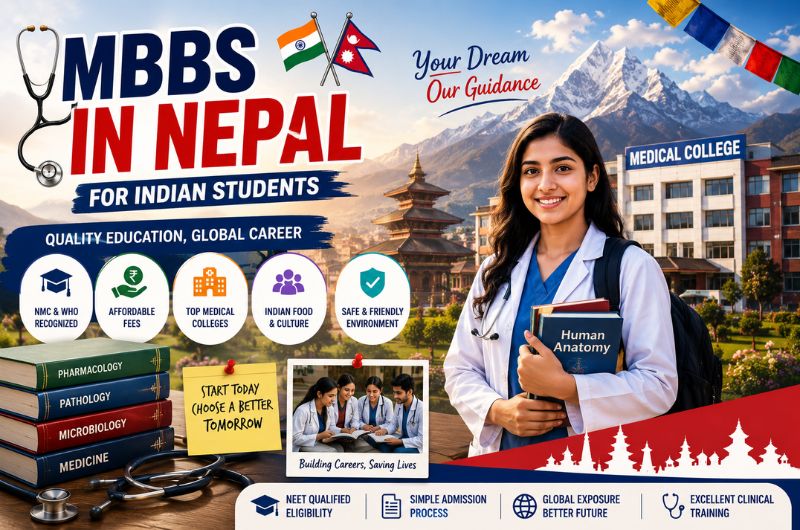
Table of Contents
MBBS in Nepal for Indian Students: Highlights 2026
Nepal currently has approximately 2,635 MBBS seats, out of which around 749 seats are reserved under the foreign quota, allowing Indian students to apply through NEET qualification. The country's medical universities are recognised by global bodies such as the National Medical Commission (NMC) and the World Health Organisation (WHO), and the MBBS program typically spans 5.5 years, including 4.5 years of academic study and one year of compulsory internship — a structure that mirrors the Indian MBBS system, offering a balanced mix of theoretical learning and hands-on clinical training in affiliated hospitals.
Why Choose MBBS in Nepal for Indian Students?
Considering Nepal for your MBBS journey? Here's why it remains a strong choice in 2026.
1. No visa required
Nepal is genuinely unique among MBBS abroad destinations — it's the only country Indian students can enter without a visa, given the open border and long-standing bilateral travel arrangement between the two countries.
2. Curriculum and language familiarity
Nepal offers English-medium instruction with a curriculum closely aligned with India, and all instruction is in English, with most patients speaking Hindi or similar languages — genuinely easing both academic and clinical communication.
3. Strong FMGE preparation advantage
The syllabus is quite similar to India's, so students can better prepare for licensing exams, and Nepal is known for producing some of the best FMGE outcomes among foreign medical education routes.
4. Simplified, student-friendly admission
Nepal offers a student-friendly academic environment with simplified admission procedures, making it particularly appealing for Indian students, with cultural similarity, familiar food habits, and minimal travel barriers reducing the adjustment challenges typically associated with studying abroad.
5. Genuine cost advantage over private Indian colleges
Nepal offers significantly lower tuition than private medical colleges in India while still providing quality clinical exposure and a globally recognised degree.
6. Strong clinical exposure
Hospitals in Nepal have high patient flow, giving students good practical experience during their clinical training years.
The bottom line: If proximity, cultural ease, and a strong licensing exam track record matter to you, Nepal offers a genuinely practical MBBS abroad pathway in 2026 — without visa hassles or drastic cultural adjustment.
Eligibility Criteria for MBBS in Nepal for Indian Students
Here's what you need to be eligible for MBBS admission in Nepal in 2026.
Academic qualification
- Must have completed 10+2 or equivalent from a recognised board
- Physics, Chemistry, and Biology (PCB) with a minimum of 50% marks — this threshold is consistently cited across sources
Age requirement
- Must be at least 17 years of age at the time of admission
- The upper age limit varies by college but is usually 25 years
NEET-UG qualification
- Indian students are required to qualify NEET according to NMC guidelines — non-negotiable if you intend to practice in India after graduation.
MECEE-BL entrance exam
- Unlike other countries where NEET alone is sufficient, Nepal requires international students to pass the Medical Education Commission Entrance Examination for Bachelor Level (MECEE-BL) — though this requirement may vary depending on the university and seat category.
Medical fitness certificate
- Some universities require applicants to submit a medical certificate confirming mental and physical readiness for MBBS.
Our advice: Since Nepal genuinely differs from destinations like Russia or Georgia by requiring the MECEE-BL exam alongside NEET, don't assume your NEET qualification alone secures admission — verify your target university's specific stance on this additional entrance test before finalising your application strategy for 2026.
NEET Requirements for MBBS in Nepal
This is the single most important section to understand thoroughly — here's exactly how NEET applies to MBBS in Nepal for 2026.
NEET is mandatory, without exception
Regardless of which college or which admission route is used, every Indian student intending to have their Nepal MBBS degree recognised in India must have a qualifying NEET-UG score — there is no route around this requirement.
Why NEET matters even though Nepal has its own entrance exam
There are some colleges where you may get admission without NEET, but you will not be allowed to practice in India afterwards — Nepal's own MECEE-BL exam governs local admission, but NEET governs your future ability to practice medicine back in India.
The 2018 rule and its continued application
From 2018 onwards, all Indian students seeking MBBS admission abroad must qualify NEET-UG — this applies to Nepal as well.
Post-graduation licensing requirement
After completing MBBS from Nepal, Indian students must clear the Foreign Medical Graduates Examination (FMGE) or the upcoming NExT (National Exit Test) to obtain a license to practice in India — and NEET qualification is the prerequisite that makes you eligible to even sit for this licensing exam.
Recommended (though not always mandatory) additional step
While not always mandatory, obtaining an NMC Eligibility Certificate before joining a foreign college is strongly recommended as an added layer of protection for your future recognition.
Our advice: Treat your NEET scorecard as more valuable than your Nepal admission letter itself — qualify NEET first, keep your scorecard secure throughout your program, and consider obtaining the NMC Eligibility Certificate proactively before committing financially to any Nepal MBBS program for 2026.
Admission Process for MBBS in Nepal 2026
Here's a step-by-step breakdown of what admission actually looks like for the 2026-27 session.
Step 1: Qualify NEET-UG first
Before anything else, appear for and clear the NEET-UG qualifying cutoff — this remains non-negotiable regardless of your chosen university or admission route.
Step 2: Understand the admission calendar
MBBS admission in Nepal for the 2026-27 session usually begins between September and October, when application forms are released by medical universities and the Medical Education Commission (MEC). The admission process generally continues until February or March, depending on seat availability and counselling schedules.
Step 3: Research and shortlist NMC-approved universities
Verify that your target college appears in the World Directory of Medical Schools (WDOMS) and meets World Health Organisation (WHO) compliance standards.
Step 4: Decide between direct NEET-based admission or MECEE-BL route
Some institutions offer direct admission based on NEET scores, while others require students to qualify for the Medical Education Commission Entrance Examination (MECEE), particularly for government seats.
Step 5: Apply directly or through authorised representatives
Indian students can apply directly through universities or authorised admission representatives after qualifying NEET.
Step 6: Prepare and submit required documents
Required documents include your NEET scorecard (if applying for direct admission based on NEET score)and your 10th and 12th mark sheets, attested by a notary, lawyer, or an authorised signatory like the principal.
Step 7: Receive your admission letter
After document submission, universities issue admission letters confirming your seat.
Step 8: Verify your college's compliance with 2026 NMC clarifications
Given the March 2026 NMC notice on online coursework compensation training, confirm in writing that your specific college maintains a genuine, well-documented record of physical, on-campus teaching throughout the entire course.
Step 9: Complete travel arrangements (no visa required)
Given the open border arrangement, Indian students can travel to Nepal without a visa, though standard university enrollment and local registration formalities still apply upon arrival.
Our advice: Since the admission window runs September through February/March, begin your NEET preparation and NMC-recognition verification well before this cycle opens — rushing this process once the window is already active significantly increases your risk of choosing a non-compliant college under time pressure.
Top Medical Colleges in Nepal for Indian Students
Here's a look at Nepal's leading, NMC-approved medical colleges genuinely worth considering for 2026.
Kathmandu University School of Medical Sciences (KUSMS), Dhulikhel
Established in 2001, this is one of the top medical universities in Nepal, known for disciplined academics and a research-oriented environment. Students appreciate its peaceful campus atmosphere, advanced laboratories, and strong academic standards. Dhulikhel Hospital serves as the university hospital for all medical programs run in collaboration with Kathmandu University.
B.P. Koirala Institute of Health Sciences (BPKIHS), Dharan
Established in 1993 and upgraded to an Autonomous Health Sciences University in 1998, BPKIHS extends healthcare services to Primary Health Care Centres, District Hospitals, and Zonal Hospitals across six districts through its teaching district concept — a government institute known for strong clinical exposure.
Manipal College of Medical Sciences (MCOMS), Pokhara
Located in Pokhara at Phulbari Hospital and established in 1994, MCOMS was once regarded as the top private medical college in Nepal and remains highly regarded today, known for great clinical exposure, first-rate facilities, and top-notch medical education. The 700-bed Manipal Teaching Hospital, inaugurated in 1998, serves the institution.
Kathmandu Medical College (KMC), Kathmandu
Established in 1997 and fully recognised by the General Medical Council (UK), Medical Council of Nepal, Sri Lanka Medical Council, and National Medical Commission, permanently affiliated to Kathmandu University. Known for high FMGE/NExT pass rates among top private colleges.
Chitwan Medical College (CMC), Bharatpur
A well-known private medical college in Bharatpur offering quality educational and healthcare services, among the colleges with genuinely strong clinical exposure given the region's patient volume.
Institute of Medicine (IOM), Tribhuvan University
A government institution offering some of the lowest fees in the country, though with genuinely limited seats for foreign/Indian students.
Nobel Medical College, Biratnagar
Established in 2004, affiliated with Kathmandu University, offering paramedical, BDS, and MBBS programs.
Gandaki Medical College (GMC), Pokhara
One of the most reputed NMC-approved medical colleges in Pokhara, offering world-class education for medical students.
Our advice: Always ensure your target college is on the NMC's approved foreign medical institutions list — all top colleges listed here are NMC-approved, and prioritise those with consistently strong FMGE/NExT pass rates like KMC, Manipal, and BPKIHS over lesser-known institutions offering lower fees but weaker licensing exam track records.
NMC Requirements for MBBS in Nepal
Here's the complete regulatory picture specific to Nepal for 2026.
NEET-UG remains mandatory, without exception
NEET qualification is mandatory for Indian students regardless of admission route, and qualifying NEET also ensures no visa is required given the bilateral arrangement.
College recognition verification
Ensure the college is on the NMC's approved foreign medical institutions list — also verify WDOMS listing and WHO compliance independently before committing.
Nepal's distinctive additional entrance requirement
Government colleges require top ranks in NEET + MEC CEE + university-specific tests, while private colleges typically require NEET + MEC CEE, sometimes with less competitive university-specific tests.
The March 2026 online coursework clarification
Applicable across all MBBS-abroad destinations, including Nepal — any portion of your course conducted online must be compensated with additional, documented physical on-campus training; a certificate alone isn't accepted by NMC.
FMGE/NExT as the final licensing gate
Top colleges (IOM, BPKIHS, KMC, Manipal, CMS) have historically shown better FMGE/NExT pass rates, while mid-tier private colleges may show more variable performance — this data point should weigh heavily in your college choice, not just fees.
Duration compliance
Nepal's 5.5-year structure (4.5 years academic + 1 year internship) aligns with NMC's minimum duration requirements, unlike some other countries where duration compliance requires closer scrutiny.
Our advice: Since top colleges' FMGE/NExT pass rates genuinely differ from mid-tier institutions, always ask for college-specific licensing exam pass-rate data — not generic "Nepal has good FMGE outcomes" claims — before finalising your 2026 admission decision.
MBBS in Nepal: Course Duration and Curriculum
Here's what you'll actually study — and for how long — in 2026.
Program duration
The MBBS program in Nepal typically spans 5.5 years, including 4.5 years of academic study and one year of compulsory internship, mirroring the Indian MBBS system.
Curriculum alignment with India
The structure closely mirrors the Indian MBBS system, offering a balanced mix of theoretical learning and hands-on clinical training in affiliated hospitals. The medical curriculum in Nepal is heavily influenced by the Indian medical system, which directly eases FMGE/NExT preparation later.
Language of instruction
Medical universities in Nepal offer medical education in English medium — an excellent opportunity for Indian students since it becomes easy to grasp the concepts.
Affiliating universities
Programs are affiliated with either Tribhuvan University, Kathmandu University, BPKIHS, or PAHS — it's worth understanding which affiliation your target college carries, since entrance exam requirements and academic frameworks can differ slightly by affiliation.
Our advice: Since the curriculum's close alignment with India's own MBBS system is one of Nepal's biggest genuine advantages for FMGE/NExT preparation, prioritise colleges with strong faculty and consistent teaching hospital access — this curriculum similarity only translates into real exam success when backed by quality instruction.
MBBS in Nepal Fees for Indian Students
Here's a realistic, college-tier-based breakdown of costs for 2026.
Government colleges (lowest fees, highest competition)
Government colleges (IOM, BPKIHS, PAHS, and newer government academies) charge ₹35-45 lakh for the entire MBBS program — the most affordable tier, but with highly competitive entrance requirements and very limited seats for foreign/Indian students.
Top private colleges
Top private colleges (KMC, Manipal, CMS) charge ₹55-70 lakh, offering higher fees but genuinely good ROI given strong FMGE/NExT pass rates.
Mid-tier private colleges
Mid-tier private colleges charge ₹45-55 lakh, positioned as a budget-friendly middle ground, though FMGE/NExT performance can be more variable — top private colleges do well, but mid-tier institutions may struggle.
Specific college examples
Chitwan Medical College: approximately ₹42 Lakh total; Institute of Medicine: approximately ₹42 Lakh total; Manipal College of Medical Sciences, Pokhara: approximately ₹52 Lakh total; Nobel Medical College, Biratnagar: approximately ₹56 Lakh total. Note that these figures may shift year to year, so always verify current rates directly.
Payment structure
Fees are typically paid in instalments across the program duration rather than as a single lump sum — for example, Manipal's ₹52 Lakh total might break down as a ₹28 Lakh first instalment, followed by subsequent smaller instalments.
Additional costs beyond tuition
Hostel and mess charges typically run approximately ₹1 Lakh/year extra, not included in the base tuition figures above.
Location-based fee variation
Foreign student quota fees are generally higher than local student fees, and Kathmandu/Pokhara-based colleges tend to charge more than colleges in border towns.
Our advice: Don't chase the absolute lowest fee alone — top private colleges charging ₹55-70 lakh often deliver better FMGE/NExT ROI than mid-tier options at ₹45-55 lakh meaningfully, so weigh total cost against actual licensing exam pass-rate data for your shortlisted colleges before deciding for 2026.
Cost of Living in Nepal for Indian MBBS Students
Here's a realistic breakdown of living expenses beyond tuition for 2026.
City-based cost differences
Kathmandu/Pokhara: ₹11-19 lakh for accommodation, food, and living expenses across your full program duration, while border towns like Birgunj, Bhairahawa, and Janakpur run somewhat lower at ₹9-15 lakh.
What drives the cost difference
Kathmandu/Pokhara offer better infrastructure but come with higher living costs, while border towns offer easier travel to India and lower costs — a genuine trade-off worth weighing based on your priorities.
What to budget beyond tuition
Factor in hostel, mess, travel, and personal expenses as separate line items from your tuition payments, since these aren't typically bundled into the headline fee figures colleges advertise.
Hidden costs to watch for
Students often underestimate costs like periodic travel home, health insurance, study materials, and initial setup expenses (bedding, essentials) when budgeting — these can add up meaningfully over a 5.5-year program if not planned for in advance.
Realistic total budget planning
Budgeting a realistic total closer to ₹60-80 lakh across 5.5 years, combining tuition, hostel, living, travel, and one-time costs, gives you a more accurate financial picture than tuition figures alone.
Our advice: Since Kathmandu/Pokhara living costs run meaningfully higher than border towns (₹11-19 lakh vs. ₹9-15 lakh across your full program), factor this into your city preference alongside academic quality — a slightly more affordable border-town college with solid clinical training can offer genuinely better overall value than a marginally more prestigious Kathmandu institution once total costs are compared.
Scholarships for MBBS in Nepal
Good news for Indian students — while options are more limited than in some other countries, genuine scholarship pathways do exist for 2026.
North-South Foundation College Scholarship
Available specifically for Indian students studying medicine in Nepal, requiring students to first pass a scholarship placement/qualifying process before receiving the award.
Merit-based scholarships (college-level)
Offered by some colleges based on academic performance or NEET score, encouraging students to maintain high academic standards while providing genuine financial relief.
Government of Nepal scholarship provisions
Recognising that MBBS's long duration combined with a high fee structure isn't feasible for every middle-class family, the Nepal government maintains scholarship programs specifically for needy, deserving candidates.
Instalment-based payment as a practical alternative
Many institutions offer instalment-based payment options, making medical education more accessible for middle-class families even without securing a formal scholarship — a genuinely useful option if scholarship funding isn't available to you.
Honest limitation to know upfront
Direct government scholarships for MBBS in Nepal specifically may be limited compared to broader postgraduate scholarship ecosystems elsewhere — most Indian students should realistically plan around securing an education loan as their primary funding strategy, with scholarships treated as a valuable but uncertain bonus.
Our advice: Don't build your entire financial plan around securing a scholarship — research merit-based and college-specific options genuinely, but plan your primary budget around either self-funding or an education loan, using instalment payment plans to ease the cash-flow burden across your 5.5-year program.
Hostel and Campus Facilities for Indian Students
Here's what day-to-day campus life genuinely looks like for Indian MBBS students in Nepal in 2026.
Comfortable, familiar living environment
Medical students in Nepal enjoy a comfortable and friendly campus environment, especially Indian students who find the culture and lifestyle quite similar to India — a genuine adjustment advantage compared to more culturally distant destinations.
Infrastructure quality
Colleges offer modern classrooms, well-equipped laboratories, digital libraries, and simulation centres for practical learning, alongside well-equipped hostel facilities across most institutions.
Food and cultural comfort
Hostels provide safe accommodation with Indian food options, making it easy for students to adjust — a genuinely underrated advantage that reduces one of the biggest daily-life stressors of studying abroad.
Hostel fee range
Accommodation runs approximately ₹ 50,000- 1.5 lakhs per annum, varying by college and amenities, with some sources citing a starting range of ₹70,000-1,00,000 per year specifically.
Extracurricular and social life
Students participate in clinical workshops, seminars, community health camps, cultural events, and sports activities throughout the year — genuinely well-rounded student life beyond just academics.
Language and community integration
There's no language proficiency test requirement for studying in Nepal (unlike IELTS, PTE, or TOEFL elsewhere), and the local community is friendly and accepts foreign students heartily, easing daily integration.
Our advice: When shortlisting colleges, specifically ask about hostel amenities, Indian food availability, and safety measures during your admission inquiries — since campus comfort genuinely affects your ability to focus on a demanding 5.5-year medical program, this deserves the same scrutiny as academic and clinical factors.
Clinical Training and Internship in Nepal
Here's what practical, hands-on training genuinely looks like during your MBBS in Nepal for 2026.
Program structure across three phases
MBBS in Nepal is divided into three phases: Pre-Clinical, Para-Clinical, and Clinical, progressively building from foundational science toward direct patient-care training.
Internship timing and requirements
After completing four years of academic study, students undergo a mandatory one-year internship in affiliated teaching hospitals, gaining direct clinical experience before graduation.
Internship location restriction
Students affiliated with an NMC-recognized college aren't permitted to choose a rotating internship except through the hospitals or practice clinics specifically provided by their own college — the internship schedule is forwarded to the Nepal Medical Council, which governs education quality and structures licensing exam preparation based on these charts.
An honest limitation worth knowing
In some hospitals, international students aren't allowed to touch patients directly during internships, functioning instead as observers rather than hands-on participants — this varies by college and hospital, so it's genuinely worth asking about during your college research.
Clinical infrastructure quality varies by college.
When evaluating colleges, specifically assess clinical infrastructure — access to teaching hospitals with sufficient patient load for practical training — since top private colleges (KMC, Manipal, CMS) generally offer stronger clinical exposure than mid-tier institutions with lower patient inflow.
Our advice: Since hands-on clinical exposure genuinely varies between observerships and true participatory training depending on the specific hospital and college, directly ask current students or recent graduates about their actual internship experience — official brochures rarely mention this distinction, but it meaningfully affects your practical readiness for the FMGE/NExT and eventual practice.
MBBS in Nepal vs MBBS in India
Here's an honest, balanced comparison for Indian students weighing this decision in 2026.
Admission competitiveness
MBBS in India requires an extremely competitive NEET rank for limited government seats. Nepal, by contrast, requires NEET qualification plus Nepal's own MECEE-BL/MEC CEE exam, but the overall competition for private-college seats is meaningfully less intense than competing for Indian government seats.
Cost comparison
Government MBBS in India remains the cheapest option overall if you secure a seat. However, private Indian medical colleges often charge extremely high capitation fees — frequently exceeding ₹50 Lakhs to ₹1 Crore — making Nepal's ₹45-75 Lakh range genuinely comparable to or more affordable than private Indian options.
Curriculum and licensing exam alignment
Nepal's syllabus mirrors the Indian pattern closely, which eases the transition back for the FMGE — a genuine advantage over destinations with more divergent medical education systems.
The FMGE hurdle applies regardless of destination.
You must clear the FMGE to practice in India, and national pass rates for foreign graduates are historically low — success depends heavily on your effort and specific college quality, not simply the country's overall reputation.
Travel and cultural adjustment
MBBS in India obviously avoids any adaptation challenges entirely. Nepal minimises these challenges significantly compared to other MBBS-abroad destinations, given cultural and culinary similarity, no visa requirement, and geographic proximity — but some adjustment (language nuances, local systems) still applies.
Clinical exposure comparison
India's government medical colleges generally offer very strong clinical exposure through well-established teaching hospitals. Nepal's clinical exposure varies meaningfully by college — top private institutions offer good exposure, but mid-tier colleges may have more moderate patient inflow.
Our verdict
If you secure a government MBBS seat in India through NEET, that generally remains the stronger choice — lower cost and no additional FMGE requirement. If you've qualified NEET but couldn't secure an affordable Indian seat, Nepal — particularly at a top-tier, NMC-approved college — offers a genuinely comparable or better alternative than paying private Indian college capitation fees, given its curriculum alignment and reasonable overall cost.
Our advice: Choosing the right country for MBBS abroad directly influences your education quality, clinical exposure, licensing exam success, and long-term career opportunities — don't treat this as a purely financial decision; weigh Nepal specifically against your realistic Indian private-college alternatives before deciding for 2026.
Recognition of MBBS Degree in India
Here's exactly how your Nepal MBBS degree translates into Indian medical practice eligibility for 2026.
The foundational requirement: NEET
Indian students can take the NMC screening test after finishing graduation from Nepal's approved institutes — but only if they've qualified NEET before enrollment in the first place.
College-level recognition verification
Most Nepalese colleges are listed in WDOMS (World Directory of Medical Schools) and recognised by WHO, enabling students to sit for not just India's FMGE/NExT, but also international licensing exams like USMLE or PLAB if they later pursue opportunities beyond India.
The licensing exam gate
After completing MBBS from Nepal, Indian students must clear the Foreign Medical Graduates Examination (FMGE) or the upcoming National Exit Test (NExT) to obtain a license to practice medicine in India — this is non-negotiable regardless of which NMC-approved college you attended.
Historical pass rate reality
National FMGE pass rates for foreign graduates have historically been low, though this varies significantly by specific college — students from Nepalese universities have shown a genuinely good pass rate relative to many other MBBS-abroad destinations, particularly from top-tier institutions.
What happens without NEET qualification
Students who complete MBBS in Nepal without ever qualifying NEET are permanently barred from sitting the FMGE/NExT, meaning their degree — however academically sound — cannot translate into Indian medical practice under any circumstances.
Post-recognition career pathways
Once NMC-recognized, graduates can pursue postgraduate specialisation in India, work in Indian hospitals and clinics, or explore international opportunities given their WDOMS/WHO-recognized degree.
Our advice: Recognition genuinely hinges on two non-negotiable pillars — your NEET qualification before enrollment, and your chosen college's confirmed NMC/WHO/WDOMS status — verify both independently through official sources before making any financial commitment, since these two factors alone determine whether your entire investment translates into a usable medical career in India.
FMGE/NExT After MBBS in Nepal
- Mandatory licensing requirement — Students must clear FMGE (or NExT once fully implemented) to legally practice medicine in India, regardless of which NMC-approved Nepali college they graduated from
- Reported pass rate range — Figures vary meaningfully by source, generally cited between 10-25% overall, though top Nepali colleges report considerably better outcomes — IOM at 30-50%, and Kathmandu University (KUSMS) reportedly reaching up to 42%
- Cohort-size caveat — Some colleges report 100% pass rates, but these often come from very small candidate pools (e.g., 6 or 2 students), making larger-cohort institutions like BPKIHS (70%+ with a bigger candidate base) a more reliable indicator of true performance
- Curriculum alignment advantage — Nepal's MBBS curriculum closely mirrors the Indian pattern, with the same 19 subjects acrossPre-ePara-ra, and Clinical studies, which is often cited as a key reason Nepal-trained students adapt faster to FMGE/NExT preparation than graduates from more dissimilar systems.e ms.
- NExT transition — India is moving toward a stricter, unified licensing system through NExT (National Exit Test), which will eventually replace FMGE — students should stay updated on this transition timeline
- Preparation strategy — Choosing a university based purely on "easy admission" is increasingly considered a poor strategy — institutional teaching quality, clinical exposure, and consistent FMGE track record matter more than low tuition fees alone.
Career Opportunities After MBBS in Nepal
- Practice in India (post-FMGE/NExT) — Once licensed, graduates can pursue government hospital roles, private practice, or hospital employment across India
- Practice within Nepal — Physician, surgeon, or academic/research roles are available directly within Nepal for those who choose to. stay
- Postgraduate specialisation(NEET-PG) — Graduates can appear for NEET-PG in India to pursue MD/MS specialisation after clearing the licensing exam
- Government sector roles — Eligibility for government doctor posts through UPSC, State PSCs, or other recruitment routes opens up post-licensing
- NGO and public health roles — National and international health-focused organisations regularly hire MBBS graduates for public health and outreach work
- International licensing pathways — Options like USMLE (USA), PLAB (UK), or AMC (Australia) remain viable for graduates open to practising abroad after further exams
- Delayed entry risk — A lower FMGE pass rate directly translates to delayed career entry, since each failed attempt typically adds 1-2 years and further coaching/retake costs before a graduate can begin practising
Best Cities to Study MBBS in Nepal
- Kathmandu — Home to IOM (Institute of Medicine, Tribhuvan University) and Kathmandu Medical College; the capital offers the widest concentration of colleges, strongest infrastructure, and largest patient inflow for clinical exposure
- Dharan — Location of BPKIHS, widely regarded as one of the most consistent performers with FMGE pass rates above 70% and strong government/autonomous institutional backing
- Pokhara — Home to Manipal College of Medical Sciences (MCOMS), known for strong international exposure and infrastructure, popular among Indian students for its brand recognition
- Chitwan — Location of Chitwan Medical College, a strong mid-range option, though recent 100% pass-rate figures should be read cautiously given small cohort sizes
- Lalitpur — Home to PAHS (Patan Academy of Health Sciences), a recognised government/deemed institution with solid clinical exposure
- City choice consideration — Larger cities (Kathmandu, Dharan) generally offer better patient inflow and clinical training depth than smaller, newer college towns, which can directly affect FMGE readiness
Compare the Best MBBS Colleges in Nepal for Indian Students
| College | City | Type | Fees (Total) | FMGE/NExT Pass Rate |
|---|---|---|---|---|
| BPKIHS | Dharan | Government/Autonomous | ~₹45-68 lakh | 70%+ (large cohort, most consistent) |
| Kathmandu University (KUSMS) | Dhulikhel | Government-affiliated | ₹45-65 lakh | Up to 42% (highest reported) |
| Kathmandu Medical College (KMC) | Kathmandu | Private | ₹45-70 lakh | High among private colleges |
| Manipal College of Medical Sciences (MCOMS) | Pokhara | Private | ₹55-70 lakh | Strong, best international exposure |
| Institute of Medicine (IOM) | Kathmandu | Government | ₹35-45 lakh (most affordable) | 30-50% |
| Chitwan Medical College | Chitwan | Private | ₹45-65 lakh | High, but small-cohort caveat applies |
| PAHS | Lalitpur | Government/Deemed | ₹35-45 lakh | Solid, government-backed |
- Best value for money: BPKIHS (₹45 lakh, SAARC quota, government autonomous)
- Highest reported FMGE rate: Kathmandu University (KUSMS, up to 42%)
- Best brand recognition: Manipal College of Medical Sciences, Pokhara
- Most affordable overall: Government colleges (IOM, BPKIHS, PAHS) at ₹35-45 lakh
Pros and Cons of Studying MBBS in Nepal
Pros:
- No visa required for Indian students — entry with just a valid passport or Aadhaar card
- Curriculum closely mirrors India's MBBS structure (same 19 subjects across Pre, Para, Clinical), easing FMGE/NExT preparation
- Comparatively strong FMGE pass rates versus several other MBBS-abroad destinations, especially at top colleges (BPKIHS, KUSMS)
- Indian faculty present at almost all Nepali medical colleges, easing the academic and cultural transition
- Open border, shared language familiarity (Nepali is mutually intelligible with Hindi for many), and easy weekend travel home
- Large, supportive Indian student community across most campuses
Cons:
- Higher total cost (₹45-65+ lakh) compared to some other MBBS-abroad options like Kyrgyzstan or Uzbekistan
- FMGE/NExT clearance remains mandatory — the degree alone doesn't permit practice in India
- Limited government/deemed college seats (IOM, BPKIHS, PAHS) make the most affordable, high-pass-rate route highly competitive
- Institution-level quality varies significantly — mid-- and lower-tier private colleges may show meaningfully weaker FMGE/NExT performan.ce
- Overall national pass rate figures (10-25% in many sessions) mean even Nepal-trained students face a genuinely difficult licensing e.xam
Frequently Asked Questions (FAQs)
Q1. Is NEET mandatory for MBBS in Nepal?
Yes, NEET-UG is compulsory for Indian students, as mandated by the National Medical Commission, regardless of which Nepali college you choose.
Q2. Do Indian students need a visa for MBBS in Nepal?
No, Indian citizens do not require a visa to travel to or study in Nepal — a valid Indian passport or Aadhaar card is sufficient.
Q3. What is the FMGE pass rate for Nepal MBBS graduates?
Reported figures vary by source, generally between 10-25% overall, though top institutions like BPKIHS (70%+) and Kathmandu University (up to 42%) perform considerably better than the national average.
Q4. What is the total cost of MBBS in Nepal?
Total cost typically ranges from ₹45-65 lakh for the full 5.5-year program, though government colleges (IOM, BPKIHS, PAHS) offer more affordable options starting around ₹35-45 lakh.
Q5. How long does MBBS in Nepal take?
The program takes 5.5 years total, including the required one-year internship, matching the structure of the Indian MBBS system.
Q6. Which is the best MBBS college in Nepal for Indian students?
It depends on priority — BPKIHS offers the best value for money, Kathmandu University (KUSMS) reports the highest FMGE rate, and Manipal College of Medical Sciences (Pokhara) offers the strongest brand recognition and international exposure.
Q7. Can I practice in India after completing MBBS in Nepal?
Yes, but only after clearing FMGE (or NExT once fully implemented) — the Nepal MBBS degree alone does not grant Indian practising rights
Conclusion
MBBS in Nepal remains one of the most practical and lower-risk options for Indian students who don't secure a government seat through NEET at home, largely because of its close curriculum alignment with Indian MBBS education, no-visa accessibility, and comparatively stronger FMGE/NExT outcomes at top institutions like BPKIHS and Kathmandu University. That said, Nepal isn't the cheapest MBBS-abroad destination, and the degree alone guarantees nothing without clearing the licensing exam — a step that remains genuinely difficult nationwide, with overall pass rates often sitting between 10-25%.