




MBBS in Nepal for Indian Students 2026: Fees, Eligibility, and Top NMC Colleges
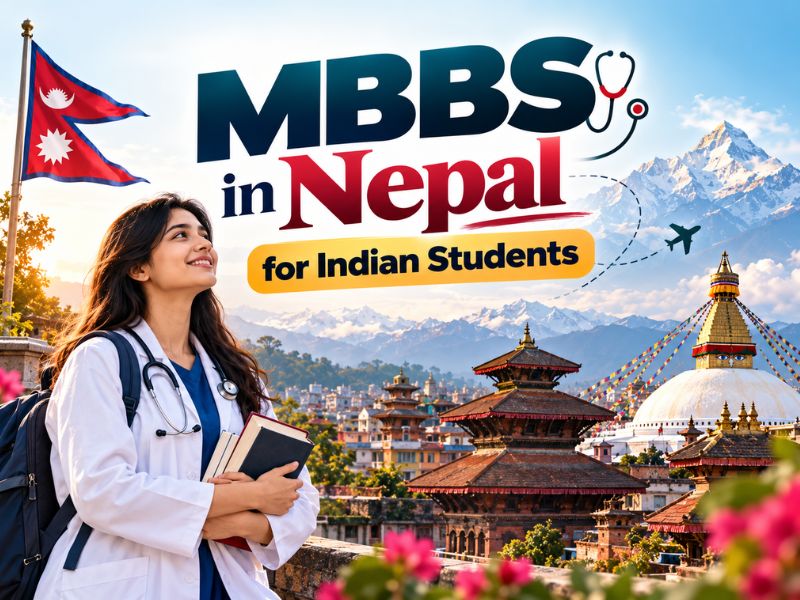
Table of Contents
MBBS in Nepal for Indian Students: Highlights 2026
Nepal is a popular destination for Indian students seeking MBBS education because of its geographic proximity, similar disease profile and relatively familiar academic environment.
Medical education close to India
Nepal offers MBBS programs through medical colleges and universities that are easily accessible for Indian students.
English-medium instruction
Many medical programs are taught in English, which is important for Indian students planning to return and practise in India.
Similar clinical environment
The patient profile and disease patterns in Nepal are broadly similar to those seen in India, which can make clinical learning more relevant for Indian students.
NEET qualification remains important
Indian students planning to study medicine abroad must satisfy Indian regulatory requirements, including NEET-related eligibility, if they intend to seek registration in India later.
NMC compliance must be checked carefully
Indian students should ensure that the foreign medical program satisfies NMC requirements relating to course duration, internship, clinical training, curriculum and medium of instruction.
Why Study MBBS in Nepal for Indian Students?
Nepal can be attractive to Indian students because of its location, cultural familiarity and medical education structure.
Close to India
Travel between India and Nepal is comparatively convenient, which can make it easier for students to stay connected with family.
Familiar cultural environment
Indian students may find food, language, festivals and day-to-day life more familiar than in many other overseas destinations.
English-medium medical education
English is commonly used in medical teaching, helping Indian students adapt academically.
Clinical exposure
Medical colleges provide hospital-based clinical training, allowing students to gain practical experience with patients.
Similar healthcare environment
The similarities between Indian and Nepalese healthcare settings can be useful for students intending to return to India after graduation.
Benefits of Studying MBBS in Nepal
Studying MBBS in Nepal can offer several practical advantages for Indian students when the chosen college and program comply with applicable regulations.
Geographical convenience
Nepal is considerably closer to India than many other foreign MBBS destinations.
No major cultural adjustment
Students usually face fewer language, food and lifestyle barriers compared with studying in more distant countries.
Relevant clinical exposure
The regional disease profile can provide practical exposure relevant to South Asian healthcare.
English-based curriculum
English-medium teaching can simplify classroom learning and medical terminology for Indian students.
Access to medical colleges with teaching hospitals
Many institutions are connected with hospitals where students receive practical and clinical training.
Potentially lower overall overseas cost
Depending on the college, studying in Nepal may involve lower travel and relocation costs than some distant international destinations.
MBBS in Nepal Eligibility Criteria for Indian Students
Indian students must satisfy both Nepalese admission requirements and Indian regulatory requirements if they plan to return to India for medical registration.
10+2 with PCB required
Applicants generally need to complete Class 12 or equivalent with Physics, Chemistry and Biology.
Minimum academic marks
Nepal's Medical Education Commission states that MBBS applicants should have at least 50% in Physics, Chemistry and Biology individually in the qualifying examination.
Medical entrance requirement
International applicants must meet the Medical Education Commission's entrance and admission requirements for MBBS study in Nepal.
NEET qualification for Indian students
Indian candidates planning to pursue MBBS abroad and later practise in India should qualify for NEET according to applicable Indian regulations.
NMC-compliant course structure
The foreign program should satisfy requirements such as at least 54 months of medical education, a 12-month internship at the same foreign institution, English-medium instruction and compliant clinical training.
NEET Requirements for MBBS in Nepal
NEET is an important requirement for Indian students planning to pursue MBBS in Nepal and later seek medical registration in India.
NEET qualification is required for Indian eligibility
Indian students studying medicine abroad must comply with the eligibility requirements applicable under Indian medical regulations.
A valid NEET result should be maintained.
Students should ensure that their NEET qualification is valid for the admission cycle in which they take admission abroad.
Nepal also considers national entrance credentials
Nepal's Medical Education Commission requires international applicants to satisfy its entrance rules and allows documentation of the national medical entrance test from the student's home country as part of the international admission framework.
NEET alone is not enough
Qualifying NEET does not automatically guarantee future registration in India. The foreign medical course must also comply with NMC requirements on duration, internship, curriculum and clinical training.
Check regulations before taking admission.ion
Before paying fees, Indian students should verify the complete medical program structure and whether it meets the latest NMC rules for foreign medical graduates.
Bilkul — same style, same depth aur without resource links:
Admission Process for MBBS in Nepal 2026
The MBBS admission process in Nepal for Indian students generally involves eligibility verification, entrance qualification, counselling or matching, and document verification.
Step 1: Check eligibility
Students should confirm Class 12 PCB requirements, NEET qualification and the latest eligibility conditions applicable to foreign applicants.
Step 2: Register for the Nepal medical admission process
International applicants need to follow the Medical Education Commission admission procedure for the relevant MBBS intake.
Step 3: Submit entrance credentials
Indian students may need to submit valid NEET details or follow the applicable Nepal entrance requirements for foreign candidates.
Step 4: Participate in matching or counselling
Eligible students select preferred medical colleges, and seat allocation is carried out according to merit, eligibility and seat availability.
Step 5: Complete document verification
Selected candidates must submit academic, identity and admission-related documents for verification.
Step 6: Pay fees and confirm admission
After allotment, students complete the required fee payment and institutional admission formalities.
Documents Required for MBBS Admission in Nepal
Indian students need academic, identity and entrance-related documents for MBBS admission in Nepal.
Class 10 documents
Class 10 marksheet and certificate may be required as proof of date of birth and academic history.
Class 12 documents
Students need Class 12 marksheets and certificates showing Physics, Chemistry and Biology results.
NEET documents
NEET scorecard, admit card or other entrance-related proof may be required for Indian applicants.
Passport or identity proof
A valid passport and/or Aadhaar-based identification may be required during registration and admission.
Passport-size photographs
Recent photographs are generally required for application, counselling and college records.
Migration and transfer documents
Migration, transfer or character certificates may be requested by the admitting institution.
Medical and other certificates
Depending on the college, students may also need medical fitness, category or other supporting certificates.
Top Medical Colleges for MBBS in Nepal for Indian Students
Nepal has several established medical colleges and teaching institutions that admit international students to MBBS programs.
B.P. Koirala Institute of Health Sciences
BPKIHS is a major medical education institution in Nepal with extensive teaching-hospital and clinical exposure.
Maharajgunj Medical Campus
Part of Tribhuvan University’s medical education system, Maharajgunj Medical Campus is one of the prominent public medical institutions in Nepal.
Kathmandu University School of Medical Sciences
KUSMS offers MBBS education with academic and clinical training through its medical system.
Kathmandu Medical College
Kathmandu Medical College is a well-known private medical institution attracting both Nepalese and international students.
Nepal Medical College
Nepal Medical College offers MBBS education supported by teaching-hospital facilities.
Nepalgunj Medical College
NGMC is another established option for international students and follows Nepal’s central medical admission framework.
NMC-Approved Medical Colleges in Nepal
Students should be careful with the term “NMC-approved college.” For foreign MBBS programs, NMC does not simply maintain a conventional approved-college list in the same way it does for Indian medical colleges.
Program compliance is important.
Indian students need to ensure that the foreign medical qualification complies with the current Foreign Medical Graduate rules.
Course duration must meet requirementss.s
The program should satisfy prescribed requirements for medical education and internship duration.
Clinical training must be adequate
Students should confirm that clinical training is completed as required within the same country and institution framework specified by current regulations.
English-medium instruction matters
The course should satisfy the applicable medium-of-instruction requirements for Indian foreign medical graduates.
Licensing eligibility should be checked.d
Students should confirm that the degree allows them to obtain medical registration or licensing in Nepal after completing the course.
Verify before paying fees.
Rather than relying only on claims such as “NMC approved,” students should verify the complete program structure and latest NMC foreign-medical-graduate requirements before admission.
MBBS Fees in Nepal for Indian Students
MBBS fees in Nepal vary significantly depending on the medical college, university affiliation and additional institutional charges.
Private medical college fees
For Indian students, total MBBS tuition at private institutions can commonly fall around ₹45 lakh to ₹60 lakh or more.
College-specific variation
Some established private medical colleges may have total tuition close to ₹50–55 lakh, while other institutions may charge higher or lower amounts.
Government institutions
Public medical institutions can have different fee structures and generally have highly competitive international seats.
Additional charges
Students should budget separately for admission fees, university registration, examinations, hostel, food, insurance and other institutional expenses.
Hostel and living expenses
Accommodation and daily living costs are usually separate from tuition and vary according to college and city.
Check the complete fee structure.
Before taking admission, students should request a written breakdown covering tuition, hostel, registration, examination and any mandatory additional charges for the entire MBBS program.
MBBS Fees in Nepal for Indian Students
MBBS fees in Nepal vary depending on the medical college, university affiliation and whether the institution is public or private.
Private medical college fees
For Indian students, total MBBS tuition at private colleges can commonly range from ₹45 lakh to ₹60 lakh or more.
Government institutions
Public medical institutions may have a different and often lower fee structure, but international seats are usually limited and highly competitive.
College-wise variation
Fees differ across institutions, so students should compare the complete tuition structure before taking admission.
Additional academic charges
University registration, examination, laboratory, library and other institutional charges may be separate from tuition.
Hostel and living costs are extra.
Accommodation, food, transport and personal expenses generally need to be budgeted separately.
Cost of Living in Nepal for Indian MBBS Students
Living costs in Nepal are generally manageable for Indian students compared with many other international MBBS destinations.
Monthly living expenses
Students may need around ₹15,000–₹30,000 per month, depending on city, hostel type and lifestyle.
Hostel accommodation
College hostels and shared accommodation are commonly used by international medical students.
Food expenses
Indian and Nepalese food options are widely available, which can help students manage daily meal costs.
Transportation
Local transport expenses are usually moderate, especially for students living close to the medical college.
Personal expenses
Students should also budget for books, mobile plans, clothing, medical equipment and other daily needs.
MBBS in Nepal Scholarships and Financial Assistance
Scholarship opportunities for international MBBS students in Nepal are limited but may be available through institutions, governments and merit-based schemes.
Merit-based scholarships
Some institutions may provide scholarships or fee concessions to students with strong academic performance.
Government-supported opportunities
Certain scholarship seats may be available under bilateral, government or institutional arrangements.
Category or special-scheme support
Eligibility may depend on nationality, academic merit, financial background or specific scholarship conditions.
Education loans
Indian students can also explore education loans from banks and financial institutions for recognised MBBS programs abroad.
Check scholarship conditions carefully
Students should verify scholarship value, eligibility, renewal rules and whether the award covers tuition only or additional expenses.
MBBS Course Duration and Syllabus in Nepal
MBBS programs in Nepal follow a structured medical curriculum combining classroom learning, laboratory work and clinical training.
Course duration
The academic medical education component is generally around 4.5 years, followed by a 1-year compulsory internship, making the total duration approximately 5.5 years.
Pre-clinical subjects
Early years include subjects such as Anatomy, Physiology and Biochemistry.
Para-clinical subjects
Students later study Pathology, Pharmacology, Microbiology, Forensic Medicine and Community Medicine.
Clinical subjects
Advanced years focus on Medicine, Surgery, Paediatrics, Obstetrics and Gynaecology and other clinical disciplines.
Clinical rotations
Students gain practical experience through hospital postings, ward training and patient interaction.
Internship
The final internship provides supervised clinical training across major medical departments.
MBBS Entrance Exams and Seat Allocation in Nepal
MBBS admission in Nepal is centrally regulated, and international students must follow the applicable entrance and seat-allocation process.
Medical entrance requirement
Applicants must satisfy the medical entrance criteria set for the relevant admission cycle.
NEET for Indian students
Indian students should qualify NEET if they plan to pursue MBBS abroad and later seek medical registration in India.
International applicant category
Foreign students generally apply under the international or foreign-student admission category.
Merit-based seat allocation
Seats are typically allotted based on entrance performance, eligibility, preference and availability.
College preference matters
Students may be allowed to select preferred colleges during counselling or matching.
Final admission confirmation
After seat allotment, candidates must complete document verification, fee payment and college admission formalities within the prescribed deadline.
Bilkul — same style, same depth aur without resource links:
Clinical Training and Internship for MBBS in Nepal
Clinical training is a major part of MBBS education in Nepal and usually begins after students complete the foundational medical subjects.
Hospital-based learning
Students receive practical exposure through teaching hospitals where they observe and participate in patient care under supervision.
Clinical rotations
Training generally includes Medicine, Surgery, Paediatrics, Obstetrics and Gynaecology, Community Medicine and other major departments.
Patient interaction
Students learn history-taking, physical examination, case presentation and basic clinical procedures during hospital postings.
Compulsory internship
After completing the academic part of MBBS, students typically undergo a 1-year compulsory rotating internship.
Important for Indian students
Students planning to return to India should ensure that the internship structure and clinical training meet the applicable Indian foreign-medical-graduate requirements.
FMGE/NExT After MBBS in Nepal for Indian Students
Indian students who complete MBBS in Nepal must satisfy the prevailing Indian licensing and registration requirements before practising medicine in India.
Licensing examination requirement
Foreign medical graduates may need to clear the applicable screening or licensing examination prescribed in India at the time of registration.
FMGE has historically been used
FMGE has been the screening route for many foreign medical graduates, although students should check the current regulatory framework for their graduation year.
NExT may affect future batches.
The National Exit Test framework has been proposed for medical licensing, but students should verify the exact rules applicable when they complete their degree.
Course compliance also matte..rs
Passing an examination alone may not be sufficient if the foreign medical qualification does not meet requirements related to course duration, internship and clinical training.
Plan before taking admission
Students should understand Indian medical registration rules before selecting a foreign medical college.
Career Opportunities After MBBS in Nepal
After completing MBBS in Nepal, graduates can explore clinical, academic and healthcare-related career pathways depending on licensing requirements.
Medical practice
Graduates who meet the registration requirements of the relevant country can work as doctors in hospitals, clinics and healthcare organisations.
Postgraduate medical education
Students can pursue MD, MS or other postgraduate medical programs after meeting entrance and eligibility requirements.
Government and private hospitals
Registered doctors can explore opportunities in public hospitals, private hospital chains and healthcare centres.
Medical research
Graduates interested in academics can move into clinical research, public health or medical research roles.
Healthcare management
Some doctors later pursue management qualifications and work in hospital administration, healthcare consulting or medical leadership.
International opportunities
Further licensing examinations may allow graduates to explore medical careers in other countries.
MBBS in Nepal vs MBBS in India
Both India and Nepal offer similar South Asian clinical environments, but admission structure, cost and licensing considerations differ.
Admission competition
Government MBBS seats in India are highly competitive, while Nepal can provide an alternative for students seeking overseas medical education.
Course environment
Both countries provide exposure to similar regional disease patterns and patient populations.
Language and culture
Indian students often find Nepal culturally and linguistically easier to adapt to than many other foreign destinations.
Cost difference
Private MBBS education in Nepal can be expensive, although total cost may still differ from many private medical colleges in India.
Licensing requirements
Students completing MBBS in India follow the domestic registration framework, while foreign graduates must satisfy additional Indian regulatory requirements.
Travel convenience
Nepal's proximity to India makes travel easier and comparatively inexpensive.
Advantages and Disadvantages of MBBS in Nepal
MBBS in Nepal offers several practical benefits, but students should also consider regulatory and financial factors.
Advantage: Cultural familiarity
Indian students usually experience less cultural adjustment because of similarities in food, language and lifestyle.
Advantage: Relevant clinical exposure
The South Asian healthcare environment can provide clinical exposure relevant to students returning to India.
Advantage: Geographic proximity
Travel between India and Nepal is relatively convenient compared with distant overseas destinations.
Disadvantage: High private-college fees
Some private medical colleges in Nepal charge substantial tuition, so affordability should be assessed carefully.
Disadvantage: Foreign-graduate licensing
Indian students must comply with additional registration and licensing requirements after completing MBBS abroad.
Disadvantage: College quality varies
Clinical exposure, hospital facilities and academic quality can differ significantly between institutions.
How to Choose the Best MBBS College in Nepal?
Choosing the right medical college requires careful verification of academics, clinical exposure, fees and regulatory compliance.
Check recognition and eligibility.
Verify that the college and program meet the requirements applicable to international medical graduates.
Review teaching hospital strength
A strong teaching hospital with adequate patient flow is important for clinical learning.
Check internship structure
Confirm where and how the compulsory internship is completed and whether it satisfies relevant regulatory requirements.
Compare complete fees
Ask for a written fee structure covering tuition, hostel, registration, examination and other compulsory charges.
Evaluate student support
Hostel quality, safety, academic support and assistance for international students should also be considered.
Speak with current students.s
Feedback from current Indian students can help you understand teaching quality, clinical exposure and actual living conditions.
FAQs About MBBS in Nepal for Indian Students
Is NEET required for MBBS in Nepal?
Indian students should qualify NEET if they plan to study medicine abroad and later seek medical registration in India.
What is the duration of MBBS in Nepal?
The program is generally around 5.5 years, including approximately 4.5 years of academics and a 1-year internship.
Is MBBS in Nepal taught in English?
Many medical colleges use English as the primary language of medical instruction.
What are MBBS fees in Nepal?
Private-college tuition for Indian students can commonly be around ₹45 lakh to ₹60 lakh or more, depending on the institution.
Can Indian students practise in India after MBBS in Nepal?
Yes, but they must satisfy the Indian licensing and registration requirements applicable at the time.
Is MBBS in Nepal easier than MBBS in India?
The medical curriculum remains demanding. The key difference is usually admission route, fee structure and foreign-graduate compliance requirements.
Which cities are popular for MBBS in Nepal?
Kathmandu, Dharan, Pokhara, Bharatpur and other major medical education centres attract both Nepalese and international students.
Conclusion
MBBS in Nepal can be a practical overseas option for Indian students because of its proximity, cultural familiarity and similar clinical environment.
Strong geographic advantage
Students can remain relatively close to India while pursuing an international medical degree.
Clinical exposure isimportanta.nt
Choosing a college with a strong teaching hospital and sufficient patient flow is essential for medical training.
Regulatory compliance must come first.
Students should verify course duration, internship, clinical training and future Indian registration requirements before taking admission.
Compare total cost carefull.y
Tuition, hostel, living expenses and additional institutional charges should all be included in the budget.
Choose the college, not just the cocountryry
The quality of the teaching hospital, faculty, internship and academic system matters more than simply selecting Nepal as the destination.