
MBA in Latvia Fees for Indian Students: Complete Cost Breakdown
Table of Contents
MBA in Latvia Fees for Indian Students: Highlights 2026
- Overall MBA fee range — €15,000-25,000/year for MBA and Medicine courses specifically, notably higher than general master's programs (€3,000-5,000/year)
- Riga Business School's pay-per-course model — Starts at €850 per course, offering unusual flexibility to spread payments as you progress rather than paying a large lump sum upfront.
- Riga Technical University — First-year MBA/PGDM tuition around INR 3,59,936 (~€3,900), for a 2-year program — considerably more affordable than the €15,000-25,000 range cited for premium MBA tracks
- EU/EEA vs non-EU/EEA fee gap — EU/EEA students pay roughly €2,000-7,000/year, while non-EU/EEA students (including Indians) typically pay meaningfully more
- Application fee — €150 for MBA applications at Riga Technical University
- Broader postgraduate cost context — Indian students spend on average ₹1.75-7 lakh (€2,000-8,000) on postgraduate programs in Latvia overall, versus ₹7-36 lakh for equivalent UK programs
- Cost variance by institute type — Since RBS's Professional MBA (pay-per-course, prestige-focused) and RTU's more affordable standard MBA sit at very different price points, comparing specific institutes rather than a single "Latvia MBA fee" figure gives a more accurate picture
MBA Tuition Fees in Latvia for Indian Students
- Riga Business School Professional MBA — €850 per course under the pay-per-course model, with total program cost depending on how many courses (2-4 per trimester) you take across the standard 2-3 year duration
- Riga Technical University MBA/PGDM — First-year tuition around INR 3,59,936 (roughly €3,900), for a 2-year, AICTE-style structured program
- Premium/elite MBA tier — Up to €15,000-25,000/year at business schools offering globally-tied or more specialised programs
- Additional living costs — €350-850/month depending on city and lifestyle choices, on top of tuition
- RTU accommodation estimate — Approximately INR 80,512 (~€870) for international student housing, as a specific reference point
- Currency conversion caveat — Since fees are quoted in both EUR and INR across different sources, and exchange rates shift, treating any rupee figure as an approximate snapshot rather than fixed is important
- Overall affordability positioning — Even at the higher end (€15,000-25,000/year), Latvia remains considerably cheaper than equivalent UK, US, or Western European MBA programs.
Why Study MBA in Latvia as an Indian Student?
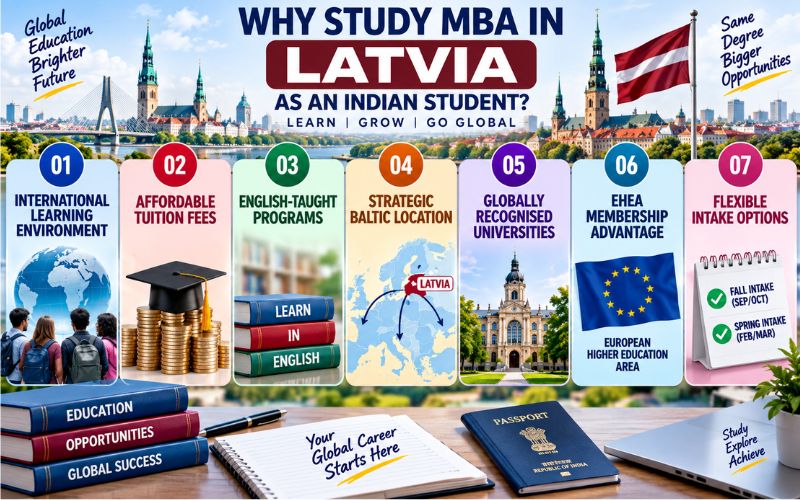
- International, diverse learning environment — Latvia attracts students from around the world, creating a genuinely international classroom that enhances global perspective and cross-cultural communication skills.s
- Affordable tuition relative to Western Europe — Compared to many other countries, MBA tuition fees in Latvia are relatively affordable, making it attractive for students seeking quality education at a lower cost.
- English-taught programs widely available — Many universities offer MBA programs fully in English, removing the need for Latvian language proficiency.
- Strategic Baltic location — Latvia's position in the Baltic region offers opportunities to connect with businesses and industries in both Eastern and Western Europe, creating a genuine crossroads for business opportunities
- Globally recognised universities — Institutions like Riga Technical University rank within the QS World University Rankings top 1,000 (761-770 range) for 2026, offering internationally recognised degrees
- EHEA membership advantage — Since Latvian institutions are part of the European Higher Education Area (EHEA), degrees carry standardised recognition across most of Europe
- Flexible intake options — Fall intake (September/October) is the most common and widely available, with some universities also offering a Spring intake (February/March) for added flexibility.
Top MBA Universities in Latvia for Indian Students
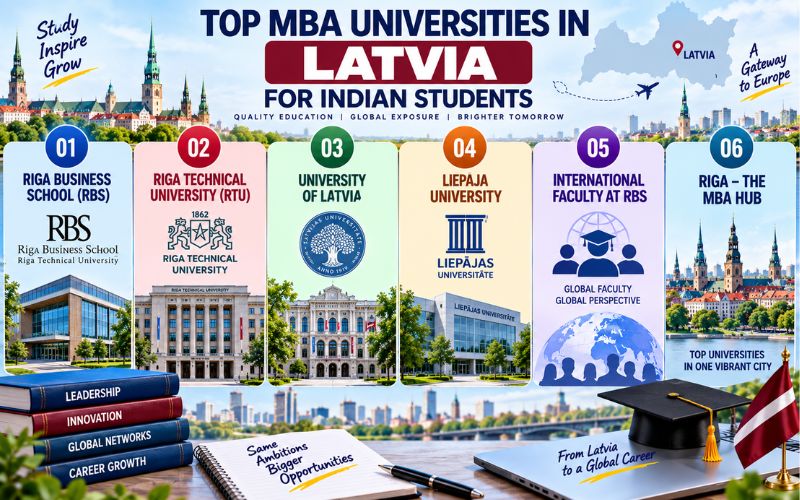
- Riga Business School (RBS) — Founded in 1991 by Riga Technical University and SUNY Buffalo; holds International Quality Assurance (IQA) accreditation; located on RTU's student campus in Riga since summer 2025; offers the Professional MBA — described as Latvia's most prestigious and well-established MBA
- Riga Technical University (RTU) — QS World University Rankings 761-770 (2026); renowned for excellence in engineering and technology, extending this strength into a comprehensive 2-year MBA program; MBA acceptance rate of 51%
- University of Latvia — Offers Foundation Scholarships and broader postgraduate programs, with amount and duration varying by specific scholarship.
- Liepaja University — Offers dedicated monthly stipend scholarships (€430-500) specifically for Master's degree students.
- Faculty quality at RBS — Employs both local and international faculty, including professors from North America, reflecting the school's founding partnership model with SUNY Buffalo and University of Ottawa.
- Riga as the concentration hub — Nearly all of Latvia's top MBA-offering institutions are based in Riga, the capital, centralising opportunities, faculty quality, and student life in one city
MBA Courses and Specialisations in Latvia
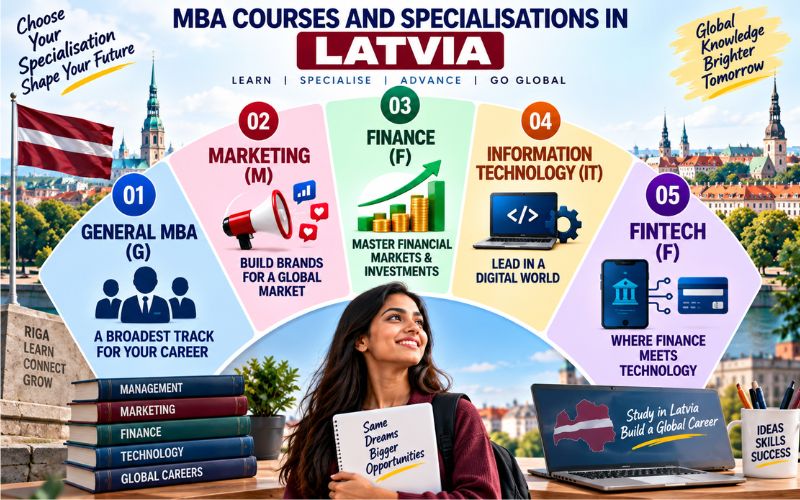
- General MBA (G) — The broadest track available at Riga Business School, suited to candidates without a narrow pre-MBA specialisation focus
- Marketing (M) — Offered as a dedicated specialisation at RBS's Professional MBA
- Finance (F) — Provides in-depth understanding of financial markets, investment types, and analytical tools for sound financing and investment decisions, equipping students to leverage financial market trends both in Latvia and globally.
- Information Technology (IT) — Designed to support managers in the IT sector and professionals managing IT systems within their organisations, preparing industry leaders to drive 21st-century, IT-critical companies.
- FinTech (F) — Students earn an official credential in financial technology, equipping them with specialised knowledge and skills at the intersection of finance and technology
- Flexible course-pacing model at RBS — Students can take 2-4 courses per trimester, completing the MBA in a minimum of 2 years and a maximum of 3 years, allowing genuine customisation based on career goals and personal schedule
- RTU's integrated business curriculum — Seamlessly blends robust business management principles, strategic insights, and leadership skills over its standard 2-year structure, drawing on the university's broader engineering and technology reputation
Note: Fees, rankings, aur specialisation details Riga Business School aur Riga Technical University ke beech significantly vary karte hain, aur currency conversion source ke hisaab se bhi differ karta hai — publish se pehle official university websites (rbs.lv, rtu.lv) se latest 2026-27 intake, fees, aur application deadline details verify kar lena strongly recommend karta hoon.
MBA Eligibility Criteria in Latvia for Indian Students
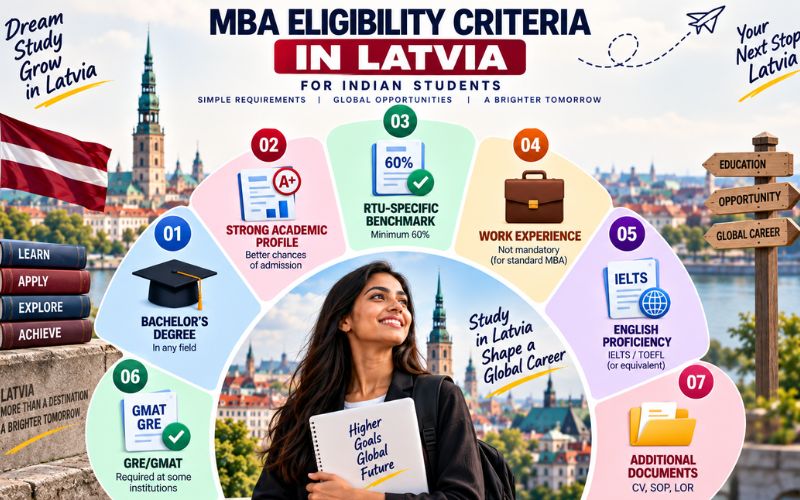
- Bachelor's degree requirement — A bachelor's degree or equivalent from a recognised institution in any field is the baseline requirement across nearly all Latvian MBA programs.
- Strong academic profile recommended — While RTU's graduate school doesn't set a strict test-score minimum, admission takes a holistic approach, considering multiple factors in a student's overall profile alongside GP..A
- RTU-specific benchmark — Applicants need a Bachelor's degree in Social Sciences or equivalent education, with at least 60% of the maximum possible results expected to qualify for studies
- Work experience — Not mandatory for most standard MBA programs, though it can strengthen an application; work experience is specifically required and significant for Executive MBA (EMBA) tracks
- English proficiency requirement — Applicants from non-English-speaking countries must submit IELTS, TOEFL, or equivalent test scores, unless their prior education was fully conducted in English (verifiable via diploma/transcript notation or a school-issued certificate)
- GRE/GMAT — Compulsory at some institutions depending on the specific course chosen, though not universally required across all Latvian MBA programs
- Additional application components — Curriculum Vitae (CV), motivation letter, and letters of recommendation are commonly required alongside academic transcripts and diplomas.
MBA Admission Process in Latvia for Indian Students
- Step 1: Decide your level and field of study — Confirm you're targeting an MBA specifically, and shortlist your preferred specialisation (General, Marketing, Finance, IT, FinTech)
- Step 2: Research universities offering English-taught programs — Riga Technical University, University of Latvia, and Riga Business School are among the top choices for international business/MBA study
- Step 3: Complete the application form — Submit through the university's official portal or an online application system, along with official transcripts and certificates from your Bachelor's degree
- Step 4: Submit language proficiency certificate — Provide IELTS, TOEFL, or equivalent scores, unless exempted through prior English-medium education
- Step 5: Submit entrance exam scores (if applicable) — GMAT or GRE scores where required by your specific target program
- Step 6: Prepare SOP and Letters of Recommendation — A well-written statement of purpose explaining your motivations and career goals, along with recommendation letters where required
- Step 7: Interview (if applicable) — Some universities conduct interviews to assess communication skills, motivation, and program fit
- Step 8: Pay the application fee and submit — Complete your application by the specified deadline (e.g., RTU's Autumn intake deadline has historically been mid-June)
- Step 9: Visa application — Once accepted, apply for your Latvian long-term student visa, ensuring all documents are translated into English or Latvian and notarized/apostilled as required
Entrance Exams Required for MBA in Latvia
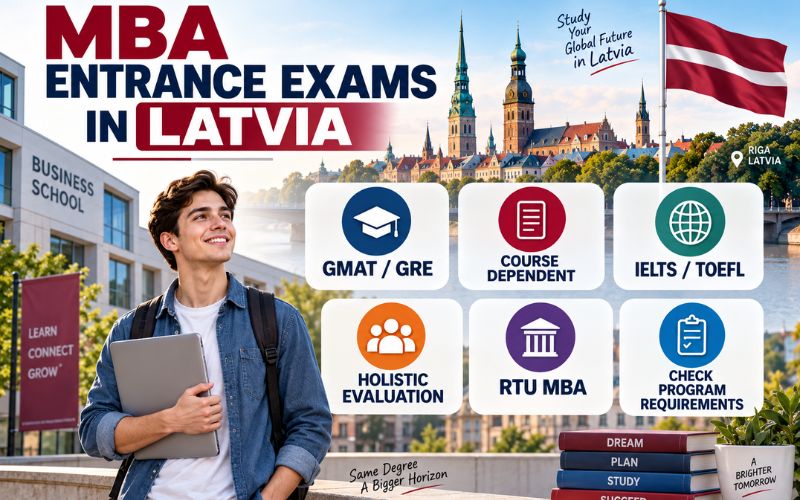
- No universal test-score minimum — Most Latvian universities, including RTU's graduate school, don't set a strict standardised minimum for admission, though individual departments may set their own requirements
- GMAT/GRE — course-dependent — These standardised exams are compulsory at some institutions but vary depending on the specific course chosen; not a blanket national requirement
- RTU's holistic evaluation approach — Rather than relying on a single test score, the admission process considers multiple factors in the student's overall profile, including GPA and academic transcript strength
- RTU MBA acceptance rate — 51%, reflecting a genuinely accessible admission process relative to elite Western business schools
- Riga Business School's flexible policy — For most MBA programs (aside from Executive MBA, which requires significant professional experience), an entrance exam or interview "may be required," rather than being a fixed universal requirement
- English proficiency test — the more consistent requirement — Unlike GMAT/GRE, IELTS or TOEFL (or equivalent) is far more consistently required across Latvian MBA programs for applicants from non-English-speaking countries
- Since exam requirements vary meaningfully by specific course and department (not just by university), confirming the exact requirement for your target MBA track directly with the admissions office is essential
English Language Requirements for MBA in Latvia
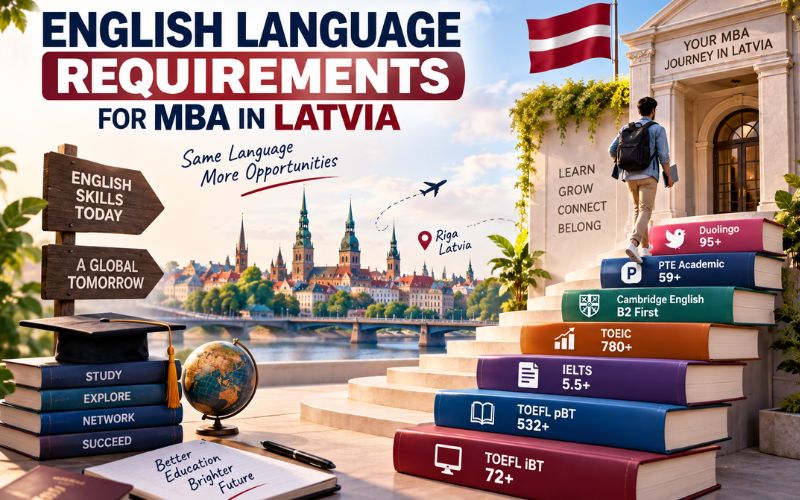
- Riga Technical University's accepted tests and minimum scores:
- TOEFL iBT — 72 or above
- TOEFL pBT — 532 or above
- IELTS — 5.5 or above
- TOEIC — 780 or above
- Cambridge English Language Assessment — B2 First
- Pearson Test of English Academic (PTE A) — 59 or above
- Duolingo English Test — 95 or above
- Exemption for English-medium prior education — Students don't need to present an English test if their previous studies were fully conducted in English, provided this is marked on their diploma/transcript or confirmed via a certificate from their prior school
- MOI letter as an alternative — A Medium of Instruction (MOI) letter is accepted at several Latvian universities as another route to demonstrate English proficiency without a separate standardised test
- Comparatively accessible IELTS threshold — RTU's IELTS 5.5 minimum is notably lower than many Western European or UK MBA programs, which often expect 6.5-7.0, making Latvia more accessible for candidates with moderate English test scores
- Riga Business School's requirement — Proof of English proficiency (IELTS, TOEFL, or equivalent) is listed as a standard requirement across its MBA and Professional MBA programs
MBA Application Fees and Other Charges in Latvia
- General application fee range — Most Latvian universities charge a non-refundable application fee of €50-150 for processing international applications, typically paid online via credit card or bank transfer at submission.
- Riga Technical University's specific MBA application fee — €150, though this can vary depending on the specific program or course chosen
- Payment timing — The application fee is mandatory and must be budgeted for at the time of submission, separate from tuition and living costs
- Document translation and notarization costs — Since all documents must usually be translated into English or Latvian (and may need notarization or apostille depending on your country), factor in this additional, often-overlooked cost when budgeting for your application
- Post-acceptance visa-related fees — Once accepted, additional costs apply for your Latvian long-term student visa application, separate from the university application fee itself.f
- Riga Business School's pay-per-course structure — At €850 per course, this represents a distinct fee model compared to a traditional lump-sum tuition charge, worth factoring into your specific cost planning if applying to R.BS.
Note: Eligibility criteria, entrance exam requirements, aur fee figures Riga Technical University, Riga Business School, aur University of Latvia ke beech significantly vary karte hain — publish se pehle official university websites (rtu.lv, rbs.lv, lu.lv) se latest 2026-27 admission cycle, deadlines, aur exact fee structure verify kar lena strongly recommend karta hoon.
Cost of Living in Latvia for Indian Students
- Overall monthly range — €300-850 per month depending on the specific source, city, and lifestyle, with most estimates converging around €450-750/month for a realistic, comfortable student budget
- Global cost comparison — Latvia's cost of living is 29.5% lower than the US, 51.1% cheaper than the UK, and 42.9% cheaper than Australia — a genuinely significant affordability advantage
- Regional European comparison — Among Baltic study destinations, Latvia offers the lowest average monthly living costs, even ahead of Lithuania and Estonia
- City-based savings — Living outside Riga (in cities like Jelgava or Daugavpils) can be 10-20% cheaper than the capital, with Jelgava specifically noted for budget-friendly housing near Latvia University of Life Sciences and Technologies
- Part-time work as an offset — International students can work up to 20 hours/week without needing an additional work permit during their studies, with average monthly earnings potentially contributing €350-400 toward living expenses
- Safe, walkable environment — Riga is compact, well-connected within Europe, and generally considered a safe, student-friendly capital city
- Since cost-of-living estimates vary meaningfully across sources (€300-850/month range), budgeting toward the middle-to-higher end (~€600-700/month) is the more prudent planning approach. oach
MBA Fees in Latvia vs Other European Countries
- Latvia's overall MBA fee range — €2,000-8,000/year for standard MBA programs, with Executive MBA programs specifically reaching up to €25,600/year (~₹23.04 lakh) as a notable exception
- Comparison to the UK — UK postgraduate programs cost ₹7-36 lakh (£7,000-36,000), while Latvia's equivalent postgraduate programs cost just ₹1.75-7 lakh (€2,000-8,000) — a dramatic cost difference.
- Comparison to Germany — German public universities are often tuition-free, though states like Baden-Württemberg require non-EU students to pay around €3,000/year — still comparable to or slightly above Latvia's lower-tier fees
- Living cost comparison across Europe — Latvia offers the most manageable living costs (€450-700/month) among comparable European study destinations, followed by Germany
- Baltic region comparison — Estonia's tuition (€1,660-7,500/year) and living costs (€500-900/month) run slightly higher than Latvia's, while Lithuania is also competitively priced but doesn't match Latvia's lowest-cost positioning
- Overall European value positioning — Latvia stands out specifically for combining low tuition (€1,550-6,000/year for most programs) with the lowest average living costs among popular European study destinations — a combination that's difficult to match elsewhere in the E
Affordable MBA Universities in Latvia
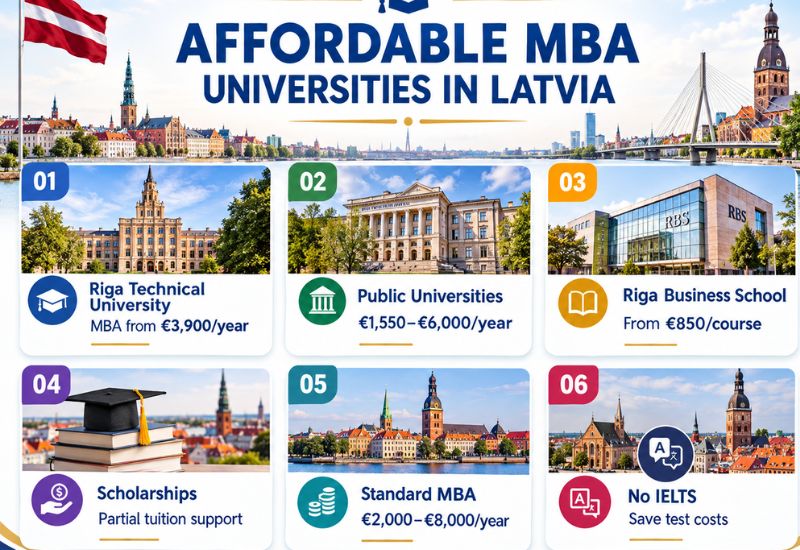
- Riga Technical University (RTU) — First-year MBA tuition around €3,900 (INR 3,59,936), positioned as one of the more accessible options among recognised, QS-ranked (761-770) universities
- General public university fee range — €1,550-6,000/year across most Latvian public universities, considerably below the Executive MBA outlier pricing
- Riga Business School's pay-per-course model — Starting at €850 per course allows students to spread costs and start with a lower initial financial commitment compared to a lump-sum tuition structure
- Institutional scholarship access widens affordability further — Most universities in the Baltic region (including Latvia) offer partial tuition waivers for academically strong international applicants, effectively lowering the already-modest sticker price.
- Program-type cost distinction — Standard/general MBA programs remain firmly in the €2,000-8,000/year range, while only specialised Executive MBA tracks push costs toward €15,000-25,600/year — so choosing a standard MBA track over an EMBA is the single biggest lever for affordability.
- No-IELTS pathway as a hidden cost-saver — Since IELTS isn't mandatory at many Latvian universities, students can avoid the cost and delay of repeated English test attempts, indirectly reducing overall application expenses
Scholarships for MBA in Latvia for Indian Students
- Latvian State Scholarships — €500/month (~₹44,000) for Bachelor's and Master's students, €700/month (~₹61,600) for PhD students
- Liepaja University Scholarships — Monthly stipend of €430-500 (~₹38,000-44,200) specifically for Master's degree students
- University of Latvia Foundation Scholarships — Amount and duration vary depending on the specific scholarship
- Riga Technical University Scholarships — Amount and duration vary based on agreements and the student's academic qualifications
- Institutional partial tuition waivers — Common across Baltic universities generally, awarded to academically strong international applicants
- Erasmus+ program access — Available for exchange and mobility purposes, relevant for students considering a partial study period elsewhere in the EU
- India-specific external options — Scholarships like the K.C. Mahindra Education Trust Scholarship (up to ₹10 lakh) can be applied toward MBA study in Latvia, supplementing university-specific awards
Education Loan Options for MBA in Latvia
- Lower loan requirement overall — Since total MBA cost in Latvia (₹1.75-7 lakh for standard programs, or up to ~₹23 lakh for Executive MBA) is dramatically lower than destinations like the UK or US, education loan amounts needed are correspondingly smaller and easier to secure
- Public sector bank loan: Nationalised Indian banks (SBI, Bank of Baroda, and others) offer education loan schemes for study-abroad programs, generally with lower interest rates but more documentation requirements.
- Private lenders and NBFCs — Options like HDFC Credila and Avanse offer faster processing and more flexible collateral requirements, useful for covering both tuition and the living-cost portion of your budget
- Collateral considerations — Given Latvia's comparatively low total cost, many students may qualify for smaller, unsecured loans without needing to pledge property or fixed deposits as collateral — a genuine advantage over higher-cost destinations
- Combining loans with scholarships — Since scholarships (Latvian State Scholarship, university-specific awards) can meaningfully offset costs, applying for both in parallel reduces the total loan principal and eases long-term repayment.
- Repayment planning advantage — Given Latvia's relatively accessible post-study work rights (20 hours/week during study, plus post-study work privileges contingent on residence/work permits) and lower overall living costs, loan repayment planning tends to be less financially strained compared to higher-debt destinations like the US or UK
Note: Cost-of-living, fee, aur scholarship figures multiple sources ke beech meaningfully vary kar rahe hain (source, city, aur currency conversion ke hisaab se) — publish se pehle official university websites aur current 2026-27 fee schedules se cross-verify kar lena strongly recommend karta hoon.
MBA in Latvia: Visa and Residence Permit Costs
- Type D long-stay visa — Required for non-EU/EEA students studying longer than 90 days; visa application fee approximately €60
- Temporary residence permit — Required after arrival for the full study period; application fee approximately €100, plus a €4.27 OCMA registration fee within 30 days of arrival
- Total upfront visa-related cost — Roughly €160-165 combined for the visa and residence permit application, a relatively modest cost compared to visa fees in destinations like the UK or Canada
- Financial proof requirement — Applicants must demonstrate sufficient funds (commonly cited around €6,000-7,000 or approximately €1,685/month, equating to roughly €20,220 for a standard one-year program, excluding tuition) — showing 20% above the minimum strengthens the application
- Health insurance cost — Mandatory for residence permits and visas, with minimum coverage requirements around €42,600 as per recent guidelines — budget this as a separate line item from tuition and living costs
- Processing time and cost implications — Typically 15-30 days, though busy intake periods can stretch to 60 days; applying 2-3 months before classes start avoids rush-processing complications
- Post-arrival OCMA registration — A mandatory step for all D-visa holders staying more than 90 days, carrying its own small registration fee alongside the temporary residence permit application
Part-Time Work Opportunities for Indian MBA Students
- Standard work-hour limit — International students can work up to 20 hours per week during the academic term without needing a separate work permit, and full-time (40 hours/week) during official holidays
- Master's-level advantage — Full-time Master's or doctoral students in Latvia — which covers most MBA candidates — have the right to work with no hour restrictions at all, a notable benefit over destinations with stricter part-time caps
- Typical earnings — Students generally earn €3-5/hour in standard part-time roles, with tech support or design-related jobs paying more (€6-8/hour); full-time holiday work can bring in €500-700/month
- Monthly savings potential — The average monthly salary from part-time work allows students to save up to €350-400 toward living expenses, meaningfully offsetting the already-low cost of living
- Popular student job sectors — Hospitality, cafes, retail, customer support, and international call centres are common sectors hiring international students, particularly concentrated in Riga
- Residence permit documentation — A valid residence permit explicitly stating part-time work rights is mandatory; non-EU students should confirm this is clearly documented before starting any job
- No separate permit for EU/EEA citizens — EU/EEA or Swiss students generally don't need a separate work permit to work in Latvia, including for internships
MBA in Latvia: Placements and Salary Prospects
- Strategic location advantage — Latvia's Baltic coastal position, EU/eurozone/Schengen/NATO membership, and strong transport links (Riga's major port and international airport) support genuine career mobility across Northern Europe
- Booming tech sector — Latvia's tech sector is growing, with Riga emerging as a regional tech hub hosting 400+ startups, and the IT industry expanding roughly 10% annually — creating strong demand for tech-adjacent management talent
- Rising FDI momentum — Latvia attracted over €1.01 billion in foreign direct investment through 31 major projects in 2025, with a further €1 billion target for 2026, focused on smart energy, bioeconomy, and defence — sectors that create fresh managerial openings.
- Role-specific salary benchmarks — Management Consultant: €25,000-45,000/year; Marketing Manager: €25,000-40,000/year; Financial Analyst: €20,000-35,000/year; HR Manager: €25,000-40,000/year; Business Development Manager: €25,000+/year
- National average wage context — Around €1,835 gross/month (~€22,020/year) nationally, with Riga-based workers earning notably more (~€2,400/month) than those in surrounding regions (~€1,700/month)
- IT/Tech sector premium — The strongest-paying sector for skilled professionals, with senior developers and leads commanding €3,800-5,000+/month — a strong option for MBA graduates with tech-adjacent specialisation.
- Placement data caveat — Latvian business schools don't publish detailed MBA-specific placement percentage statistics the way larger markets do, so role-specific salary ranges remain the more reliable data points currently available
Career Opportunities After MBA in Latvia
- Management Consulting — Advising businesses on strategic planning, operations, and organisational improvements, with salaries ranging €25,000-45,000/year
- IT and Tech-Adjacent Management — Given Latvia's advanced digital infrastructure and thriving startup ecosystem (400+ startups in Riga), MBA graduates with tech specialisation can access some of the country's highest-paying opportunities.
- Finance and Compliance Roles — Particularly strong given demand for AML specialists and compliance officers, who earn €2,500-3,500/month, reflecting high niche demand
- Marketing and Business Development — Steady demand across corporate Latvia, especially in Riga's concentrated business ecosystem
- Entrepreneurship / Startup Founding — A genuinely viable path given Latvia's vibrant, government-supported startup and innovation ecosystem
- Regional EU mobility — Latvia's Baltic location and EU/Schengen membership create natural pathways to careers across the Nordics, Poland, Germany, and the broader European market beyond Latvia alone.e
- Sector demand for foreign talent — Latvia is openly seeking to attract foreign workers, freelancers, and entrepreneurs to address a shortage of skilled labour, favouring internationally trained MBA graduates.
Return on Investment (ROI) of MBA in Latvia
- Standard MBA tier ROI — Fees: €2,000-8,000/year vs. role-specific salaries of €20,000-45,000/year → Very strong ROI, among the fastest payback periods available in Europe given the dramatically low upfront cost
- Executive MBA tier ROI — Fees: up to €25,600/year vs. stronger managerial/consulting salary outcomes → Moderate ROI, dependent on securing a senior role, though still considerably cheaper than equivalent EMBA programs in Western Europe
- UK comparison for context — Since Indian students spend just ₹1.75-7 lakh on Latvian postgraduate programs versus ₹7-36 lakh for equivalent UK programs, the upfront investment gap alone dramatically improves relative ROI
- Cost-of-living advantage compounds ROI — With living costs 29.5-51.1% lower than the US, UK, and Australia, nominal salary figures stretch considerably further in Latvia than the raw numbers suggest
- Unrestricted work rights as an ROI enabler — Since full-time Master's students face no work-hour restrictions during study, many can substantially offset their already-low program cost through part-time or full-time work throughout the MBA
- Sector choice significantly affects ROI — IT/tech and finance compliance roles pay more than general management or HR tracks, making specialisation choice a major lever in the overall ROI calculation.
- Honest positioning — Latvia isn't a peak-salary MBA destination compared to the US, UK, or even Netherlands/Germany — its ROI case rests overwhelmingly on dramatically lower upfront cost, unrestricted work rights during study, and genuinely lower living expenses, rather than high absolute earning potential
FAQs About MBA in Latvia Fees for Indian Students
Q1. What is the total cost of an MBA in Latvia for Indian students?
Standard MBA programs cost €2,000-8,000/year in tuition, with total postgraduate program costs for Indian students averaging ₹1.75-7 lakh — dramatically lower than the UK's ₹7-36 lakh for equivalent programs.
Q2. How much does an Executive MBA cost in Latvia?
Executive MBA programs are the exception to Latvia's affordability, reaching up to €25,600/year (~₹23.04 lakh) — still worth comparing against EMBA costs in Western Europe or the US.
Q3. Is IELTS mandatory for MBA admission in Latvia?
No — IELTS is not mandatory at many Latvian universities, with alternatives like TOEFL, PTE, Duolingo, or an MOI (Medium of Instruction) letter often accepted instead.
Q4. What is the cost of living for an MBA student in Latvia?
Living costs generally range €300-850/month depending on the source and city, with most realistic estimates converging around €450-750/month — notably cheaper than the UK, US, or Australia.
Q5. Can I work while studyingan MBA in Latvia?
Yes — full-time Master's students (which covers most MBA candidates) have unrestricted work rights during their studies, a significant advantage over the 20-hour weekly cap that applies to bachelor's-level students.
Q6. What visa and residence permit costs should I budget for?
Roughly €160-165 combined for the Type D visa (~€60) and temporary residence permit (~€100 plus a small OCMA registration fee), plus mandatory health insurance coverage.
Q7. What is the average salary after an MBA in Latvia?
Role-specific salaries typically range €20,000-45,000/year depending on specialisation, with management consultants and marketing managers at the higher end.
Q8. Are scholarships available to reduce MBA costs in Latvia?
Yes — options include Latvian State Scholarships (€500-700/month), Liepaja University Scholarships, university-specific merit awards, and India-specific external scholarships like the K.C. Mahindra Education Trust Scholarship.
Conclusion
An MBA in Latvia stands out as one of Europe's most genuinely cost-effective postgraduate business education options for Indian students, combining tuition fees as low as €2,000-8,000/year with a cost of living that runs 29.5-51.1% below the US, UK, and Australia. Beyond the headline affordability, Latvia offers real practical advantages specifically suited to Indian applicants — a no-IELTS pathway at many universities, unrestricted work rights for full-time Master's students, a comparatively modest €160-165 combined visa and residence permit cost, and a growing tech and startup ecosystem in Riga that creates genuine career openings beyond the country's traditional industries. While role-specific salaries (€20,000-45,000/year) don't match peak Western European or US MBA outcomes, and only the Executive MBA track carries a meaningfully higher price tag (up to €25,600/year), the overall ROI case remains compelling precisely because the upfront investment is so dramatically lower than comparable European or UK programs.