







MBA in Germany for Indian Students Admission, Universities, Scholarships & Career Guide

Table of Contents
- Top-ranked schools — ESMT Berlin is ranked in the FT Global MBA top 50, while Mannheim Business School ranks in the top 100 — with Mannheim Business School widely considered the best in Germany overall
- Fee range — MBA costs in Germany range from EUR 6,350 to EUR 49,500 (₹5.5-44.9 lakh) depending on the program and university, though a top German MBA typically costs EUR 25,000-45,000 total
- Cost advantage vs US/UK — Far lower cost than the USA or UK — a top German MBA costs EUR 25,000-45,000 total, versus USD 80,000-150,000 in the USA
- Free public university option — MBA at a public university is possible at very nominal cost, though acceptance rates at the top 10 public universities are as low as 7%, requiring high GMAT scores
- Living cost — Cost of living in Germany is a minimum of EUR 1,100 (₹1.1 lakh) per month for business studies
- Salary outcomes — MBA graduates can earn an average salary of ₹49 lakh (EUR 55,000) per year after completing their MBA in Germany
- Post-study work advantage — A generous 24-month work search permit opens doors to career opportunities after study completion
- Wide program choice — More than 400 recognised universities offer over 8,000 MBA specialisations to choose from
Why Study MBA in Germany?
- Strong global rankings at lower cost — Access to schools like ESMT Berlin (FT Global Top 50) and Mannheim (Top 100) at meaningfully lower tuition than comparable US or UK programs
- Europe's largest economy — Germany offers access to Europe's largest economy alongside strong industry connections, particularly valuable for students targeting European corporate careers.
- English-taught program availability — Since 2017, English-taught MBA programs have been available at several German business schools, easing the language transition for Indian applicants.s
- Strong Mittelstand ties — Programs like Mannheim's have very strong links to Germany's biggest companies and famous "Mittelstand" (mid-sized industrial) businesses
- Family-friendly study environment — Germany is generally more family-friendly for international students than the UK in 2026
- Significant ROI potential — Tuition fees are on par with highly ranked Indian MBA schools, but ROI is far higher in Germany due to global conglomerates offering 3 to 5 times the packages
- Global career mobility — These universities equip students with skills for the global marketplace, with maximum Indian students opting for German MBA colleges among European destinations.ns
Benefits of Pursuing an MBA in Germany

- High-quality, globally recognised education — Germany offers top-tier business schools with globally recognised programs, providing a strong foundation in management and business practices.
- Affordable tuition relative to outcomes — Comparatively lower total program cost than US/UK peers, while still delivering strong post-MBA earning potential
- Strong networking opportunities — Direct access to major German corporations and Mittelstand businesses through curriculum-embedded industry links
- Post-study work flexibility — The 24-month work search permit gives graduates substantial time to convert internships or networking into full-time offers
- Diverse specialisation access — Popular specialisations among Indian students include General Management, Marketing Management, Financial Management, Entrepreneurship, and Supply Chain Management.
- Public university cost advantage (for qualified candidates) — Extremely low-cost MBA options exist at public universities for students who can meet the highly competitive admission bar
- Scholarship access — Many scholarships are available in Germany specifically for Indian students pursuing an MBA, including the prestigious DAAD scholarship program
Eligibility Criteria for MBA in Germany for Indian Students
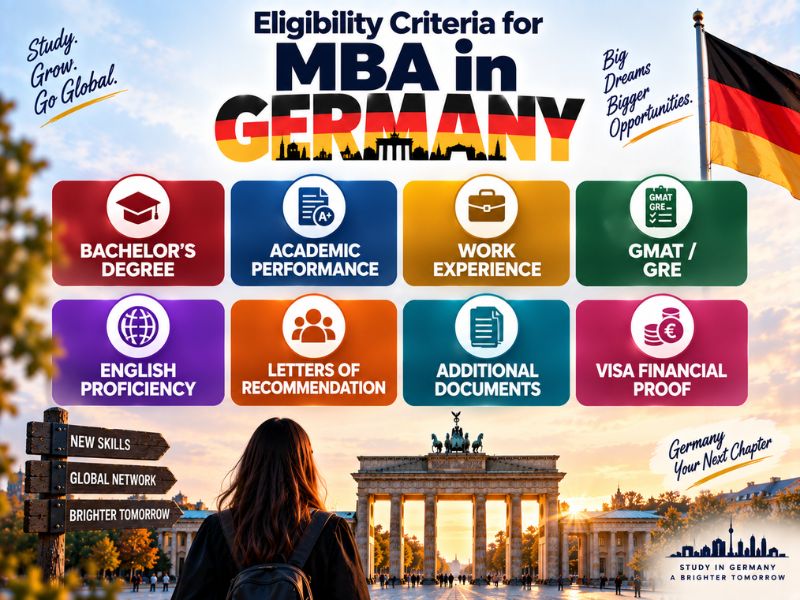
- Bachelor's degree — A recognised undergraduate degree from an accredited institution is required, with some programs like HHL Leipzig accepting a recognised Bachelor's degree in any field of study
- Academic performance benchmark — Some schools like Mannheim expect at least a B+ average
- Work experience — Most programs require 2 to 5 years of relevant work experience, though schools like Mannheim and HHL Leipzig expect at least 3 years of professional postgraduate experience
- GMAT/GRE scores — A GMAT score of 600 or higher is typically expected, though the requirement is typically 620-680, lower than US top schools, with GRE accepted at most institutions
- English proficiency — TOEFL 80-100 (iBT) or IELTS 6.5-7.0 for non-native English speakers, though some elite schools like HHL Leipzig expect TOEFL iBT 90 or IELTS 7.0
- Letters of recommendation — Two or three letters of recommendation from academic or professional referees are typically required
- Additional documents — A CV and motivation letter are required alongside recommendation letters at schools like HHL Leipzig
- Visa financial proof — For the 2026 visa, a Blocked Account with €11,904 is required
Admission Process for MBA in Germany 2026
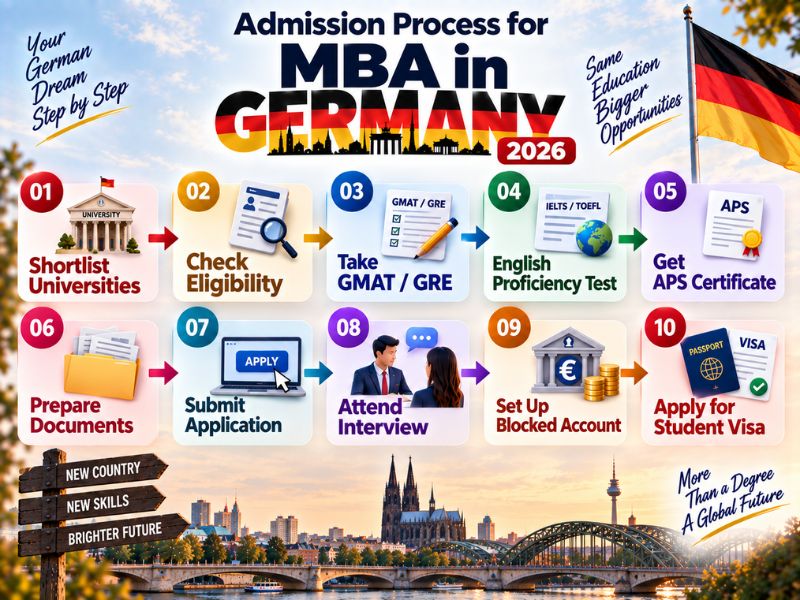
- Step 1: Shortlist universities — Compare based on FT/QS rankings (Frankfurt School #40, Mannheim #47 globally), fees, specialisation strength, and GMAT requirement
- Step 2: Confirm eligibility — Check each university's specific work experience requirement, since ESMT and WHU generally prefer 4+ years, while schools like TUM's Master in Management accept fresh graduates
- Step 3: Prepare and take GMAT/GRE — Top programs (ESMT, WHU) expect 660-720, mid-tier schools (Mannheim, Frankfurt School) expect 630-700, while other programs accept 600-650; note that German MBAs weigh work experience, essays, and interviews heavily alongside test scores
- Step 4: English proficiency test — Take IELTS (6.5+) or TOEFL as required by your target school
- Step 5: Obtain APS Certificate — A mandatory certification step specifically for Indian students applying to German universities, verifying academic documents
- Step 6: Compile application documents — Academic transcripts, CV, motivation letter, and recommendation letters
- Step 7: Submit application — Apply through the university's admissions portal within the specified intake window (e.g., September 2026 or October 2027 depending on program readiness)
- Step 8: Interview round — Attend the school's admissions interview where required
- Step 9: Blocked account (Sperrkonto) setup — Arrange the mandatory blocked account (€11,904 for 2026) through providers like Fintiba or Expatrio — budgeted separately from tuition
- Step 10: Visa application — Apply for the German student visa well in advance, ensuring the blocked account, APS certificate, and insurance are all in place before your visa appointment
GMAT, GRE & English Language Requirements
- Top-tier schools (ESMT, WHU) — GMAT 660-720 expected for competitive positioning
- Mid-tier schools (Mannheim, Frankfurt School) — GMAT 630-700 typical range
- Broader minimum benchmark — Elite schools generally require GMAT 600+ minimum, with Mannheim, WHU, and ESMT aiming for 630-650+ for a genuinely competitive edge
- GMAT-optional/waiver pathways — Mid-tier options like IU International University and GISMA often waive GMAT entirely; HHL Leipzig offers a waiver pathway for experienced professionals; TUM's Executive MBA doesn't require GMAT
- Holistic evaluation approach — German MBAs are less GMAT-focused than US programs — a GMAT of 620 combined with 5+ years of work experience can still secure admission to strong programs
- English proficiency benchmark — IELTS 6.5-7.0 or TOEFL 80-100 (iBT) is the standard range, though elite schools like HHL Leipzig expect TOEFL iBT 90+ or IELTS 7.0
- German language consideration — While programs are taught in English, starting German at the A1 level early (right after receiving your admission offer) meaningfully affects both job prospects and PR eligibility timelines later on
Top MBA Universities in Germany for Indian Students
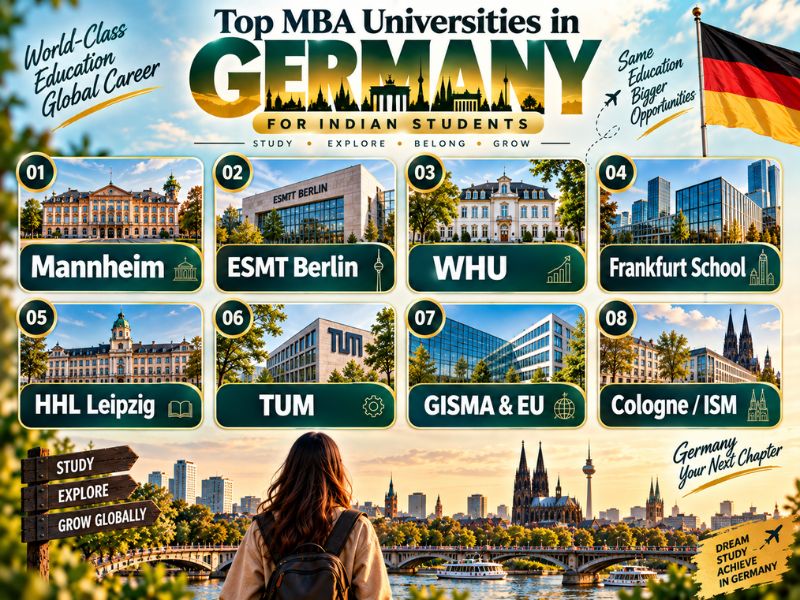
- Mannheim Business School — Widely considered the best in Germany overall; QS #47 globally; strong Mittelstand and corporate ties; 12-15 month program
- ESMT Berlin — FT Global Top 50; strong technology and engineering industry connections; accepts candidates with as few as 2 years of experience for its September intake
- WHU (Otto Beisheim School of Management) — Renowned for high academic standards with a strong entrepreneurship-focused curriculum, preparing students for leadership roles
- Frankfurt School of Finance & Management — QS #40 globally; located in Europe's financial hub; ideal for finance-focused careers; average salary after MBA around €110,000 (~₹97 lakh)
- HHL Leipzig Graduate School of Management — One of the oldest and most respected German business schools; more GMAT-flexible with a waiver pathway for experienced professionals
- TUM School of Management — Purpose-built for the intersection of management and technology; Executive MBA doesn't require GMAT, drawing directly on Germany's automotive and engineering networks
- GISMA & EU Business School Munich — Credible, more accessible fallback options for candidates without strong GMAT scores or extensive work experience
- University of Cologne / ISM — Public/affordable options offering flexible entry, suited for candidates earlier in their career
MBA Specialisations in Germany
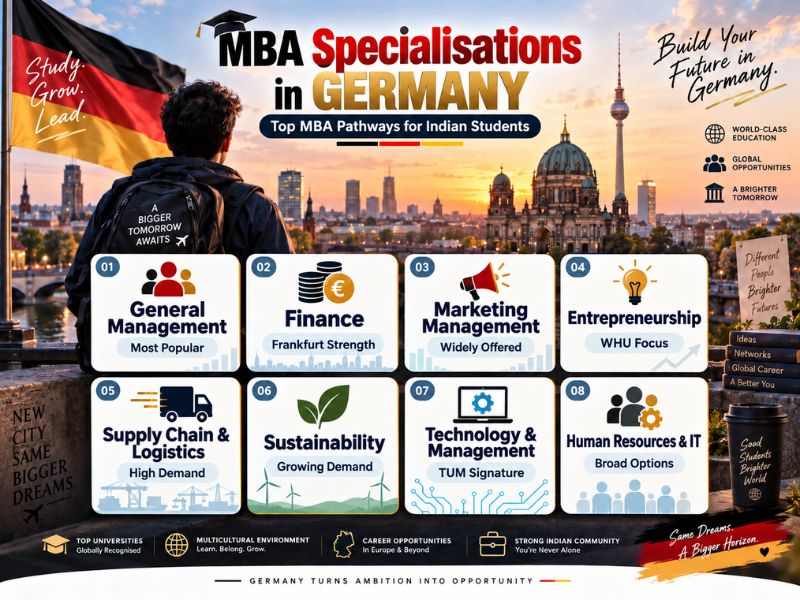
- General Management — The broadest and most commonly chosen specialisation among Indian students
- Finance — Core strength at Frankfurt School, given its location in Europe's financial capital
- Marketing Management — Widely offered across most top German business schools
- Entrepreneurship — Signature strength at WHU, with a curriculum specifically emphasising startup and venture-building skills
- Supply Chain & Logistics — Currently undersupplied in Germany, making it a strong specialisation choice for IT/consulting professionals looking to differentiate their profile
- Sustainability — Also undersupplied and growing in demand, particularly relevant given Germany's strong industrial and environmental policy focus
- Technology & Management Intersection — TUM's signature specialisation, connecting management education directly with Germany's engineering and automotive strengths
- Human Resources & IT — Additional specialisations offered across the broader pool of 89 MBA colleges and 8,000+ specialisation combinations available nationally
MBA Fees in Germany for Indian Students
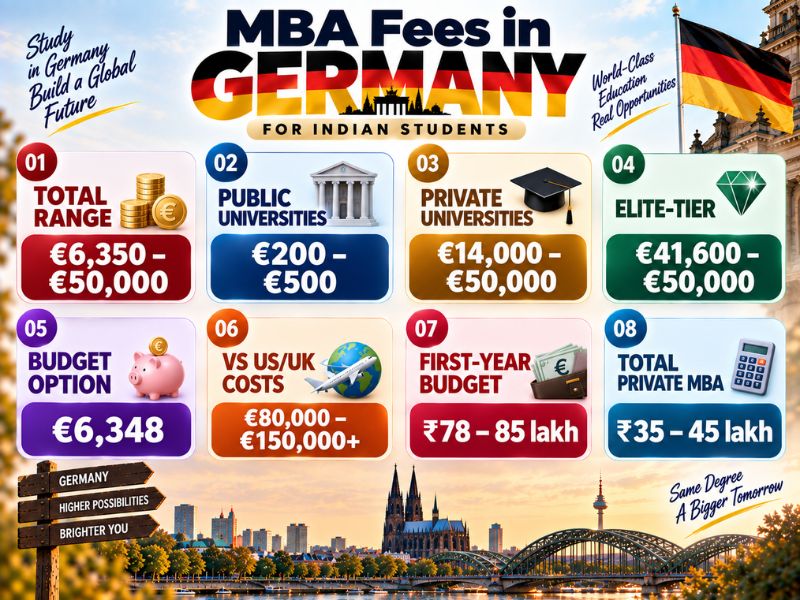
- Overall national range — €6,350 to €50,000 (~₹5.5-44.9 lakh) depending on program and university, with average tuition for Indian students typically landing around ₹25-35 lakh (€28,000-39,000)
- Public university fee bracket — Near-zero tuition, with only a semester administrative contribution of €200-500 (~₹18,000-45,000); some Executive MBA tracks at public universities do charge tuition
- Private university fee bracket — €14,000-50,000 total, with elite private schools (ESMT, WHU, Frankfurt School) charging €24,000-44,000 for a 2-year program
- Elite-tier specific figures — HHL Leipzig (€41,600) to ESMT Berlin (€50,000) for full program duration
- Budget-tier option — IU International University starts as low as €6,348 total
- US/UK cost comparison — Even elite German MBAs (€24,000-44,000) remain far cheaper than US programs (€80,000-150,000+)
- Total first-year budget (top-ranked Munich/Frankfurt program) — Approximately ₹78-85 lakh including program fees, blocked account, living costs, and visa/insurance setup costs
- Total budget-private-MBA estimate — Around ₹35-45 lakh for a full 12-month program including living costs at more accessible schools like GISMA
Cost of Living in Germany for Indian Students
- Monthly minimum estimate — At least €1,100 (~₹1.1 lakh) per month for business studies students
- DAAD 2025 benchmark — €900-1,200/month across most German cities
- City-based variation — Mannheim and Düsseldorf offer strong corporate connections with lower living costs than Munich or Frankfurt, which run higher
- Frankfurt-specific estimate — Approximately €10,000-14,000 per annum (~₹8-12 lakh) for living costs near Frankfurt School
- Blocked account (Sperrkonto) requirement — €11,904 (~₹13.08-13.09 lakh) for the 2026 visa — this is not a fee but funds released to the student monthly (~€992/month) via Fintiba or Expatrio, and must be budgeted separately from tuition
- Total pre-arrival cost planning — Budget at least ₹10-11.5 lakh for pre-arrival expenses alone (visa, APS certificate, insurance setup), on top of the blocked account and tuition
- Additional recurring costs — Health insurance, transportation, study materials, and potential German language course fees should be factored into the overall annual budget
Note: Fees, GMAT benchmarks, aur living cost figures multiple sources ke beech meaningfully vary kar rahe hain (source aur intake year ke hisaab se) — publish se pehle official university websites aur DAAD se latest 2026-27 figures cross-verify kar lena strongly recommend karta hoon.
Scholarships for MBA in Germany for Indian Students
- University-driven MBA scholarships — ESMT Berlin, Mannheim, HHL Leipzig, and Frankfurt School run merit and women-in-business awards covering 20-50% of tuition; DAAD does not fund standalone MBAs directly.
- DAAD's broader role — As Germany's largest scholarship provider with 86 scholarship programs and 3 Information Centres in India (Bangalore, Pune, Chennai) plus a New Delhi Regional Office, DAAD is central for research-linked and Master's-level funding, even though it excludes standalone MBAs
- Baden-Württemberg-Stipendium — A named scholarship option specifically relevant for students in that state
- Erasmus+ Mobility Programme — Supports higher education mobility for eligible students.
- Kurt Hansen Fellowship, Welcome scholarship (German University Foundation), ESV scholarships — Additional named funding routes worth exploring alongside university-specific awards
- APS Certificate requirement (critical, not optional) — All Indian applicants must obtain APS Certificate verification before booking a visa appointment — this should be applied for the moment you decide to study in Germany, even before shortlisting colleges, since processing can take up to two months
- Bundesland (state) tuition variation — Since 2025/26, Bavaria (TUM, LMU) and Baden-Württemberg now charge non-EU tuition (~€1,500/semester), while Berlin, North-Rhine-Westphalia, Hamburg, and Saxony remain tuition-free at public universities — your state choice now meaningfully affects total cost.t
- Application timeline — Start the scholarship process 12-14 months before your intended start date, including language test prep (IELTS/TOEFL 6.5-7.0+) and APS documentation
Germany Student Visa Requirements for Indian Students
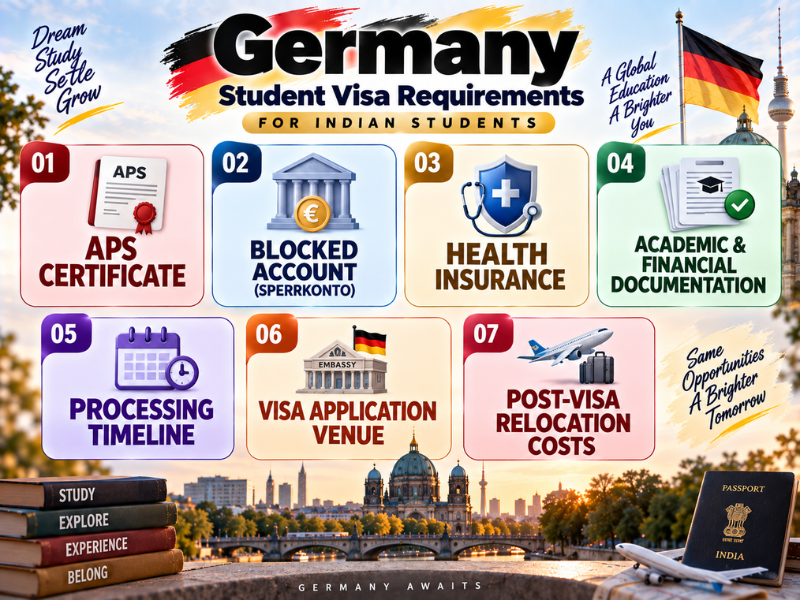
- APS Certificate — Mandatory first step for all Indian applicants with degrees from India, required before both university admission finalisation and visa processing
- Blocked account (Sperrkonto) — €11,904-€11,908 (~₹13.08-13.09 lakh) for 2026, set up through Fintiba or Expatrio, released monthly (~€992/month) as living funds — this is not a fee, it's your own money held for visa compliance
- Health insurance — Mandatory for the full duration of stay
- Academic and financial documentation — Admission letter, academic transcripts, and proof of funds (blocked account statement) form the core visa application package
- Processing timeline — APS verification alone can take up to two months, so applying well ahead of your target intake (ideally 12-14 months prior) is essential to avoid delays
- Visa application venue — Submitted through the German Embassy/Consulate in India after APS Certificate issuance
- Post-visa relocation costs — Budget separately for visa fees, travel, and initial settling-in costs beyond the blocked account and tuition
MBA Placements in Germany
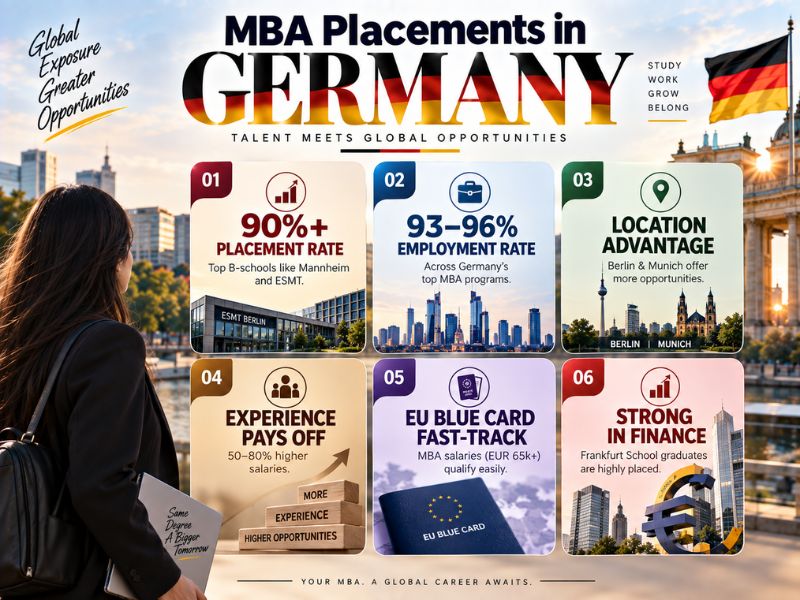
- Strong overall placement rates — Top B-schools like Mannheim and ESMT report 90%+ placement rates within three months of graduation
- National employment benchmark — Broader industry sources cite 93-96% employment rates for MBA graduates across Germany's top programs.
- Location impact on recruitment — Location significantly impacts both salary and the types of companies available for recruitment, with Berlin and Munich tech hubs prioritising skill over language fluency, making the transition easier for Indian professionals
- Work-experience premium valued highly — German employers heavily value prior work experience, with most MBA graduates seeing a 50-80% jump over their pre-MBA salaries.
- EU Blue Card fast-track — With average MBA salaries (EUR 65k+) far exceeding the 2026 EU Blue Card threshold (~EUR 43,800-50,000), most graduates qualify immediately for fast-track residency upon securing employment
- Sector-specific placement strength — Frankfurt School graduates are particularly well-placed for finance-sector roles given the school's location in Europe's financial hub
Top Recruiters Hiring MBA Graduates in Germany
- McKinsey, Siemens, SAP — German MBAs "punch above their price" with graduates respected and recruited by these major consulting, industrial, and technology employers
- Finance sector (Frankfurt-based) — Major banking and financial services firms recruit heavily from Frankfurt School graduates given its financial-hub location
- Technology sector (Berlin & Munich) — Berlin and Munich's English-friendly tech ecosystem actively recruits MBA graduates, prioritising skill over German language fluency.
- Automotive & Engineering sector — TUM School of Management graduates are particularly well-positioned given direct ties to Germany's automotive and engineering industry networks
- Mittelstand (mid-sized industrial) companies — Mannheim's strong links to Germany's biggest companies and Mittelstand businesses translate into a broad, stable recruiter base beyond just multinational giants.s
- Sector concentration overall — Consulting, finance, technology, and industrial/engineering firms collectively form the core recruiting pillars across Germany's top MBA programs.
Average MBA Salary in Germany
- Overall national range — MBA graduates in Germany can earn between €61,0and to €140,000 per year, depending on role, industry, and German language proficiency level
- Elite school average — Graduates from triple-accredited schools like Mannheim, ESMT Berlin, and WHU earn average starting salaries of €80,000-100,000 (~₹72-90 lakh) annually
- Frankfurt School specific figure — Average salary after MBA around €110,000 (~₹97 lakh), reflecting its finance-specialisation strength
- Broader industry benchmark — Other sources cite a slightly lower average of ₹49 lakh (EUR 55,000) per year, reflecting the range across all German MBA programs rather than just elite schools
- Salary growth vs pre-MBA earnings — Most graduates see a 50-80% jump in salary compared to their pre-MBA compensation, given how heavily German employers value prior professional experience
- EU Blue Card qualification — Since average MBA salaries comfortably exceed the 2026 Blue Card threshold (~€43,800-50,000), most graduates secure fast-track residency eligibility immediately upon employment.
- German language impact — Salary and role variety both improve meaningfully with German language proficiency (B1/B2 level), even though most MBA programs and many initial job roles operate primarily in English
Note: Scholarship amounts, visa costs, aur salary figures multiple sources ke beech meaningfully vary kar rahe hain (source aur intake year ke hisaab se) — publish se pehle DAAD, official university websites, aur German Embassy India se latest 2026 figures cross-verify kar lena strongly recommend karta hoon.
Post-Study Work Visa After MBA in Germany
- 18-Month Job Seeker Visa — International students can stay in Germany for up to 18 months after graduation to search for a full-time job.
- Work Without Restrictions — Graduates can work in any field while looking for a job related to their MBA qualification.
- EU Blue Card Eligibility — After securing a qualifying job, students can apply for the EU Blue Card, offering long-term work and residency benefits.
- Pathway to Permanent Residency — MBA graduates may become eligible for permanent residence after meeting employment and residency requirements.
- High Demand for MBA Graduates — Industries such as Finance, Consulting, IT, Automotive, Manufacturing, and Logistics actively recruit MBA professionals.
- German Language Advantage — Learning basic German significantly improves job opportunities, although many multinational companies hire English-speaking professionals.
- Excellent Career Prospects — Germany's strong economy and low unemployment rate make it an attractive destination for Indian MBA graduates.
Career Opportunities After MBA in Germany
- Management Consultant — Join global consulting firms like Deloitte, PwC, EY, KPMG, and Accenture with competitive salary packages.
- Marketing Manager — Lead digital marketing, branding, product strategy, and international business expansion.
- Financial Analyst — Build a career in banking, investment management, financial planning, and corporate finance.
- Operations Manager — Manage business operations, production planning, and process optimisation across industries.
- Supply Chain Manager — High demand in Germany's automotive, logistics, manufacturing, and e-commerce sectors.
- Business Analyst — Help organisations improve business performance using data-driven decision-making.
- Average Salary — MBA graduates typically earn €55,000–€90,000 per year, depending on experience, specialisation, and employer.
ROI of MBA in Germany (Fees vs Salary)
- Affordable Tuition Fees — Public universities offer low-cost education, while private MBA programs provide excellent global exposure.
- High Graduate Salaries — MBA graduates can earn €55,000–€90,000 annually, delivering an excellent return on investment.
- Lower Living Costs — Compared to other European countries, Germany offers affordable student living with discounts and support services.
- Part-Time Work Opportunities — Students can earn additional income while studying through part-time employment.
- Scholarship Availability — Various government and university scholarships help reduce the overall cost of education.
- Fast Cost Recovery — Most graduates recover their education investment within the first few years of employment.
- Strong Long-Term Career Growth — Germany's stable economy ensures excellent salary growth and career progression.
Student Life in Germany for Indian Students
- World-Class Education — Study in globally recognised universities with modern teaching methods and practical learning.
- Multicultural Environment — Interact with students from different countries and build an international professional network.
- Indian Student Community — Large Indian communities across Berlin, Munich, Frankfurt, Hamburg, and Stuttgart provide cultural support.
- Part-Time Employment — Students can work legally while studying to gain experience and manage living expenses.
- Excellent Public Transport — Affordable and efficient transportation makes travelling across Germany simple and convenient.
- Safe and Student-Friendly Cities — Germany offers a secure environment with a high quality of life for international students.
- Balanced Lifestyle — Students enjoy academics, internships, travel opportunities, cultural festivals, and networking events.
How to Choose the Best MBA University in Germany
- Check Global Accreditations — Choose universities accredited by AACSB, AMBA, or EQUIS for international recognition.
- Compare MBA Specialisations — Select programs that align with your career goals, such as Finance, Marketing, Business Analytics, or Supply Chain.
- Review Placement Records — Analyse graduate employment rates, recruiter partnerships, and average salary packages.
- Evaluate Industry Connections — Universities with strong corporate collaborations offer better internship and placement opportunities.
- Compare Tuition Fees & ROI — Consider total education costs, scholarships, and expected post-MBA salaries before applying.
- Choose the Right Location — Business hubs like Munich, Frankfurt, Berlin, and Hamburg provide stronger networking opportunities.
- Check Admission Requirements — Review GMAT/GRE, English proficiency, work experience, and application deadlines before applying.
This format is SEO-friendly, easy to read, and matches the bullet-point style shown in your screenshot, making it ideal for ranking on Google while improving user experience.
Frequently Asked Questions (FAQs)
1. Is Germany a good destination for an MBA for Indian students?
Yes. Germany is one of the best countries for Indian students because of its globally recognised universities, affordable tuition fees, strong economy, excellent job opportunities, and high return on investment (ROI).
2. What is the average cost of an MBA in Germany?
MBA tuition fees generally range between €15,000 and €45,000 at private universities, while some public universities charge only semester fees. Living expenses typically range from €900 to €1,300 per month.
3. Can I study an MBA in Germany without a GMAT?
Yes. Several German universities offer MBA programs without requiring a GMAT, especially for applicants with relevant work experience and a strong academic background.
4. What are the eligibility requirements for an MBA in Germany?
Most universities require:
- A bachelor's degree from a recognised institution.
- 2–5 years of work experience (for Executive or Full-Time MBA).
- English language proficiency (IELTS, TOEFL, or equivalent).
- Valid passport and supporting admission documents.
5. Can Indian students work while studying in Germany?
Yes. International students are allowed to work part-time during their studies, helping them gain practical experience and manage living expenses.
6. What is the average salary after completing an MBA in Germany?
MBA graduates can earn between €55,000 and €90,000 per year, depending on the university, specialisation, industry, and work experience.
7. Is it necessary to learn German before studying?
No. Many MBA programs are taught entirely in English. However, learning basic German can improve internship opportunities, daily communication, and future employment prospects.
8. Can I stay in Germany after completing my MBA?
Yes. International graduates can apply for an 18-month post-study work visa to search for full-time employment. After securing a qualifying job, they may become eligible for the EU Blue Card and permanent residency.
9. Which MBA specialisation is best in Germany?
Some of the most popular specialisations include General Management, Finance, Business Analytics, Supply Chain & Logistics, Marketing, Entrepreneurship, and Sustainability Management, depending on your career goals.
10. Is Germany better than the UK or Canada for an MBA?
Germany is an excellent choice for students looking for affordable education, strong ROI, high-paying jobs, and long-term career opportunities. The best destination depends on your budget, preferred specialisation, and career objectives.
Conclusion
Pursuing an MBA in Germany for Indian Students is a smart investment for those seeking world-class education, international exposure, and outstanding career opportunities. Germany offers globally ranked business schools, affordable tuition fees, excellent scholarship options, and a thriving job market across industries such as finance, consulting, technology, manufacturing, and logistics.