




MBA in Austria for Indian Students Fees, Scholarships, and Career Scope
September 19, 2026
1 min read

Table of Contents
MBA in Austria for Indian Students: Highlights 2026
- Triple Crown flagship institute — WU Wien Executive Academy holds the rare Triple Crown accreditation (EQUIS, AACSB, AMBA), held by fewer than 1% of business schools worldwide; ranked #46 in FT European Business School rankings and #17 globally for Masters in Management
- Fee range across the country — WU Executive MBA: €39,200-59,200 (~₹35-53 lakh); other recognized programs (MCI, MODUL, Webster): €20,000-35,000 (~₹18-31.5 lakh)
- Public university value alternative — WU's Master's in International Management costs just €1,500/year at public university rates while still ranking #17 globally — a striking option for candidates open to a Master's rather than a full MBA
- English-taught program breadth — Austria offers 200+ English-taught Master's programs nationally, easing the transition for Indian applicants without German proficiency
- Salary outcomes — Overall Austrian MBA graduates earn €50,000-70,000/year, while WU Wien Executive Academy graduates specifically report €70,000-100,000
- GMAT largely optional — Most Austrian MBA programs waive GMAT/GRE entirely, admitting based on work experience, transcripts, and interview performance
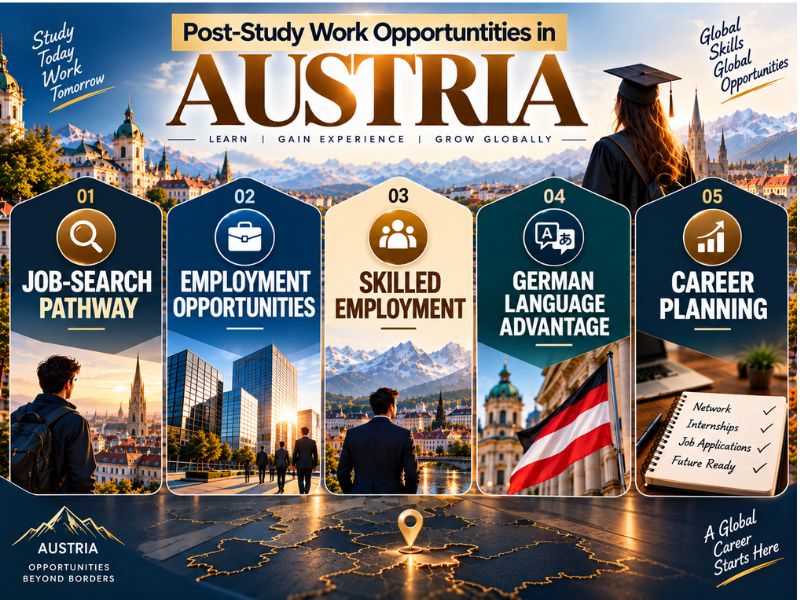
- Post-study work advantage — The Rot-Weiß-Rot Karte (Red-White-Red Card) pathway offers a 12-month job-search extension without a competitive points test — notably easier than many alternative European destinations
Why Study MBA in Austria as an Indian Student?
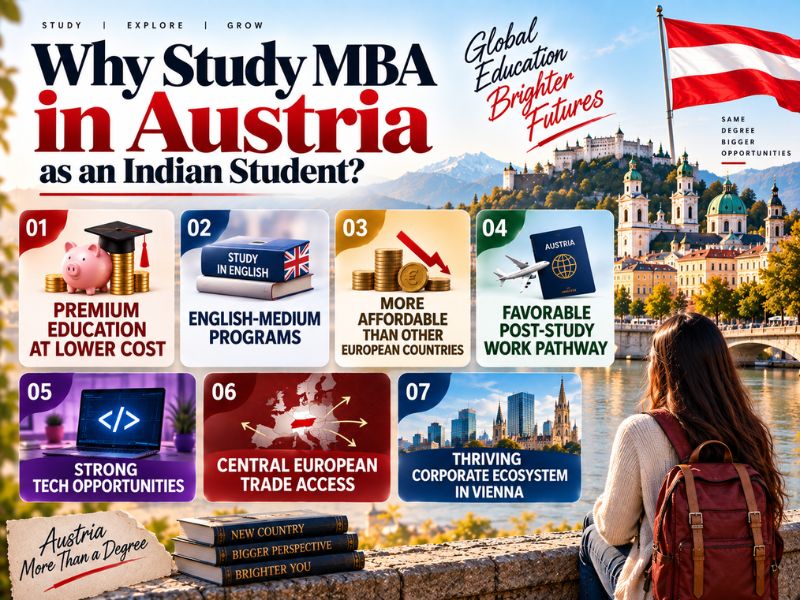
- Genuinely compelling cost-to-prestige ratio — WU Wien offers Triple Crown accreditation at roughly half the cost of comparable UK or Swiss MBA programs, a rare combination in European business education
- English-medium accessibility without sacrificing local integration — Since 200+ Master's/MBA programs are taught fully in English, Indian students can study without German fluency, while still benefiting from Austria's central European location and strong local job market access
- Regional value advantage — Austria is 27-45% cheaper than Germany and 50-60% cheaper than the Netherlands for the combined cost of visa and first-year survival
- Favorable post-study work pathway — The Red-White-Red Card gives graduates a 12-month job-search window without needing to pass the standard points-based test required of other skilled migrant categories — significantly easier than equivalent UK or US options
- Strong tech-sector accessibility without German — Tech/IT roles are genuinely accessible without German language skills, making this sector a particularly strong entry point for Indian MBA graduates
- Central European trade positioning — Vienna's location gives graduates natural pathways into International Business, Finance, and Supply Chain roles across the broader EU market
- Vienna's dense corporate ecosystem — Being based in the capital gives MBA students direct access to Austria's densest concentration of multinational corporates, banks (Erste Bank, Raiffeisen), and consulting firms (McKinsey, BCG)
Eligibility Criteria for MBA in Austria
- Bachelor's degree requirement — A recognized undergraduate degree from any accredited institution is the baseline academic requirement
- Work experience expectation — Most Austrian MBA programs (particularly WU Wien's Executive Academy) expect 2-5 years of professional experience, positioning these programs toward working professionals rather than fresh graduates
- English proficiency — IELTS 6.5+ or TOEFL 90+ for English-taught programs; German B2/C1 proficiency required specifically for German-medium program options
- Alternative English proficiency proof — Some universities accept documentation of prior education conducted fully in English instead of mandating a fresh standardized test score
- Academic transcripts and CV — A complete academic record alongside an updated resume/CV highlighting professional experience and achievements
- Statement of Purpose and Letters of Recommendation — Standard application components across nearly all Austrian MBA programs
- Financial proof (relevant at both admission and visa stages) — Bank statements or proof of funds demonstrating ability to cover tuition and living expenses
Admission Process for MBA in Austria 2026
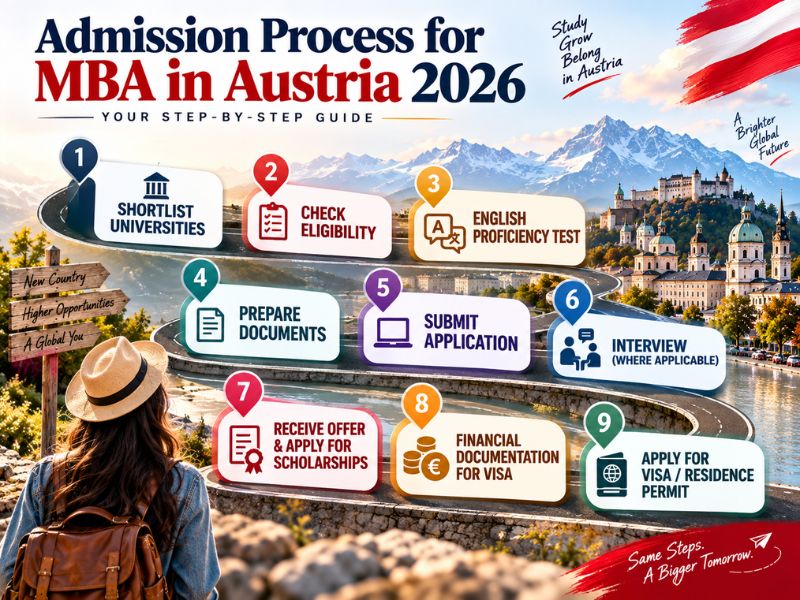
- Step 1: Shortlist universities — Compare based on accreditation (WU Wien's Triple Crown vs. MCI/MODUL/Webster), fees, specialization strength, and English vs. German medium of instruction
- Step 2: Confirm eligibility — Check each university's specific work experience, academic score, and any GMAT/GRE requirements
- Step 3: English proficiency test — Take IELTS (6.5+) or TOEFL (90+), or confirm eligibility via prior English-medium education
- Step 4: Compile application documents — Academic transcripts, updated CV, Statement of Purpose, and Letters of Recommendation
- Step 5: Submit application — Apply directly through the university's official admissions portal within the specified intake window
- Step 6: Interview round (where applicable) — Some programs conduct interviews to assess motivation, leadership potential, and professional readiness
- Step 7: Offer and scholarship application — Apply separately for scholarships like OeAD, Ernst Mach Grants, or university-specific merit awards where eligible
- Step 8: Financial documentation for visa — Arrange proof of funds (approximately €12,707/year via a blocked account/Sperrkonto), since student loans, cryptocurrency, and cash are explicitly not accepted as proof
- Step 9: Visa/residence permit application — Apply for the Residence Permit – Student (Aufenthaltsbewilligung Student), ensuring all documents (passport, admission proof, financial means, health insurance, accommodation proof) are ready well in advance, given 8-12 week processing times
Entrance Exams Required for MBA in Austria
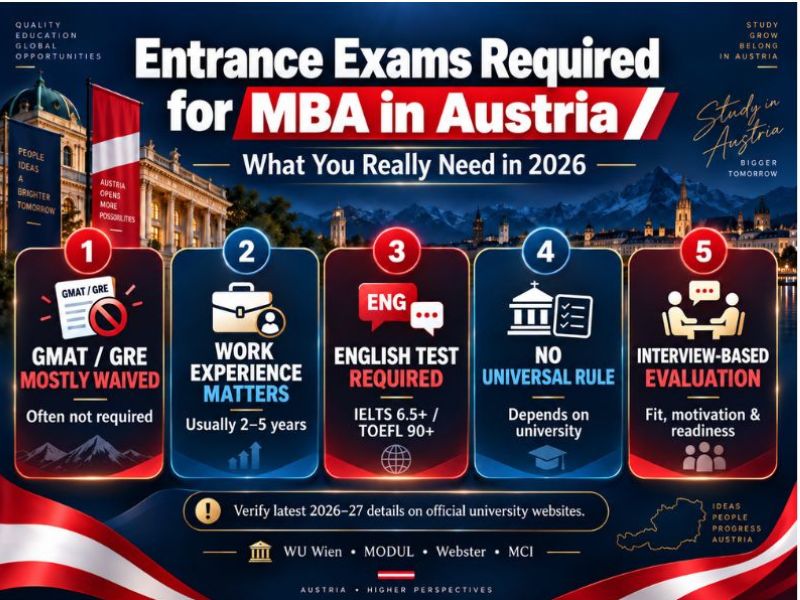
- GMAT largely waived — Most Austrian MBA programs (WU Wien, MCI, MODUL, Webster) do not require GMAT or GRE, admitting students based on work experience, academic transcripts, and interview performance instead
- Work experience as the primary evaluation factor — Since standardized tests are frequently optional, professional experience (typically 2-5 years) and a strong academic transcript become the more decisive factors in admission decisions
- English proficiency remains the more consistent requirement — Unlike GMAT/GRE, IELTS 6.5+ or TOEFL 90+ is far more consistently required for English-taught programs, given Austria's predominantly English-medium MBA landscape
- No universal national standard — Since exact test requirements can vary slightly by program type (Executive MBA vs. standard MBA vs. specialized tracks), confirming the specific requirement with your shortlisted school is the safest approach
- Interview-based holistic evaluation — In place of standardized testing, most Austrian business schools rely on a personal interview to assess candidate fit, motivation, and career readiness as the final admission gateway
Note: Fees, eligibility, aur entrance requirements WU Wien, MODUL, Webster, aur MCI ke beech significantly vary karte hain — publish se pehle official university websites (wu.ac.at, modul.ac.at, webster.ac.at, mci.edu) se latest 2026-27 admission cycle details verify kar lena strongly recommend karta hoon.
English Language Requirements for MBA in Austria
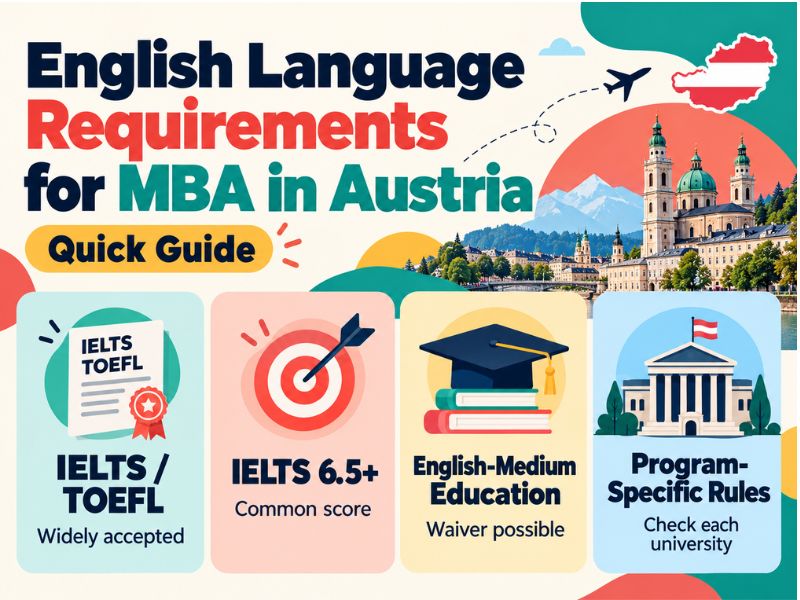
- IELTS/TOEFL commonly accepted — English-taught MBA programs generally require proof of English proficiency, with many institutions accepting IELTS, TOEFL, or equivalent tests.
- Typical IELTS requirement — Many MBA programs expect around IELTS 6.5, although the exact score varies by university and program.
- English-medium education may qualify for exemption — Applicants who completed previous education entirely in English may be eligible for a language-test waiver at some institutions.
- Program-specific requirements — English requirements can differ between universities, so students should verify the exact score requirement before applying
- Top MBA Colleges in Austria for Indian Students
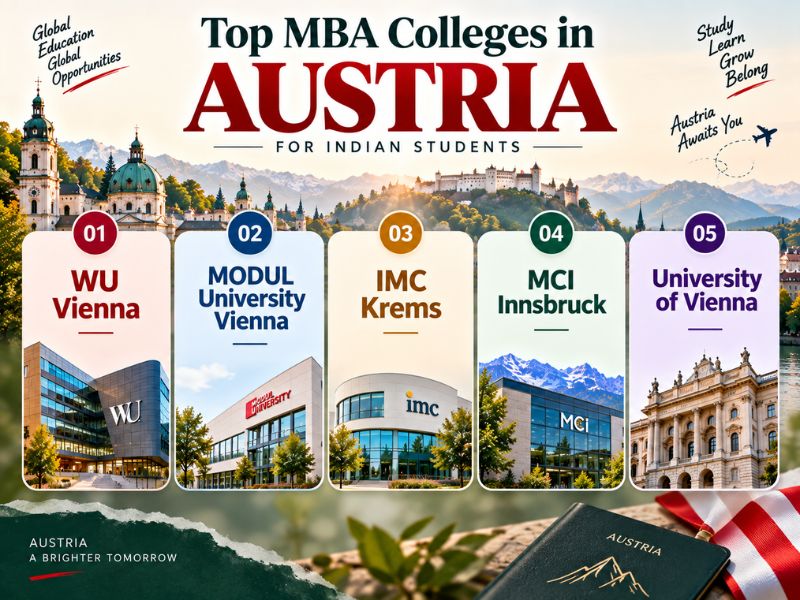
- WU Vienna — Offers internationally oriented management education with strong academic and business connections.
- MODUL University Vienna — Known for internationally focused business and management programs with a strong practical orientation.
- IMC Krems — Provides business-focused postgraduate programs with an international learning environment.
- MCI Innsbruck — Combines management education with practical business exposure and international opportunities.
- University of Vienna — Offers a broad academic environment and access to one of Austria's major university networks.
3. Best MBA Universities in Austria
- Internationally recognised institutions — Austrian business schools offer MBA and management programs designed for international students.
- Strong academic environment — Universities combine theoretical business knowledge with practical case studies, projects, and industry exposure.
- International classroom experience — Many programs attract students from different countries, creating opportunities for global networking.
- Career-focused learning — Several MBA programs emphasise leadership, management, entrepreneurship, and business strategy.
Popular MBA Specialisations in Austria
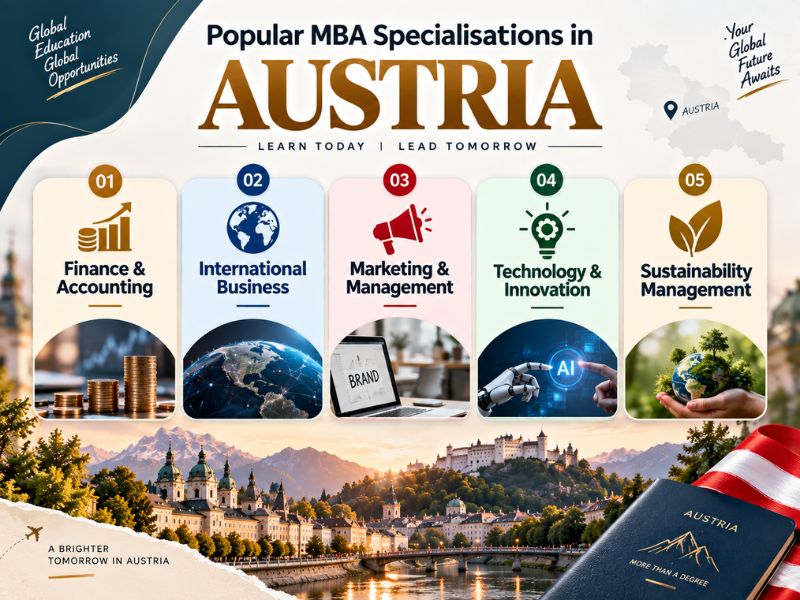
- Finance & Accounting — Suitable for careers in financial management, banking, investment, and corporate finance.
- International Business — Focuses on global markets, international strategy, and cross-border business operations.
- Marketing & Management — Covers brand strategy, consumer behaviour, digital marketing, and business development.
- Technology & Innovation — Combines management skills with technology, innovation, digital transformation, and entrepreneurship.
- Sustainability Management — Focuses on sustainable business models, ESG, responsible management, and green business practices.
Popular MBA Specialisations in Austria
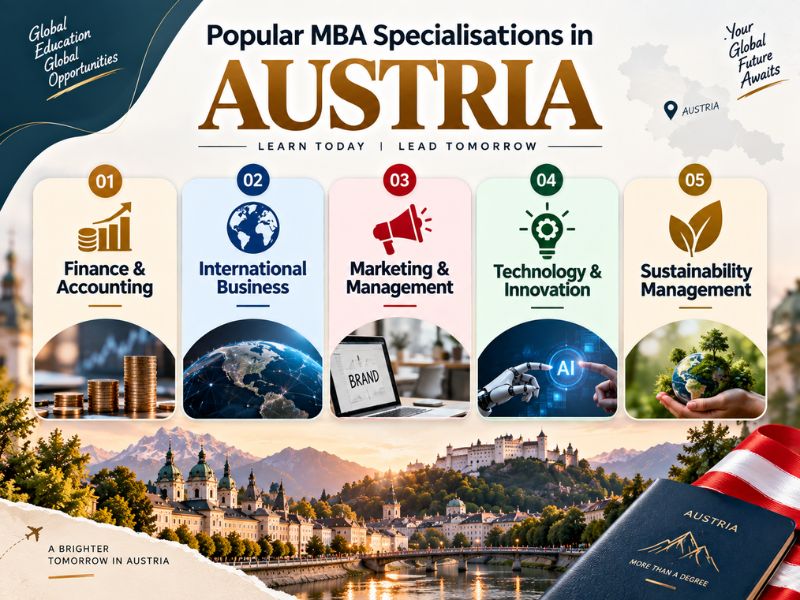
- International Business — Focuses on global markets, international strategy, and cross-border management.
- Finance & Accounting — Covers investment, financial planning, banking, and corporate finance.
- Marketing Management — Develops skills in branding, digital marketing, consumer behaviour, and sales.
- Technology & Innovation — Combines business management with digital transformation, innovation, and entrepreneurship.
- Sustainability Management — Covers ESG, sustainable business models, and responsible management.
MBA Fees in Austria for Indian Students
- Public universities — Tuition can be comparatively affordable, depending on the institution and program.
- Private business schools — MBA fees are generally higher because of their international and specialised program structures.
- Executive MBA programs — These may have significantly higher fees than regular MBA programs.
- Additional expenses — Students should also plan for accommodation, insurance, food, transportation, and study materials.
- Scholarships — Financial support may reduce the overall cost for eligible students.
3. Cost of Living in Austria for Indian Students
- Accommodation — Rent is usually the largest monthly expense, especially in Vienna and other major cities.
- Food & groceries — Monthly food costs depend on lifestyle, location, and whether students cook at home.
- Transportation — Austria has an extensive public transport network, making student travel convenient.
- Other expenses — Students should budget for health insurance, mobile services, study materials, and personal expenses.
- Budget planning — Choosing student accommodation and cooking regularly can help control monthly expenses.
Affordable MBA Colleges in Austria
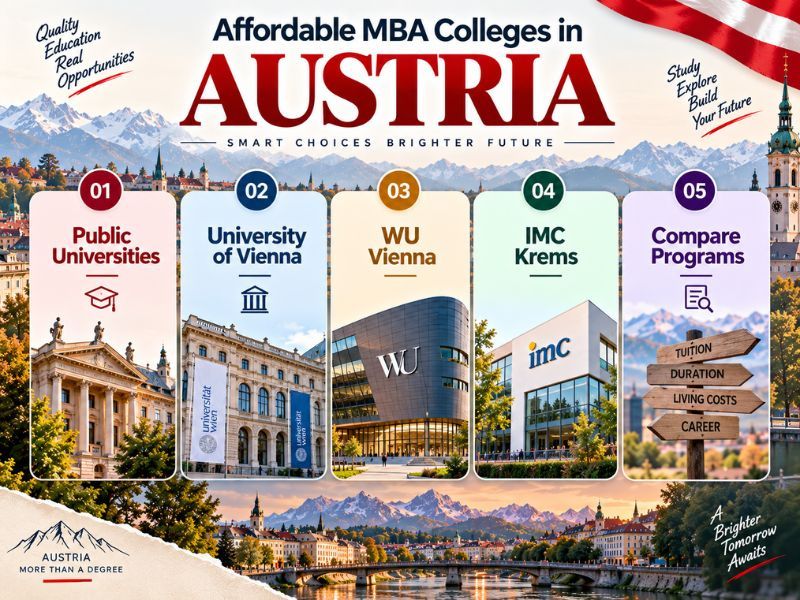
- Public universities — Public institutions can offer comparatively lower tuition than private business schools.
- University of Vienna — Provides access to a major public university environment and a wide academic network.
- WU Vienna — A prominent institution for business and economics education.
- IMC Krems — Offers internationally oriented management education with practical learning.
- Program comparison is important — Students should compare tuition, duration, living costs, and career opportunities before applying.
Scholarships for MBA in Austria
- University scholarships — Some institutions provide financial support based on academic performance or other eligibility criteria.
- Merit-based scholarships — Strong academic records can improve eligibility for certain scholarship opportunities.
- Need-based assistance — Some funding opportunities may consider the student's financial circumstances.
- External scholarships — International students can also explore government, institutional, and private funding options.
- Early application matters — Scholarship deadlines may differ from regular MBA admission deadlines.
6. Documents Required for MBA Admission in Austria
- Academic documents — Bachelor's degree, transcripts, and relevant academic certificates are generally required.
- English proficiency proof — IELTS, TOEFL, or another accepted test may be required for English-taught programs.
- Resume/CV — A professional CV highlighting education, work experience, and achievements is commonly requested.
- Statement of Purpose — Some MBA programs ask applicants to explain their career goals and motivation.
- Additional documents — Passport, recommendation letters, work-experience proof, and application forms may be required depending on the university.
7. Student Visa & Residence Permit for Indian Students
- Student residence process — Indian students generally need the appropriate Austrian residence authorization for longer-term study.
- Admission confirmation — A university admission letter is an important part of the application process.
- Financial proof — Students may need to demonstrate sufficient funds to support themselves during their stay.
- Accommodation proof — Evidence of suitable accommodation may be required.
- Health insurance — Valid health coverage is generally required as part of the residence process.
MBA Placements in Austria
- Strong business environment — Austria offers opportunities across finance, consulting, technology, manufacturing, tourism, and international business.
- Industry exposure — MBA programs may provide networking events, projects, internships, and employer interactions.
- Vienna as a business hub — The capital provides access to numerous international companies and organisations.
- Career support — Universities and business schools may offer career counselling, job fairs, and networking services.
- German language advantage — German skills can expand opportunities with Austrian employers, depending on the role.
Average MBA Salary in Austria

- Salary depends on experience — MBA graduates with previous professional experience may command different salaries from fresh graduates.
- Industry matters — Consulting, finance, technology, and management roles can have different compensation levels.
- Job role influences earnings — Positions such as business analyst, marketing manager, financial manager, and consultant have different salary structures.
- Location matters — Salaries can vary between Vienna and other Austrian cities.
- Experience remains important — An MBA can strengthen career progression, but compensation depends on qualifications, skills, industry, and professional experience.