







MBA Colleges in Malta Fees, Admission, Eligibility, Scholarships & Career Opportunities

Table of Contents
MBA Colleges in Malta: Highlights 2026
Malta has emerged as a genuinely compelling, if lesser-known, MBA destination for Indian students — offering full EU membership benefits at a fraction of the cost associated with more established European destinations. Malta is a full EU member state, meaning your Maltese MBA carries EQF Level 7 recognition across all 27 EU countries — the same framework used in Germany, France, and the Netherlands.
Top institutions include GBSB Global Business School, the University of Malta, and the American University of Malta (AUM), all globally recognised and accepted worldwide for their MBA programs, with the London School of Commerce Malta campus and the University of Malta home to a genuinely diverse student body — more than 5,000 international students were enrolled across Maltese universities in the 2022-23 session alone.
Why Choose MBA Colleges in Malta?
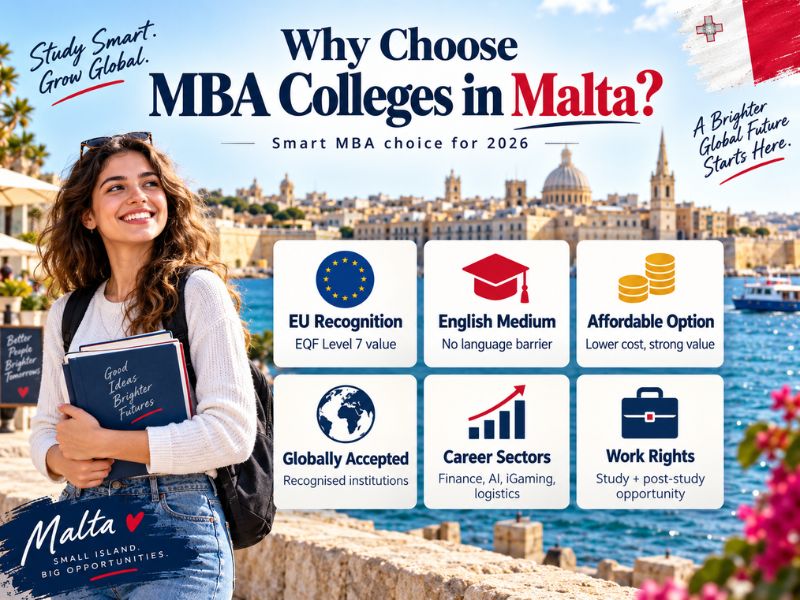
Considering Malta for your MBA? Here's why it makes strategic sense in 2026.
1. Genuine EU-wide recognition
Your Maltese MBA carries EQF Level 7 recognition across all 27 EU countries — meaning your degree holds real weight well beyond just Malta itself.
2. English-medium instruction, zero language barrier
English is an official language in Malta — no IELTS language shock, no Goethe-Institut prep required. Classes run in English from day one.
3. Genuinely affordable relative to other EU destinations
Malta quietly hands out internationally benchmarked, MQF Level 7 MBA degrees at a fraction of the cost of more established European destinations, with programs like MFMAC's standard MBA priced at just €10,000.
4. Global recognition backing your degree
Universities including GBSB Global Business School, the University of Malta, and AUM are accepted worldwide for their MBA programs.
5. Booming local economy with real recruiting sectors
Malta has become a genuine Mediterranean hub for iGaming, financial services, AI-tech companies, logistics, and maritime industries — sectors actively recruiting MBA graduates locally.
6. Genuine work rights during and after your program
Indian students pursuing MBA programs in Malta can work up to 20 hours per week during the academic term and full-time during holidays, and after completing an MBA in Malta, graduates can apply for a post-study work visa valid for up to nine months, allowing them to stay while seeking employment in sectors like finance, consulting, and technology.
The bottom line: If you want genuine EU-wide degree recognition, English-medium instruction, and a genuinely affordable price point compared to bigger-name European destinations, Malta offers a strategically smart, if under-the-radar, choice for 2026 — provided you enter with realistic expectations about its smaller local job market.
Eligibility Criteria for MBA Colleges in Malta
Before applying to MBA programs in Malta, make sure you meet the following eligibility requirements for 2026 admissions.
Academic qualification
- A bachelor's degree in a relevant field, with a minimum of 50% marks required at most institutions
Work experience
- While some programs require 1-2 years of work experience, others accept fresh graduates with strong academic records — genuinely flexible depending on your specific target university.
Standardised test scores
- GMAT/GRE requirements vary genuinely by institution, with many Maltese business schools not mandating standardised testing, particularly at more accessible institutions
English proficiency
- No IELTS is required for programs conducted entirely in English at several institutions, though institutions like Malta College of Arts, Science & Technology (MCAST) are genuinely flexible in accepting alternatives to the IELTS exam for students who don't hold a traditional IELTS score.
Application essentials
- Academic transcripts, passport documents, a Statement of Purpose (SOP), and proof of English language proficiency are standard requirements across Maltese institutions.s
Admission Process for MBA Colleges in Malta 2026
Here's a step-by-step breakdown of what the admission process looks like for 2026.
Step 1: Research and shortlist universities
Compare Malta's MBA-offering institutions — GBSB Global Business School, University of Malta, AUM, GBS Malta, Global College Malta, EIE, and MFMAC — based on fees, specialisation, and your specific eligibility profile.
Step 2: Verify your eligibility match
Confirm you meet your target institution's specific bachelor's degree, minimum percentage, and work experience requirements.
Step 3: Gather required documents
Prepare academic transcripts, passport documents, a Statement of Purpose, and English language proficiency documentation.
Step 4: Submit your application
Complete the online application form with all required documents within your target institution's specified deadlines.
Step 5: Attend entrance exam or interview (where applicable)
Some universities may conduct an online interview as part of their admission assessment process, particularly for programs without standardised test requirements.
Step 6: Receive your offer letter
Upon selection, you'll receive a conditional or unconditional offer letter confirming your admission.
Step 7: Apply for scholarships alongside your admission process
Universities such as GBS Malta and Global College Malta provide merit-based and excellence scholarships that can cover up to 50-100% of tuition fees for deserving candidates — research and apply for these during, not after, your main application.
Step 8: Apply for your Maltese student visa
Complete the Maltese student visa process with financial proof and required documentation well ahead of your intended start date.
Step 9: Arrive and begin orientation
Attend orientation and begin classes, with most programs starting in the September-October intake window.
Our advice: Since scholarships at GBS Malta and Global College Malta can genuinely cover up to 100% of tuition for deserving candidates, actively research and apply for these opportunities during your application process rather than treating them as an afterthought — Malta's scholarship landscape is genuinely more generous than its smaller international profile might suggest.
Entrance Exams & English Language Requirements
Here's what you need to know about testing requirements for MBA programs in Malta in 2026.
Standardised test requirements are genuinely flexible
GMAT/GRE requirements vary by institution — many Maltese business schools don't mandate standardised testing at all, particularly at institutions like GBS Malta, MFMAC, and Global College Malta, which prioritise academic background and professional profile over test scores.
English proficiency — genuinely accessible alternatives exist
Since English is an official language in Malta, there's no IELTS language shock or intensive prep required at institutions conducting programs entirely in English. The top colleges in Malta that are affordable and flexible in accepting alternatives to the IELTS exam include Malta College of Arts, Science & Technology (MCAST).
Medium of Instruction (MOI) as a genuine alternative
For students from English-medium undergraduate backgrounds, several Maltese institutions accept an MOI certificate from your previous university in place of a formal IELTS/TOEFL score — worth checking specifically with your shortlisted colleges.
Interview-based assessment as an alternative to testing
Some universities may conduct an online interview as part of their admission assessment process, particularly for institutions without mandatory GMAT/GRE requirements — this genuinely shifts evaluation weight toward your professional narrative and academic background rather than standardised scores.
Our advice: Since Malta's MBA landscape genuinely leans toward flexible, holistic admissions rather than rigid standardised testing requirements, prioritise building a strong academic transcript and compelling SOP over investing heavily in GMAT preparation — this destination rewards a different application strategy than more test-score-driven MBA markets like the US or UK.
Top MBA Colleges in Malta 2026
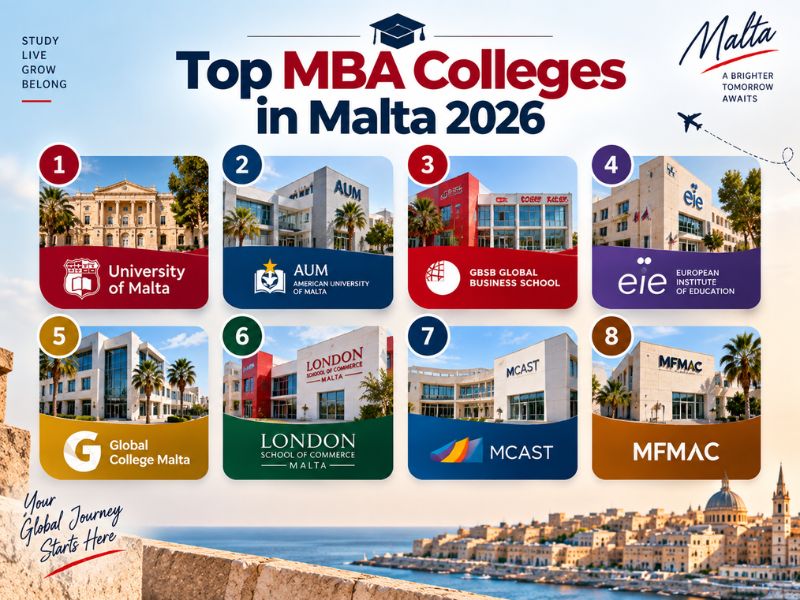
Here's a rundown of Malta's leading MBA institutions worth considering for 2026.
1. University of Malta
Malta's flagship public university, offering MBA programs with tuition ranging from €12,000-16,000 for the entire program, and a wide range of specialisations including healthcare management, logistics, and supply chain management.
2. American University of Malta (AUM)
A US-style degree program, offering an MSc in International Business Administration alongside MBA options, roughly $16,000-22,000 per year for its private, American-modelled curriculum.
3. GBSB Global Business School
A globally recognised private business school known for practical, industry-focused MBA programs and strong international student support.
4. European Institute of Education (EIE)
Tuition for the MBA program ranges from approximately €11,000-15,000 for the entire program duration.
5. Global College Malta
Tuition ranges from approximately €10,000-14,000 for the complete program — genuinely accessible pricing among Malta's business schools.
6. London School of Commerce Malta
Offers Business Management Studies alongside multiple MBA programs for international students, with fees close to USD 7,750 per academic year.
7. Malta College of Arts, Science and Technology (MCAST)
A vocational and technical institute offering flexible admission (including alternatives to IELTS), with generally lower tuition than the private business-focused institutions.
8. MFMAC
Offers a standard MBA at €10,000 and an MBA with AI Specialisation at €12,500, with fees inclusive of course materials and assessments.
Our advice: Match your school choice to your budget and career goals — University of Malta offers the strongest public-institution credibility, AUM delivers an American-style curriculum at a premium, while Global College Malta, EIE, and MFMAC offer genuinely accessible entry points without sacrificing EU-wide recognition.
MBA Colleges in Malta: Rankings & Accreditation
Here's what accreditation genuinely tells you about Malta's MBA programs for 2026.
EU-wide recognition as the foundational quality signal
Since Malta is a full EU member state, degrees from its accredited institutions carry EQF Level 7 recognition across all 27 EU countries — the same framework used in Germany, France, and the Netherlands, meaning your degree's validity extends genuinely far beyond Malta itself.
Malta doesn't feature prominently in global MBA rankings
Unlike destinations with schools regularly appearing in QS or Financial Times MBA rankings, Malta's institutions are better understood through national accreditation (MQF Level 7) and EU-wide recognition rather than global league table positioning — genuinely worth setting realistic expectations here.
Global acceptance despite limited ranking visibility
Universities including GBSB Global Business School, the University of Malta, and AUM are accepted worldwide for their MBA programs, even without consistently appearing in headline global rankings.
The honest brand recognition trade-off
Malta carries limited brand recognition in India — it's not yet a household name — meaning employers may be less immediately familiar with specific Maltese institutions compared to more established European or American MBA brands.
What to verify instead of chasing rankings
Since global ranking visibility is limited, prioritise verifying MQF Level 7 accreditation status directly, checking whether your specific program is recognised by Malta's National Commission for Further and Higher Education (NCFHE), and confirming EU-wide EQF Level 7 equivalency for your target institution.
Our advice: Don't judge Malta's MBA programs by their absence from global ranking tables — instead, verify MQF/EQF Level 7 accreditation directly and weigh this against your genuine career goals, since Malta's value proposition rests on EU-wide degree validity and affordability rather than global brand prestige.
MBA Specialisations Offered in Malta
Here's what specialisation options are genuinely available across Malta's MBA landscape in 2026.
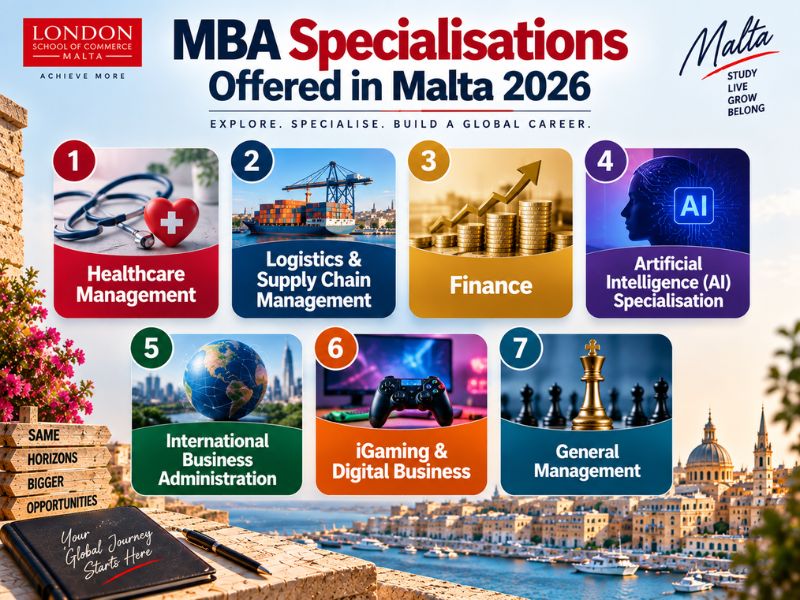
1. Healthcare Management
Available specifically at the University of Malta, catering to students interested in the growing healthcare administration sector.
2. Logistics and Supply Chain Management
A genuine strength given Malta's status as a Mediterranean maritime and logistics hub, with real local industry demand.
3. Finance
Well-supported given Malta's growing financial services sector, reflecting the country's position as a genuine EU financial hub for certain niche services.
4. Artificial Intelligence (AI) Specialisation
A distinctly modern offering — MFMAC specifically offers an MBA with AI Specialisation, priced at €12,500, reflecting genuine demand from Malta's booming AI-tech sector.
5. International Business Administration
Offered at the American University of Malta, combining a US-style curriculum with genuine international business exposure.
6. iGaming and Digital Business
A genuinely distinctive Malta specialisation, reflecting the country's status as a global iGaming industry hub — a sector rarely offered with this depth elsewhere.
7. General Management
The standard, broadly available specialisation across most institutions, providing foundational business administration training.
Our advice: If you're drawn to Malta's most distinctive local industry strengths, prioritise iGaming/Digital Business or Logistics and Supply Chain Management specialisations — these leverage Malta's genuinely unique economic positioning in ways that generic specialisations elsewhere in Europe can't replicate.
MBA Colleges in Malta: Fees Comparison
Understanding the fee landscape helps you budget realistically across Malta's MBA programs for 2026.
Overall national range
The cost of pursuing an MBA in Malta is affordable, with annual tuition fees ranging from ₹5.5 Lakhs to ₹22 Lakhs — genuinely lower than most Western European MBA destinations.
Public university tier
- University of Malta: €12,000-16,000 for the entire program (approximately ₹10,800-18,000/year for non-EU/EEA postgraduate students specifically)
Private university tier
- American University of Malta (AUM): $16,000-22,000 per year for its US-style degree
- European Institute of Education (EIE): €11,000-15,000 for the entire program
- Global College Malta: €10,000-14,000 for the entire program
- MFMAC: €10,000 for the standard MBA, €12,500 for the AI Specialisation track
- London School of Commerce Malta: Close to USD 7,750 for one academic year
Budget-friendly institutions
Global College Malta, MCAST, GBS Malta, and the European Institute of Education (EIE) are among the cheapest options, with average annual tuition starting from €6,000 and going up to €10,000 for postgraduate courses — courses in business, management, marketing, and IT generally carry lower fees than other specialisations at these institutions.
Broader EU-wide fee context
Non-EU/EEA students across Malta typically pay between €9,000-27,000/year for specialised programmes like an MBA, with science-based and business-related programmes generally the most expensive, and private universities charging even higher fees than public options.
Cost of Living for MBA Students in Malta
Here's a realistic breakdown of monthly living expenses for MBA students in Malta in 2026.
Overall monthly range
Depending on your lifestyle, accommodation type, and whether you live alone or with other students, monthly living costs in Malta can range from €500-800, with a broader estimate of €700-1,100/month including all essentials.
Accommodation cost breakdown
- University residence halls: Generally cheaper than renting a private flat, though prices vary by institution
- Privately rented flat: €700-1,500/month
- Room in shared accommodation: €450-900/month depending on location — busy Sliema runs higher, while quieter inland towns offer meaningfully lower costs
Utilities
If renting a flat independently, budget an additional €90-120/month for utilities beyond your base rent.
Climate advantage worth factoring in
Malta's Mediterranean climate keeps winter heating bills genuinely low compared to colder European destinations — a small but real cost advantage over programs in Northern Europe.
Location-based cost strategy
Choosing quieter inland towns over busy coastal areas like Sliema can meaningfully reduce your accommodation costs while still keeping you within reasonable commuting distance of most Maltese universities, given the country's genuinely small geographic size.
Scholarships for MBA Colleges in Malta
Good news for Indian applicants — Malta offers genuine, accessible scholarship pathways for 2026, though with an important honest caveat worth knowing upfront.
University and institution-specific merit scholarships
Universities such as GBS Malta and Global College Malta provide merit-based and excellence scholarships that can cover up to 50-100% of tuition fees for deserving candidates — genuinely substantial coverage compared to many other MBA destinations.
The honest limitation on government funding
While Malta government-funded scholarships are limited and usually geared toward EU students, MBA aspirants can still benefit from institutional awards specifically designed to attract global talent — meaning non-EU Indian applicants should focus their search on university-level rather than government-level funding.
External and India-specific options
Some external opportunities like Erasmus+ or private Indian foundations may support students depending on eligibility — worth researching alongside your primary institutional scholarship applications rather than relying on them as a sole strategy.
Timing matters for scholarship eligibility.
Many universities require applications to be submitted at least 3-4 months before intake to be eligible for financial aid — for Indian students specifically, the September 2026 intake is the main entry point, with deadlines from 30 June to 15 July 2026, so early application genuinely protects your scholarship eligibility, not just your admission chances.
Our advice: Since Malta's scholarship landscape leans heavily on institutional (not government) funding, apply to your target university's scholarship program well within the 3-4 month window before intake — and don't assume automatic eligibility for government-funded options, since these are genuinely geared toward EU applicants rather than international students.
MBA Colleges in Malta for Indian Students
Here's what genuinely matters specifically for Indian applicants weighing Malta for 2026.
Genuine work rights during your studies
Indian students pursuing MBA programs in Malta can work up to 20 hours per week during the academic term and full-time during holidays, though this typically kicks in after three months of arrival — a genuine practical benefit for managing living costs.
Visa requirements specific to your program length
International students planning to pursue an MBA in Malta must obtain a Type D student visa for courses longer than 90 days, which covers most MBA programs lasting 1-2 years — applications need an admission letter from an accredited institution as the foundational document.
Visa processing timeline to plan around
Long-stay student visa (Type D) applications can take 6-8 weeks, so early application genuinely avoids last-minute delays that could affect your intake timing.
Pre-sessional English support if needed
If IELTS or other English requirements aren't fully met, enrol in pre-sessional English programs early to secure your place — a genuinely useful safety net if your current scores fall short.
Malta's Bologna Process alignment
Malta's higher education system is aligned with the European Bologna Process, making its degrees recognised across Europe — genuinely relevant reassurance for Indian students weighing degree portability across the EU.
Our advice: Since visa processing alone can take 6-8 weeks, and scholarship deadlines fall 3-4 months before intake, Indian students should realistically begin their entire Malta application process at least 5-6 months before their target September 2026 start date to comfortably manage both funding and visa timelines together.
MBA Colleges in Malta: Course Duration & Syllabus
Here's what the actual program structure and curriculum look like for 2026.
Standard program duration
Most MBA programs in Malta run 18 months to 2 years — for example, both MBA programs at MFMAC are 18 months in duration, delivered through a blended (online + classroom) format that balances flexibility with genuine campus engagement.
Curriculum structure
The entire syllabus of an MBA covers points related to managing business, managing teams, managing client relationships, and managing every situation within an organisation — a comprehensive, generalist management foundation across most Maltese programs.
Core subjects (representative example)
Core coursework typically includes Strategic Management, Corporate Finance, and Behavioural Economics, alongside electives spanning ESG Reporting, Blockchain Governance, and Digital Health Ventures — reflecting genuinely modern, forward-looking curriculum design at several institutions.
Practical, hands-on components
Many programs include a genuine consultancy project — for instance, a 12-week brief for a Maltese SME, with recent student teams re-engineering a yacht-charter firm's pricing algorithm — offering real business problem-solving rather than purely theoretical coursework.
Fast-track and specialised modules
Some programs offer fast-track modules like Managerial Accounting in eight weeks or Supply-Chain Leadership in six weeks, alongside boardroom simulations where cohorts pitch to panels of industry professionals like HSBC Mediterranean bankers.
Blended learning format
Blended learning (combining online and classroom components) is increasingly common across Malta's MBA programs, helping students maintain work/life balance while studying — genuinely useful for those balancing part-time work alongside their degree.
Our advice: If genuine hands-on, real-business exposure matters to you, prioritise programs featuring live consultancy projects with actual Maltese companies (like the yacht-charter case study) over purely theoretical curricula — this practical component genuinely differentiates stronger Malta MBA programs from generic offerings.
MBA Colleges in Malta: Placements
Here's what employment outcomes genuinely look like after completing an MBA in Malta in 2026.
An honest distinction worth understanding upfront
Insist on distinguishing "guaranteed campus placements" from "career support" — these are genuinely not the same thing, and Malta's smaller institutions typically offer strong career support infrastructure rather than guaranteed placement pipelines like some larger global business schools.
Genuine post-graduation work pathway
Malta lets degree-seeking non-EU students work 20 hours weekly after three months of arrival, and grants a nine-month job-search residence permit on graduation — giving genuine time to secure employment after completing your degree.
Salary threshold for converting to a work visa
Employers only need to show the job pays the national median wage (approximately €21,000 per year) to convert your job-search permit into a longer work visa — a genuinely achievable threshold for most MBA graduates.
Strong sector-specific hiring reality
Given that entry-level managerial salaries in iGaming touch €28,000, most MBA holders satisfy the median wage conversion threshold effortlessly — reflecting Malta's genuinely strong local demand in this particular sector.
What "career support" typically looks like
Rather than guaranteed placement drives, expect boardroom simulations with real industry panels (like HSBC Mediterranean bankers), consultancy projects with actual Maltese SMEs, and genuine career coaching — building your employability through practical exposure rather than a formal campus recruitment pipeline.
Our advice: Since Malta's MBA programs genuinely emphasise career support over guaranteed placements, actively build your own network through consultancy projects, industry panels, and part-time work opportunities during your program — this proactive approach matters more here than at destinations with formal, large-scale campus recruitment drives.
Average MBA Salary in Malta
Here's a realistic breakdown of what you can expect to earn after completing an MBA in Malta in 2026.
National median wage as your baseline reference
Malta's national median wage sits at approximately €21,000 per year — a genuinely useful baseline for understanding what "typical" employment looks like in the country, though MBA graduates should expect to earn meaningfully above this figure.
Sector-specific salary strength: iGaming
Entry-level managerial salaries in iGaming touch €28,000 — reflecting Malta's genuine global hub status in this particular industry, and comfortably clearing the median wage threshold needed for work visa conversion.
What genuinely drives higher salaries in Malta
Sectors like financial services, AI-tech companies, logistics, and maritime industries actively recruit MBA graduates, with compensation genuinely varying by which of these Malta-specific growth sectors you enter.
The honest context on salary expectations
Since Malta carries limited brand recognition in India and operates a genuinely small local job market, salary expectations should be calibrated against Malta and broader EU benchmarks rather than comparing directly to larger MBA destinations like the US, UK, or even bigger EU economies like Germany.
A realistic mobility mindset matters
Small local job market requires an EU mobility mindset — meaning your strongest salary outcomes may come not from staying in Malta long-term, but from using your EU-recognized degree and initial Malta-based experience as a stepping stone into broader EU job markets with larger economies and correspondingly higher salary ceilings.
Our advice: Treat Malta's own salary figures (€21,000-28,000+ entry-level range) as a realistic starting point rather than your final earning ceiling — the genuine long-term value of a Maltese MBA often comes from leveraging its EU-wide EQF Level 7 recognition to pursue opportunities across larger European economies once you've built initial experience.
- Compare the Best MBA Colleges in Malta
Student Visa & Residence Permit for Malta
- Type D student visa requirement — Required for courses longer than 90 days, covering most MBA programs lasting 1-2 years
- Core application documents — Admission letter from an accredited Maltese university, valid passport, proof of funds, health insurance, academic transcripts, and English proficiency proof
- Financial proof — Applicants must demonstrate sufficient funds to cover both tuition and living expenses for the duration of study, in line with Malta's cost-of-living benchmarks
- Health insurance — Mandatory as part of the visa application, covering the full duration of stay
- Application timing — Since visa processing takes time, applying well in advance of your intended program start date is advisable to avoid delays
- Part-time work rights during study — Indian students can work up to 20 hours per week during the academic term and full-time during holidays
- Residence registration after arrival — Students typically need to register for local residency formalities shortly after arriving in Malta, alongside their student visa documentation
- Since exact visa requirements and processing timelines can shift, confirming the latest checklist directly with Malta's immigration authorities or your university's international office is strongly advised
Career Opportunities After MBA in Malta
- iGaming and digital gaming industry — A distinctly strong sector in Malta, with entry-level managerial salaries reaching around €28,000/year, well above the national median wage
- Financial services and fintech — Malta's growing financial services sector, supported by its EU membership, offers roles in banking, financial consulting, and fintech-adjacent management
- Consulting — Programs' built-in consultancy projects (like 12-week briefs for Maltese SMEs) often translate into genuine industry connections and potential career pathways
- Blockchain and digital health ventures — Emerging specialisation-linked sectors, reflecting elective coursework offered at several Maltese business schools
- Tourism and hospitality management — A traditionally strong Maltese sector, relevant for students with hospitality-adjacent specialisations
- Boardroom and banking exposure — Some programs include direct engagement with panels from institutions like HSBC Mediterranean bankers, creating tangible networking opportunities
- Broader EU/Schengen mobility — Since Malta is part of the Schengen Area, an MBA here can also open pathways to career opportunities across the wider EU, not just within Malta itself
Post-Study Work Opportunities in Malta
- Post-study work visa duration — Graduates can apply for a post-study work visa valid for up to nine months, allowing time to search for MBA-relevant employment
- Qualification requirements — Requires proof of degree completion, a valid residence permit, and evidence of sufficient funds to support the job-search period.
- Conversion to a full work permit — Once a graduate secures a valid job offer, they can transition from the post-study visa to a standard work permit tied to that employment
- Salary threshold for conversion — Employers only need to show the job pays at or above Malta's national median wage (~€21,000/year) to convert the post-study permit into a longer-term work visa
- Sector accessibility — Given that iGaming entry-level managerial salaries (~€28,000) comfortably clear this threshold, most MBA holders targeting this sector satisfy the requirement without difficulty
- Extended stay requirement — Graduates extending their length of stay beyond the post-study period must apply for a work permit based on a valid job offer, meeting the minimum salary requirement (€1,200/month) and holding valid health insurance
- Realistic planning window — Since nine months is a comparatively short post-study window versus some other destinations, prioritising active job searching and leveraging university career support early is important.
ROI of MBA Colleges in Malta (Fees vs Salary)
- University of Malta — Fees: €12,000-16,000 (total) vs national median wage ~€21,000/year and iGaming entry-level ~€28,000/year → Strong ROI, particularly for graduates targeting Malta's digital/gaming economy
- Global College Malta — Fees: €10,000-14,000 (total) vs similar salary benchmarks → Very good ROI given the lower fee bracket relative to potential earnings
- MFMAC — Fees: €10,000 (standard) or €12,500 (AI specialisation) vs solid sector-aligned salary outcomes → Strong ROI, particularly for the AI-specialisation track given growing tech-sector demand
- Overall positioning — Malta compresses cost, risk, and time-to-ROI into roughly an 18-month horizon, making it a genuinely fast-payback option compared to costlier destinations like the UK or Germany
- Living cost factor — With combined tuition + living costs typically landing around €15,000-25,000/year, and iGaming-sector salaries reaching €28,000/year, many graduates in this sector can realistically recover their investment within 1-2 years of employment
- Trade-off consideration — While ROI is strong for students targeting iGaming, fintech, or blockchain-adjacent roles, those seeking more traditional corporate salary levels comparable to larger European economies should weigh Malta's smaller overall job market size against its faster, lower-risk payback profile
Compare the Best MBA Colleges in Malta
| College | Fees (Total) | Type | Notable Strength |
|---|---|---|---|
| University of Malta | €12,000-16,000 | Public | Widest specialisation range (Healthcare, Logistics/Supply Chain) |
| American University of Malta (AUM) | Moderate-high | Private | Small class sizes, personalised learning |
| GBS Malta | Moderate | Private | Career-oriented, employability-focused |
| Global College Malta | €10,000-14,000 | Private | Budget-friendly, merit scholarships up to 50-100% |
| Ascencia Business School | Moderate | Private | Practical, consultancy-project-driven learning |
| MFMAC | €10,000 (₹12,500 AI track) | Private | Most affordable, distinctive AI-MBA specialisation |
| Advenio eAcademy | Moderate | Private (e-learning) | Flexible remote format, Erasmus+ partnered |
- Best for brand + specialisation range: University of Malta
- Best for ROI: MFMAC, Global College Malta
- Best for personalised learning experience: American University of Malta
- Best for flexible/remote study: Advenio eAcademy
Frequently Asked Questions (FAQs)
Q1. How much does an MBA in Malta cost for Indian students?
Tuition ranges from €10,000 (MFMAC standard MBA) to €16,000 (University of Malta), with total costs including living expenses typically landing around €15,000-25,000 per year.
Q2. Is GMAT mandatory for MBA admission in Malta?
Not always — some institutions may require GMAT/GRE, but several private schools like MFMAC don't list it as a strict requirement, focusing instead on academic background and work experience.
Q3. Can Indian students work while studying an MBA in Malta?
Yes, Indian students can work up to 20 hours per week during the academic term and full-time during holidays.
Q4. Are scholarships available for MBA in Malta?
Yes, universities like GBS Malta and Global College Malta offer merit-based and need-based scholarships covering up to 50-100% of tuition fees, though government-funded scholarships are largely reserved for EU students.
Q5. What is the post-study work visa duration in Malta?
Graduates can apply for a post-study work visa valid for up to nine months to search for employment, after which they need a valid job offer to convert to a full work permit.
Q6. What is the average salary after an MBA in Malta?
The national median wage is around €21,000/year, while entry-level managerial roles in Malta's strong iGaming sector reach approximately €28,000/year.
Q7. Which are the top universities for an MBA in Malta?
University of Malta, American University of Malta, GBS Malta, Global College Malta, and Ascencia Business School are among the most recognised options.
Q8. Is an MBA in Malta a good alternative to the UK or Germany?
Yes — Malta offers a British-influenced education system, EU/Schengen mobility, and a notably faster time-to-ROI (around 18 months), at a meaningfully lower cost than London or major German cities, though its overall job market remains smaller in scale.
Conclusion
An MBA in Malta offers Indian students a distinctive, lower-risk entry point into European business education — combining a British-influenced curriculum, EU/Schengen mobility, and genuinely affordable tuition and living costs compared to destinations like the UK or Germany. With scholarships potentially covering up to 100% of tuition at some institutions, and strong sector-specific salary alignment in Malta's thriving iGaming and fintech industries, the country presents a compelling fast-ROI option, particularly for mid-career professionals prioritising a shorter payback horizon over the largest possible job market.