




MBA Colleges in Japan Top Universities, Fees, Admission, Scholarships & Placements
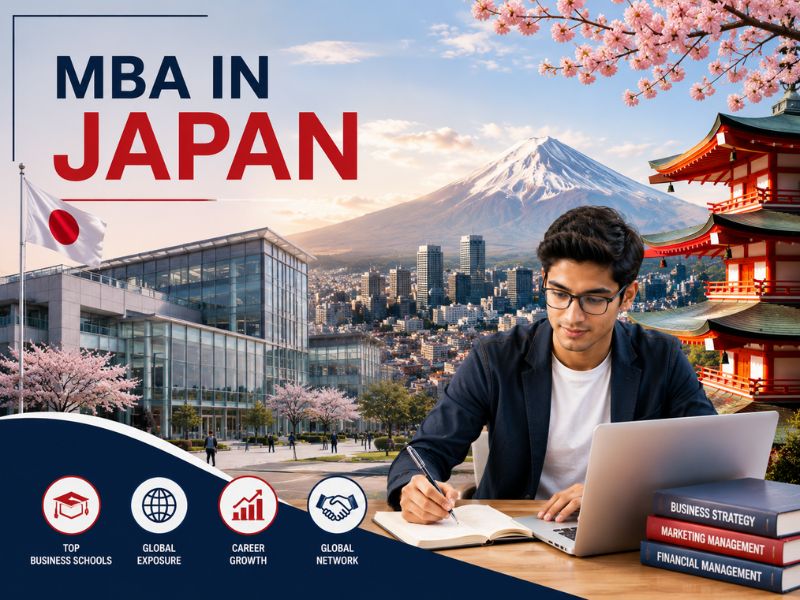
Table of Contents
MBA Colleges in Japan: Highlights 2026
Japan has quietly become a genuinely compelling MBA destination for Indian students, combining globally recognised programs with meaningfully lower tuition than Western alternatives. Universities like NUCB Business School and Hitotsubashi University stand out at the top position per QS Rankings for MBA programs globally 2026, alongside strong options like Waseda Business School, Doshisha University, International University of Japan (IUJ), and Ritsumeikan APU.
Most programs run for 1-2 years and are taught entirely in English, with tuition ranging from ¥1.8M-3.0M (roughly ₹12-20 lakh) annually — genuinely more affordable than comparable programs in the US or the UK. Over 1,300 Indian students are currently pursuing higher education in Japan, reflecting the country's growing appeal beyond its traditional engineering and technology reputation.
Why Choose MBA Colleges in Japan?
Considering Japan for your MBA? Here's why it makes strategic sense in 2026.
1. Genuinely more affordable than Western alternatives
Annual fees range between ¥1.8M-3.0M (₹12-20 lakh) — significantly more accessible than comparable programs in the US or UK, without sacrificing global recognition.
2. Strong industry connections in key growth sectors
Graduates benefit from strong industry connections in consulting, finance, and technology, with schools like NUCB offering unique access to Japan's manufacturing and automotive sectors through direct proximity to companies like Toyota, Brother, and Noritake.
3. GMAT flexibility across multiple schools
Japanese business schools are more holistic in admissions than their US counterparts — GLOBIS University doesn't require GMAT at all, while Hitotsubashi ICS and Waseda accept GMAT or GRE without a mandatory minimum score.
4. Genuinely strong post-MBA earning potential
Average salaries range from ¥9M-13M (₹55-80 lakh) annually, with some sources citing figures as high as ¥10M-15M for top performers in tech and global industries.
5. Meaningful post-study work and residency pathways
The Designated Activities visa allows graduates up to one year of job-hunting after graduation, and Japan's 2026 immigration reforms have expanded fast-track permanent residency options, with some qualifying for PR in as little as one year.
6. Growing demand for English-speaking business talent
The demand for English-speaking business professionals is growing rapidly in Japan, creating genuine opportunity for international graduates who might otherwise worry about the language barrier.
The bottom line: If you want a globally recognised, genuinely affordable MBA with real GMAT flexibility and a distinctive long-term career pathway into Japan's growing international business ecosystem, this destination offers a strategically compelling choice for 2026.
Eligibility Criteria for MBA Colleges in Japan
Before applying to MBA programs in Japan, make sure you meet the following eligibility requirements for 2026 admissions.
Academic qualification
- A completed bachelor's degree from a recognised institution, with a minimum GPA typically around 2.5 as a general baseline expectation
Work experience
- Most programs expect 2-5 years of professional work experience, though this requirement varies by school and program format.
Standardised test scores
- GMAT/GRE requirements vary significantly by school — GLOBIS University requires no GMAT at all, Hitotsubashi ICS and Waseda accept GMAT or GRE without mandating a minimum score, while Keio Business School treats GMAT/GRE as optional. An average GMAT score of 600 is generally considered good where submission is recommended, with one program's cohort average reported around 685.
English proficiency
- IELTS 6.5+ or TOEFL 80+ (internet-based) is generally recommended, though this requirement is typically waived if your earlier degree was taught in English
Application essentials
- Academic transcripts, 2-3 Letters of Recommendation from academic or professional referees, a Statement of Purpose/essays articulating career goals, and a detailed professional CV
Visa-specific documentation
- Most universities also require a Certificate of Eligibility for visa purposes, processed alongside your admission.
Our advice: Since GMAT policies vary so dramatically between schools — mandatory-ish at some, completely waived at GLOBIS — map your target schools' exact testing requirements early, and if your English-medium education already covers the proficiency requirement, you can save meaningful preparation time to focus on your SOP and interview instead.
Admission Process for MBA Colleges in Japan 2026
Here's a step-by-step breakdown of what the admission process looks like for 2026.
Step 1: Choose your program and target schools
Prioritise schools based on program specialisation, global rankings, and language of instruction — most competitive English-taught options include NUCB, Hitotsubashi ICS, Waseda, IUJ, and GLOBIS.
Step 2: Take the GMAT or GRE if required (or beneficial)
While optional at many schools, GMAT/GRE can strengthen your application even where not strictly mandatory — check your specific target school's stance before deciding whether to skip it.
Step 3: Secure English proficiency proof
Ensure proficiency in English through TOEFL/IELTS, and check whether your target school also expects some Japanese language ability, though most English-taught MBA programs don't require this for the coursework itself.
Step 4: Compile your application documents
Gather academic transcripts, a professional CV, and recommendation letters, then draft a compelling Statement of Purpose (SOP) or essays clearly articulating your career goals and motivation.
Step 5: Submit your application through the university's official portal
Fill out the application form, upload all required documents, and pay the application fee — note that schools like NUCB have multiple application windows (deadlines in October, December, and January for Spring/Fall 2026), while Doshisha Business School conducts seven application rounds from November to June.
Step 6: Prepare for and attend your interview
If shortlisted, prepare for an interview, which may be conducted online — this holistic evaluation component carries genuine weight in Japanese MBA admissions.
Step 7: Await your final admission decision
After completing the interview, wait for your official decision from the university.
Step 8: Begin visa preparation and accommodation arrangements
Once accepted, start preparing your visa application (including your Certificate of Eligibility) and accommodation arrangements well ahead of your intended start date.
Our advice: Since application windows differ dramatically by school — some with a single deadline, others with 7 rounds running November through June — start your process 6-12 months ahead, giving yourself enough time to prepare for entrance exams, gather documents, and process your visa without unnecessary time pressure.
GMAT, GRE & English Language Requirements
Here's what you need to know about standardised testing and English proficiency for MBA programs in Japan in 2026.
GMAT/GRE requirements genuinely vary by school
- GLOBIS University: No GMAT required at all, making it genuinely accessible for career changers
- Hitotsubashi ICS and Waseda: Accept GMAT or GRE but don't mandate a minimum score
- Keio Business School: Treats GMAT/GRE as an optional component
- Broader guidance: GMAT/GRE is often officially listed as "optional, but can strengthen the application" across many programs
What's a competitive score if you do submit one?
An average GMAT score of 600 is generally considered good for admission and scholarship consideration, though one competitive program's cohort average was reported around 685 — giving you a sense of the range depending on your target school's selectivity.
Alternative pathways to standardised testing
Some programs accept the JLPT (Japanese Language Proficiency Test) or a strong interview performance instead of standardised test scores — reflecting Japan's generally more holistic admissions approach compared to US-style programs.
English proficiency requirements
A minimum IELTS score of 6.5, or TOEFL 80 (internet-based)/550 (paper-based), is generally recommended for international students whose native language isn't English.
When can this be waived?
English proficiency testing is typically not needed if your earlier degree was taught in English — a genuine advantage for Indian applicants with English-medium undergraduate education.
Japanese language requirement
Since most MBA programs are taught entirely in English, Japanese language proficiency generally isn't a coursework requirement, though it can meaningfully ease daily life and broaden local job market access after graduation.
Our advice: Given how genuinely varied GMAT policy is across Japan's top schools — completely waived at GLOBIS, optional at Keio, no minimum threshold at Hitotsubashi/Waseda — don't assume you need a strong GMAT score to access Japan's best programs; instead, verify each target school's specific stance and invest your prep time accordingly.
Top MBA Colleges in Japan
Here's a rundown of Japan's leading MBA institutions worth considering for 2026.
1. NUCB Business School (Nagoya University of Commerce and Business)
The only business school in Japan holding all three major global accreditations at once — AACSB, AMBA, and EQUIS — a distinction shared by only a handful of schools worldwide, including London Business School. Teaches in the same case-study style Harvard Business School is known for, with offices in Japan's manufacturing hub, Nagoya.
2. Hitotsubashi University Business School (Hitotsubashi ICS)
Tokyo-based and top-ranked alongside NUCB per QS Rankings, offering a 1-year MBA option and accepting GMAT/GRE without mandating a minimum score.
3. Waseda Business School
A globally recognised Tokyo program with strong industry connections, accepting GMAT or GRE without a strict minimum threshold requirement.
4. International University of Japan (IUJ)
Located in Niigata, one of Japan's earliest English-taught MBA programs with a long track record of training international students.
5. GLOBIS University
Stands out for flexibility and strong startup ecosystem connections — founder Yoshito Hori is one of Japan's most prominent venture capitalists. No GMAT required at all, making it genuinely accessible for career changers, with generous scholarships that can significantly reduce its higher headline tuition.
6. Doshisha University (Kyoto)
A top research university offering a genuinely small-batch program (around 20 students a year), providing closer faculty access through a smaller alumni network than bigger programs like Waseda or NUCB.
7. Ritsumeikan APU (Asia Pacific University)
Known for exceptional student diversity, offering a genuinely international classroom environment.
8. Keio Business School
Treats GMAT/GRE as optional, offering a well-regarded, holistic-admissions MBA program.
Our advice: If Triple Crown accreditation and Harvard-style case teaching matter most, NUCB is the clear standout. If you want GMAT-free entry with strong startup connections, GLOBIS offers a genuinely distinctive alternative — match your school choice to your specific priorities rather than name recognition alone.
MBA Colleges in Japan: QS & Global Rankings 2026
Here's how Japan's top MBA programs currently stack up in global rankings for 2026.
Top-ranked position
As per QS Rankings 2026 for MBA, NUCB Business School and Hitotsubashi University Business School stand out in the top position among Japanese schools.
Broader QS presence
NUCB Business School, Hitotsubashi University, Waseda Business School, Doshisha University, International University of Japan, and Ritsumeikan APU are all considered top universities for MBA in Japan by the QS Rankings for MBA programs globally 2026.
Accreditation as a ranking-adjacent quality signal
NUCB's Triple Crown accreditation (AACSB + AMBA + EQUIS) places it in the same elite global accreditation tier as schools like London Business School — a distinction that matters as much as, or more than, headline ranking position when evaluating genuine program quality.
Our advice: Since Japan's MBA rankings landscape is less saturated with globally-tracked positions compared to the US or UK, cross-reference QS rankings with accreditation status (Triple Crown vs. single/dual accreditation) for a fuller picture of program quality across your shortlisted schools.
MBA Specialisations Offered by MBA Colleges in Japan
Japan's MBA programs offer genuinely distinctive specialisation strength, tailored to the country's economic backbone. Here's what's available in 2026.
1. General Management
The core offering across most programs, blending management fundamentals with electives focused on innovation, finance, and global strategy.
2. Innovation and Entrepreneurship
A genuine strength at schools like GLOBIS, given its founder's venture capital background and strong startup ecosystem connections.
3. Finance
Well-supported given Tokyo's status as a major Asian financial hub, with strong industry connections in consulting and finance more broadly.
4. Manufacturing and Operations Management
A distinctive NUCB strength, given its Chubu industrial region location providing unique access to Japan's manufacturing and automotive sectors through partnerships with companies like Toyota, Brother, and Noritake.
5. Global Strategy and International Business
Reflecting Japan's position as a bridge between Western and Asian business practices, this specialisation draws students specifically interested in cross-regional strategy.
6. Dual-Degree/International Partnership Tracks
Some programs, like certain 2-year formats, offer the option to earn a second degree from partner institutions like Nanyang Business School in Singapore or ESCP in Paris — a genuinely distinctive value-add for students wanting broader international exposure.
7. Case-Method Focused Programs
NUCB specifically uses the same case-study teaching style Harvard Business School is known for, appealing to students who prefer practical, discussion-based learning over pure lecture formats.
Our advice: If manufacturing, operations, or automotive industry connections matter to your career goals, NUCB's Chubu region location offers genuinely unique access. If entrepreneurship and startup ecosystem exposure matter more, GLOBIS's VC-founder background gives it a distinctive edge.
MBA Colleges in Japan: Fees Comparison
Understanding the fee landscape helps you budget realistically across Japan's top MBA programs for 2026.
Premium, dual-degree programs
- Program with Nanyang/ESCP dual-degree option: Approximately ₹24,15,000 total tuition, GMAT/GRE required, based in Tokyo
NUCB Business School
- Tuition around ¥2.7 million (approximately ₹15.4 lakh), with up to 80% of tuition waivable based on GMAT or GRE score — GMAT/GRE is required but can be waived if you have 8+ years of work experience, though submitting a score anyway usually unlocks better scholarship access.
GLOBIS University
- Higher headline tuition at approximately ¥5.8 million (₹33 lakh), though generous scholarships can reduce this significantly — no GMAT required for admission
Doshisha University (Kyoto)
- Tuition approximately ₹7,80,000 for the full program, with an average GMAT score in the cohort around 685, and an English test not needed if your earlier degree was taught in English.
Broader national average
MBA tuition fees in Japan typically range from JPY 1.5-4 million per year (approximately EUR 9,000-24,000), with annual fees more broadly cited as ¥1.8M-3.0M (₹12-20 lakh).
What genuinely varies fee outcomes
- Whether you submit GMAT/GRE scores (can unlock 80%+ scholarship waivers at schools like NUCB)
- Public vs. private university status
- Program format (1-year vs. 2-year, full-time vs. part-time)
Our advice: Even at schools where GMAT is technically waivable (like NUCB with 8+ years of experience), submitting a score anyway is genuinely worth the effort — it typically unlocks better scholarship access meaningfully, potentially covering up to 80% of your tuition.
Cost of Living for MBA Students in Japan
Here's a realistic breakdown of monthly living expenses across Japan's major student cities for 2026.
National comfortable budget benchmark
A comfortable monthly budget for an international student is approximately ¥150,000 (₹84,000), including modest rent in a non-central area — with the yearly cost of living (excluding tuition) for an Indian student typically running around ₹6.2 Lakhs (¥1.1 million).
City-by-city monthly breakdown
- Tokyo: ¥108,000-260,000 depending on lifestyle (various sources cite ¥108,000 as a baseline student estimate, up to ¥220,000-260,000 for a fuller single-resident budget), with student apartments alone ranging from ¥50,000-70,000
- Nagoya (NUCB): ¥82,000, roughly 25-30% cheaper than Tokyo (~₹52,000-64,000/month) — exchange students specifically report spending ¥60,000-90,000 excluding accommodation.
- Kyoto (Doshisha): ¥89,000, roughly 25% cheaper than Tokyo
- Sapporo: ¥93,000, offering relatively low costs especially for students
- Fukuoka, Sendai: Among the most affordable smaller cities, running materially cheaper across rent, groceries, and transport
Overall national range
For many foreign residents, total monthly cost of living in Japan ranges between ¥150,000-300,000 depending on lifestyle and location, with tuition-plus-living combined for an Indian student typically ranging from ¥820,000-1.64 million per year (approximately ₹5.8-11.6 lakhs).
Part-time work as a cost offset
International students on a College Student visa can apply for permission to work up to 28 hours/week during the semester and up to 40 hours/week during school breaks — at Tokyo's 2026 minimum wage (¥1,226/hr), 28 hours weekly works out to roughly ¥137,000/month gross, materially offsetting living costs.
Japan vs. Western destinations
Japan is materially cheaper than the US, UK, Canada, and Australia for healthcare, public transport, and basic dining — the US costs $10K-25K/year for these categories versus Japan's roughly $7K/year equivalent.
Our advice: If minimising costs matters, prioritise Nagoya (NUCB) or Kyoto (Doshisha) over Tokyo — the 25-30% cost difference compounds meaningfully over a 1-2 year program, and part-time work rights (up to 28 hrs/week) can further offset expenses regardless of which city you choose.
Scholarships for MBA Students in Japan
Good news for Indian students — Japan offers genuine, well-funded scholarship pathways for MBA and postgraduate applicants in 2026.
MEXT Scholarship (Monbukagakusho Scholarship)
Japan's flagship government scholarship, run by the Ministry of Education, Culture, Sports, Science and Technology, has funded over 140,000 international students since 1954. It fully covers tuition, provides a monthly living allowance, and pays for round-trip economy-class airfare — genuinely comprehensive support. Applications typically fall between February and May for the following year's intake, processed through either Embassy Recommendation (via your local Japanese embassy) or University Recommendation routes.
JASSO Scholarship
Provides a monthly stipend to help offset living costs, functioning as a complementary support option alongside tuition-focused funding.
University-specific scholarships
- NUCB Business School: Up to 80% of tuition can be waived based on GMAT or GRE score — submitting a strong score even where not strictly mandatory genuinely pays off here
- Hitotsubashi ICS: Scholarship recipients report an average GMAT score of 695, suggesting meaningful score-linked scholarship consideration
- GLOBIS University: Offers generous scholarships that can significantly reduce its comparatively higher headline tuition, even without requiring GMAT
Eligibility basics for MEXT specifically
Applicants need a CGPA equal to or higher than 2.30 out of 3.00 (calculated by MEXT's own formula), must be nationals of a country with diplomatic relations with Japan, and must be willing to newly enter Japan on a student visa for the scholarship period.
Our advice: Since scholarship deadlines (particularly MEXT's February-May window) run well ahead of most program start dates, begin your scholarship research immediately alongside your university shortlisting — and even at schools where GMAT is optional, submit a score anyway if you're hoping for meaningful tuition reduction, since this is consistently how the strongest waivers get unlocked.
MBA Colleges in Japan: Placements
Here's what employment outcomes genuinely look like after completing an MBA in Japan in 2026.
Strong overall placement rates
At Hitotsubashi ICS specifically, about 85% of self-funded graduates find jobs in Japan, earning between ¥3.6M-8M (₹19.4-43 Lakhs) annually — a genuinely strong outcome for a program costing a fraction of Western equivalents.
GLOBIS's standout placement speed
GLOBIS reports 85% of students finding jobs within three months of graduation, along with an average 58% salary bump after graduation — among the strongest reported outcomes across Japan's MBA landscape.
Strong corporate network infrastructure
Japanese MBA colleges maintain genuinely strong corporate networks that translate directly into placement and internship access — for example, Hitotsubashi ICS has links to companies like Mitsubishi UFJ and Toyota, Waseda works closely with SoftBank and Sony, and NUCB maintains exchange relationships with over 120 overseas partner schools, providing broad international exposure alongside domestic placement strength.
International student advantage in admissions
Japanese universities welcome international students with higher acceptance rates than domestic applicants at several programs, reflecting the country's active push to internationalise its business school talent pool.
Our advice: Since placement outcomes vary meaningfully by school (85% at Hitotsubashi ICS and GLOBIS specifically), request each target school's actual published employment report — including specific timeframes and salary ranges — rather than relying on general "strong placements in Japan" claims.
Top Recruiters Hiring MBA Graduates in Japan
Curious which companies actively hire MBA graduates from Japan's business schools? Here's a look at major employers for 2026.
Financial services
- Mitsubishi UFJ (direct Hitotsubashi ICS recruiting relationship)
Automotive and manufacturing
- Toyota (direct Hitotsubashi ICS relationship, also strong at NUCB given Nagoya's manufacturing hub location)
- Brother, Noritake (both connected to NUCB's Chubu industrial region presence)
Technology and telecommunications
- SoftBank (direct Waseda relationship)
- Sony (direct Waseda relationship)
International and multinational companies
Many international companies maintain offices in Japan, alongside national companies with their headquarters based domestically — creating genuine dual access to both Japanese conglomerates and Western multinationals operating in the country.
Sector-wide in-demand specialisations
Some of the most in-demand MBA specialisations tied to recruiter interest include finance, business analytics, technology management, marketing, IT, and international business.
Our advice: If you're specifically targeting a named employer (like Toyota, SoftBank, or Mitsubishi UFJ), prioritise the school with the direct, established recruiting relationship — these named partnerships genuinely matter more for landing specific-company roles than general "strong Japan placements" claims.
Average MBA Salary in Japan
Here's a realistic breakdown of what you can expect to earn after completing an MBA in Japan in 2026.
Overall average salary range
Average post-MBA salaries range from ¥9M-13M per year (₹55-80 Lakhs), especially strong in consulting, finance, and technology sectors — with some broader estimates citing figures reaching ¥10M-15M annually for tech and global industry roles.
Hitotsubashi ICS-specific outcomes
Self-funded graduates specifically report salaries between ¥3.6M-8M (₹19.4-43 Lakhs) annually — notably a wider, somewhat lower range than the broader national average, reflecting the diversity of roles graduates enter.
Top-tier field-specific outcomes
Some sources cite finance-related MBA specialisations earning average salaries reaching ¥19M-23M for top performers, reflecting genuine upside for graduates entering premium consulting or finance tracks.
GLOBIS-specific salary growth
Graduates see an average 58% salary bump after graduation — a genuinely meaningful jump reflecting career acceleration rather than just absolute salary level.
What influences your salary?
- Institute reputation and specific program strength
- Chosen specialisation (Finance and Technology Management typically command premium salaries)
- Prior work experience before pursuing the MBA
- Whether you learn Japanese, since this further expands career prospects, especially in multinational corporations
Our advice: Since salary ranges vary meaningfully across sources and schools (¥3.6M-8M at Hitotsubashi vs. broader ¥9M-13M national averages vs. ¥19M-23M for top finance roles), treat the ¥9M-13M range as your realistic planning benchmark, while recognising genuinely exceptional upside exists in premium finance and consulting tracks.
Post-Study Work Visa After MBA in Japan
Here's what your post-graduation work options look like after completing an MBA in Japan in 2026.
The Designated Activities visa
Graduates can remain in Japan to seek employment by changing their visa status from "Student" to "Designated Activities." This visa is typically valid for six months and can be extended once for a total stay of up to one year to continue the job-hunting process.
Converting to a work visa
Once employed, you can switch to a Work visa (Engineer/Specialist in Humanities/International Services) — the standard pathway for skilled foreign professionals working in Japan.
Genuine fast-track to permanent residency
Japan's 2026 immigration reforms have expanded the Highly Skilled Professional visa with faster permanent residency pathways — some qualifying for PR in as little as one year, a genuinely distinctive advantage compared to many other countries' 5-year standard timelines.
Part-time work during your studies
International students on a College Student visa can work up to 28 hours/week during the semester and up to 40 hours/week during designated school breaks — helping offset living costs while building local work experience even before graduation.
Growing demand context
The demand for English-speaking business professionals is growing rapidly in Japan, creating genuinely favourable conditions for international graduates navigating this post-study job search window.
Our advice: Since the Designated Activities visa gives you up to one year to find work, and Japan's Highly Skilled Professional visa can fast-track permanent residency to as little as one year post-employment, treat Japan as a genuinely strong long-term settlement option — not just a study destination — if career stability and residency matter to your decision.
Career Opportunities After MBA in Japan
Once you've completed your MBA in Japan, here's what your career path can genuinely look like in 2026.
Working within Japan's business ecosystem
Japan offers no shortage of opportunities to pursue a business career, especially in international business, with many international companies maintaining offices in Japan alongside strong national companies headquartered domestically.
Strong corporate network advantage
Direct school-employer relationships genuinely matter here — Hitotsubashi ICS connects to Mitsubishi UFJ and Toyota, Waseda works closely with SoftBank and Sony, and NUCB's Chubu region location gives graduates unique access to Japan's manufacturing and automotive sector employers.
High-demand specialisation areas
The most in-demand MBA specialisations currently include finance, business analytics, technology management, marketing, IT, and international business — reflecting Japan's genuine business strengths and where employer demand concentrates.
The Japanese language factor
Learning Japanese further expands career prospects, especially in multinational corporations — while many roles are accessible with English alone, genuine fluency meaningfully broadens your opportunity pool over time.
Career progression path
- 0-3 years: Analyst/Associate roles across consulting, finance, or technology management
- 3-6 years: Manager-level positions, often within multinational corporations' Japan operations
- 6-10 years: Senior Manager or Director roles, potentially across broader Asia-Pacific operations
- 10+ years: VP/Executive leadership, particularly valuable given Japan's position as a bridge between Western and Asian business practices
A genuinely distinctive value proposition
Beyond salary, MBAs in Japan open doors that are hard to open otherwise — a promotion from specialist to management track, genuine access to Japan's business culture and networks, and a realistic pathway to long-term residency through the country's expanding Highly Skilled Professional visa program.
Our advice: If your priority is a global career with no particular attachment to Japan itself, be honest that schools here (even NUCB with Triple Crown accreditation) don't carry the same brand recognition as European or American equivalents in New York or London — but if you're genuinely drawn to building a career within Japan's business environment long-term, few destinations offer better value.
MBA Colleges in Japan: ROI (Fees vs Salary)
Is your Japan MBA investment genuinely worth it? Let's break down realistic ROI for 2026.
Exceptional value tier (Hitotsubashi ICS)
At roughly ¥535,800 (₹3.25 Lakh) for the 1-year program, or ¥1,071,600 (₹6.5 Lakh) for the 2-year format, against self-funded graduate salaries of ¥3.6M-8M annually — this represents one of the most exceptional ROI equations in global MBA education. An MBA from Hitotsubashi at roughly $9,000 total could genuinely be considered a rounding error in career investment terms.
Strong mid-tier ROI (NUCB)
At approximately ¥2.7 million (₹15.4 Lakh) — with up to 80% waivable based on GMAT/GRE score — against Japan's broader ¥9M-13M average salary range and NUCB's unique manufacturing-sector access, this delivers genuinely strong value, especially for students who submit competitive test scores.
Premium tier ROI (GLOBIS, Waseda)
GLOBIS's higher tuition (~¥5.8M/₹33 Lakh) is offset by generous scholarships and an 85% employment rate within three months plus a 58% average salary bump — while Waseda (~¥3.37M-4.425M for 2-year programs including fees) offers strong ROI backed by direct relationships with SoftBank and Sony.
The honest overall calculation
₹40 Lakhs is generally sufficient to complete an MBA in Japan, covering both tuition (₹15-25 Lakhs) and living expenses (₹10-15 Lakhs) — a genuinely modest total investment relative to programs of comparable global standing elsewhere.
What genuinely affects your real-world ROI
- Whether you submit a GMAT/GRE score even where optional (unlocks significant scholarship value at schools like NUCB)
- Your specific specialisation (Finance and Technology Management typically outperform generalist tracks)
- Whether you learn Japanese, meaningfully broadening your long-term local opportunity pool
- Whether global brand portability or Japan-specific career depth matters more to your goals
Our advice: Hitotsubashi ICS's genuinely tiny tuition relative to its salary outcomes makes it arguably the strongest ROI story in global MBA education — but weigh this against its more limited international brand recognition if your career ambitions extend well beyond Japan itself.
Student Life in Japan for International Students
Beyond academics, here's what day-to-day student life genuinely looks like for Indian MBA students in Japan in 2026.
City-specific cost and lifestyle differences
- Tokyo: Japan's capital and most expensive city, with monthly costs around ¥108,000-260,000 depending on lifestyle, but offering the most sought-after program access, top universities, and highest salary opportunities
- Nagoya (NUCB): Roughly 25-30% cheaper than Tokyo, at approximately ¥60,000-90,000/month excluding accommodation, balancing modernity with tradition as a key industrial and cultural hub
- Kyoto (Doshisha): Roughly 25% cheaper than Tokyo, offering a harmonious blend of historical richness and contemporary student life with genuinely small, close-knit cohorts
- Sapporo, Fukuoka: Among the most affordable options, with Sapporo known for seasonal festivities and Fukuoka standing out for its welcoming community
Genuine international diversity
Waseda specifically admits the most international students of any Japanese university, with its student body representing over 100 different countries, and offers over 50 English-taught programs across 2,400 courses.
Cultural adjustment considerations
MBA students quickly learn that punctuality is a vital part of Japanese business culture — a cultural adjustment worth preparing for beyond just academics.
Part-time work as both income and integration
Working up to 28 hours/week during the semester (up to 40 during breaks) offers genuine financial relief while also providing meaningful early exposure to Japanese workplace culture and professional norms.
Housing options
University dormitories offer more affordable, community-oriented housing, though availability is limited and allocated first-come, first-served — furnished monthly apartments serve as a flexible alternative for newcomers who miss dormitory placement.
Our advice: Even in English-taught programs, invest time in basic conversational Japanese and understanding workplace punctuality norms early in your program — this genuinely eases both daily life and your eventual transition into Japan's distinctive professional culture.
Compare MBA Colleges in Japan
Comparing your top options side by side makes decision-making easier for 2026.
Best for exceptional ROI
Hitotsubashi ICS stands out decisively — genuinely minimal tuition (¥535,800-1,071,600) against strong salary outcomes and direct ties to Mitsubishi UFJ and Toyota, making it arguably the strongest value proposition in global MBA education.
Best for accreditation and manufacturing sector access
NUCB Business School is Japan's only Triple Crown-accredited school (AACSB + AMBA + EQUIS), with unique access to Toyota, Brother, and Noritake through its Chubu region location, plus up to 80% tuition waivers for strong GMAT/GRE performers.
Best for GMAT-free entry and startup connections
GLOBIS University requires no GMAT at all, offers the fastest reported placement outcomes (85% employed within 3 months, 58% average salary bump), backed by founder Yoshito Hori's genuine VC industry connections.
Best for international diversity and program flexibility
Waseda Business School admits students from over 100 countries with 50+ English-taught program options, backed by direct relationships with SoftBank and Sony.
Best for small-cohort, research-focused experience
Doshisha University (Kyoto) offers a genuinely intimate batch size (around 20 students annually) with close faculty access, though a smaller alumni network than larger programs.
Our advice: If pure ROI matters most, Hitotsubashi ICS is genuinely hard to beat. If Triple Crown accreditation and manufacturing-sector access matter more, NUCB offers the strongest credentialing story among Japan's options.
How to Choose the Best MBA College in Japan
With Japan's genuinely distinctive mix of ultra-affordable and premium options, here's a practical framework for making this decision in 2026.
Step 1: Define your career goals and target specialisation
Decide whether Finance, Technology Management, Manufacturing/Operations, or International Business aligns best with your career direction, then match this to each school's specific industry strength.
Step 2: Honestly assess whether Japan-specific or global career mobility matters more
If global brand portability is your primary concern, NUCB is your best option among Japanese schools; otherwise, be realistic that even accredited Japanese programs aren't household names in New York or London the way European or American equivalents are.
Step 3: Verify GMAT policy per school and decide your testing strategy
Since policies range from mandatory-with-waiver-options (NUCB) to fully optional (Hitotsubashi ICS, Keio) to not required at all (GLOBIS), decide whether submitting a strong score anyway makes sense for scholarship purposes.
Step 4: Calculate realistic total costs including scholarships
Factor in tuition, city-specific living costs, and actively research MEXT and university-specific scholarship eligibility — Hitotsubashi ICS's minimal base tuition combined with any scholarship support creates an exceptionally low-risk investment.
Step 5: Consider city-lifestyle fit and cost of living
Decide whether Tokyo's networking intensity and higher costs suit you better, or whether Nagoya (NUCB), Kyoto (Doshisha), or other regional cities offer lower expenses meaningfully while still providing strong program quality.
Step 6: Verify direct employer partnerships aligned with your career goals
If targeting specific companies (Toyota, SoftBank, Mitsubishi UFJ), prioritise the school with the established, named recruiting relationship.
Step 7: Think seriously about your long-term residency intentions
Given Japan's 2026 immigration reforms offering fast-track PR pathways, factor in whether long-term settlement in Japan is part of your career vision — this genuinely changes which trade-offs (brand recognition vs. local integration) matter most.
Step 8: Talk to current students or recent alumni
Reach out through LinkedIn or university alumni networks to get genuine, unfiltered insight into program quality and day-to-day student experience beyond official marketing materials.
Our advice: Create a simple scoring system weighing career goal alignment, realistic budget fit, and Japan-specific vs. global career intent most heavily — these three factors combined will determine both your genuine admission strategy and your actual long-term ROI for your 2026 Japan MBA journey.
Frequently Asked Questions (FAQs)
1. Is GMAT mandatory for MBA admission in Japan?
It varies significantly by school. GLOBIS University requires no GMAT at all, Hitotsubashi ICS and Waseda accept GMAT or GRE without mandating a minimum score, and NUCB allows waivers based on work experience — though submitting a score anyway often unlocks better scholarship access.
2. What is the total cost of an MBA in Japan?
Total costs range dramatically — from as low as ₹9,000 (approximately) at Hitotsubashi ICS's 1-year program, to ₹15-25 Lakhs in tuition at most mainstream programs, with total budgets (tuition + living) generally sufficient at around ₹40 Lakhs even at premium schools.
3. What is the average salary after an MBA in Japan?
Average salaries range from ¥9M-13M annually (₹55-80 Lakhs), with Hitotsubashi ICS graduates specifically reporting ¥3.6M-8M, and top finance-focused roles reaching ¥19M-23M for exceptional performers.
4. Can I work in Japan after completing my MBA?
Yes, graduates receive a Designated Activities visa valid for six months, extendable once for a total of one year of job-hunting, after which you can convert to a Work visa upon securing employment.
5. Are scholarships genuinely available for Indian students?
Yes, including the fully-funded MEXT Scholarship (tuition, living stipend, and airfare), JASSO monthly stipends, and university-specific scholarships that can waive up to 80% of tuition at schools like NUCB.
6. Do I need to know Japanese for an MBA in Japan?
No, most top MBA programs are taught entirely in English, though learning Japanese meaningfully expands your career prospects afterwards, particularly at multinational corporations.
7. Can I apply for Permanent Residency after my MBA in Japan?
Yes, and Japan's 2026 immigration reforms have expanded the Highly Skilled Professional visa with faster PR pathways — some qualifying for permanent residency in as little as one year of qualifying employment.
8. Which is the best MBA college in Japan?
NUCB and Hitotsubashi University top the QS Rankings 2026 for Japan, though "best" ultimately depends on your priorities — Hitotsubashi ICS for pure ROI, NUCB for accreditation and manufacturing access, GLOBIS for GMAT-free entry and startup connections.
Conclusion
Japan has genuinely emerged as one of the most distinctive and cost-effective MBA destinations for Indian students in 2026 — offering globally recognised, English-taught programs at tuition levels that make even premium Western alternatives look expensive by comparison. From Hitotsubashi ICS's remarkably strong ROI to NUCB's Triple Crown accreditation and manufacturing-sector access, and GLOBIS's GMAT-free entry with strong startup connections, Japan's business schools offer genuine variety to match different career priorities and budgets.