







MBA Colleges in Australia for Indian Students Fees, Admission, Eligibility, Scholarships & Career Scope

Table of Contents
MBA Colleges in Australia for Indian Students: Highlights 2026
Australia has cemented itself as a genuinely strong MBA destination for Indian students, combining world-class business schools with a straightforward path to post-study work rights and a culturally welcoming environment. Top-ranked Australian universities for MBA include the University of Melbourne, University of Sydney, UNSW, Macquarie University, University of Queensland, and RMIT University, with rankings drawn from sources like QS Global MBA Rankings 2026 and Shiksha Popularity Rankings.
Why Study MBA in Australia for Indian Students?
Considering Australia for your MBA specifically as an Indian applicant? Here's why it makes strategic sense in 2026.
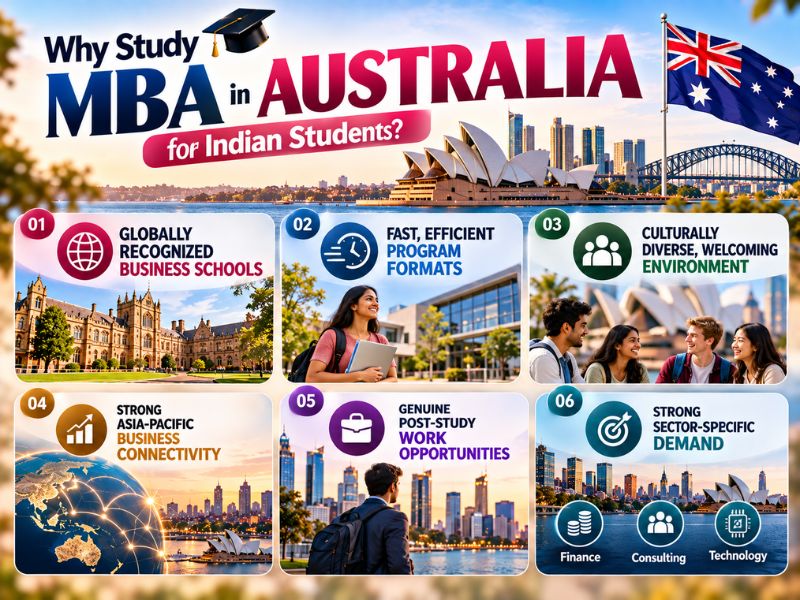
1. Globally recognised business schools with strong rankings
Australian universities featured in the QS Global MBA Rankings 2026 provide some of the best MBA programs acknowledged worldwide, giving your degree genuine international credibility.
2. Fast, efficient program formats
One-year full-time MBA options are available at institutions such as Melbourne Business School and UNSW's AGSM, meaningfully reducing your total opportunity cost compared to longer two-year formats.
3. Culturally diverse, welcoming environment for Indian students
International students experience a culturally diverse feel and are treated equally, with skills practised through program-based virtual projects and internships — genuinely easing the transition for Indian applicants given Australia's large, established Indian community.
4. Strong Asia-Pacific business connectivity
Good transport links to the Asia-Pacific region ensure strong relations with most industries, a genuine advantage for Indian students eyeing careers spanning both Asian and Western markets.
5. Genuine post-study work opportunities
Post-study work experience becomes possible given Australia's strong economy, offering graduates a real runway to build local career experience after completing their MBA.
6. Strong sector-specific demand
High demand for MBA graduates exists in sectors like finance, consulting, and technology, aligning well with common Indian applicant career goals.
The bottom line: If you want a globally respected MBA, a fast program format, and a genuine pathway to work experience in a stable, high-quality-of-life country, Australia offers a strategically compelling choice for Indian students in 2026.
Eligibility Criteria for MBA Colleges in Australia
Before applying to MBA programs in Australia, make sure you meet the following eligibility requirements for 2026 admissions.
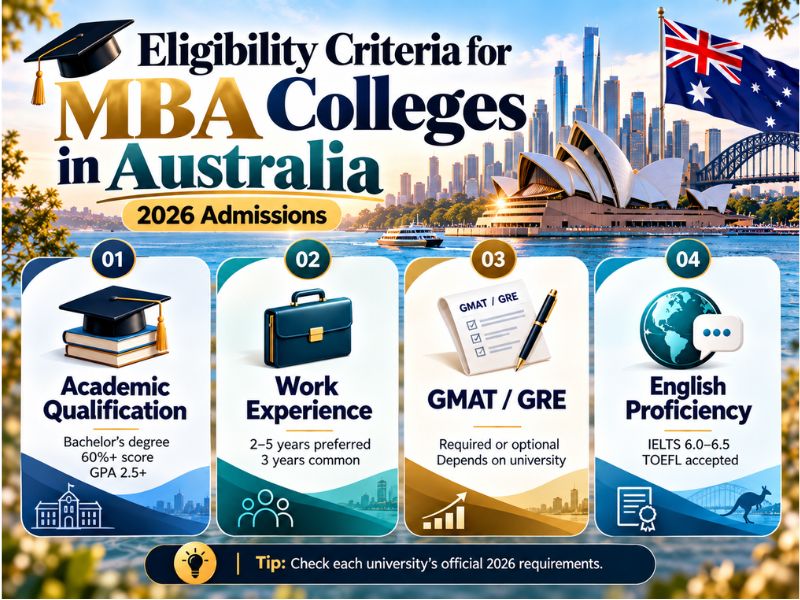
Academic qualification
- A bachelor's degree from a recognised university, with a minimum GPA of 2.5 or higher — specifically, a 10+2+3 degree from an accredited institution with a minimum score of 60% for many programs
Work experience
- Students must generally have at least 3 years of work experience to study an MBA in Australia, though the broader range cited is 2-5 years of work experience for international students. Work experience is not always mandatory but is preferred by many universities.
Standardised test scores
- A GMAT or GRE score is required at many institutions, though GMAT or GRE scores may be required, but not always. GMAT scores ranging from 550-600 are often cited as optional but recommended, while some programs specify a GMAT score of 600-680 as optional.
English proficiency
- International students must have a minimum IELTS Academic score of 6.5 bands at several top institutions, though some programs accept a minimum IELTS score of 6.0. TOEFL is also accepted as an alternative valid English proficiency test.
Our advice: Since GMAT requirements genuinely vary — mandatory at some schools, optional-but-recommended at others, and occasionally waivable entirely — verify each target university's specific policy early, and don't assume a strong academic record alone guarantees a GMAT exemption everywhere.
Admission Process for MBA Colleges in Australia 2026
Here's a step-by-step breakdown of what the admission process looks like for 2026.
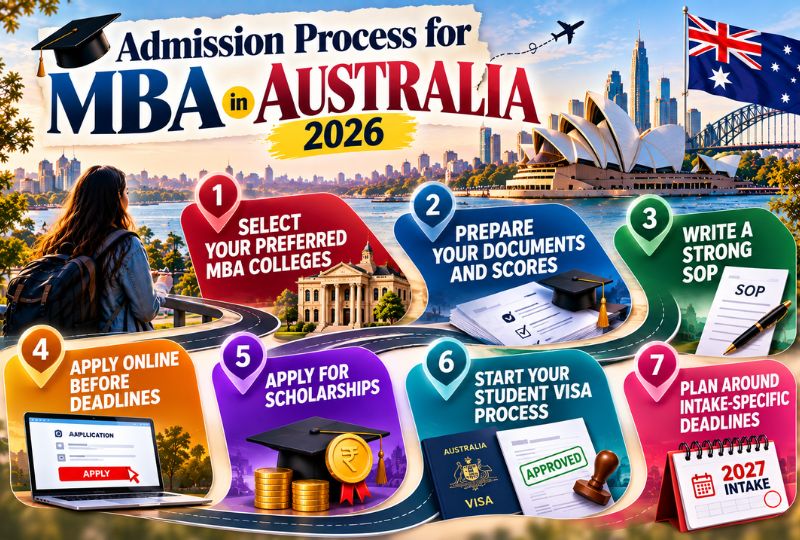
Step 1: Select your preferred MBA colleges
Choose your preferred MBA colleges in Australia based on course curriculum, location, and affordability.
Step 2: Prepare your academic documents and scores
Gather your academic documents and GMAT/GRE scores if required by your target institutions.
Step 3: Write a strong Statement of Purpose
Draft an SOP highlighting your career goals and specifically why you chose Australia for your MBA.
Step 4: Apply online before respective deadlines
Submit your application online to your chosen universities before their specific deadlines — note that Australian universities either have rolling admissions or fixed admission deadlines, so verify each institution's specific format.
Step 5: Apply for scholarships to reduce costs
Consider applying for scholarships available specifically for Indian students to help reduce your overall tuition burden.
Step 6: Start your student visa process after receiving your offer
Once you receive your Letter of Offer, begin your student visa process promptly.
Step 7: Plan around intake-specific deadlines
Application deadlines for the February 2027 intake close as early as October 2026 for offshore international students, allowing sufficient visa processing time — a useful benchmark for planning your 2026 application timeline for subsequent intakes.
Our advice: Start your application process at least 6 months in advance given the combination of document preparation, GMAT prep (where required), SOP drafting, and visa processing timelines — Australia's mix of rolling and fixed deadlines means early preparation genuinely protects your options.
Here's what you need to know about standardised testing and English proficiency for MBA programs in Australia in 2026.
GMAT, GRE, IELTS, PTE & TOEFL Requirements
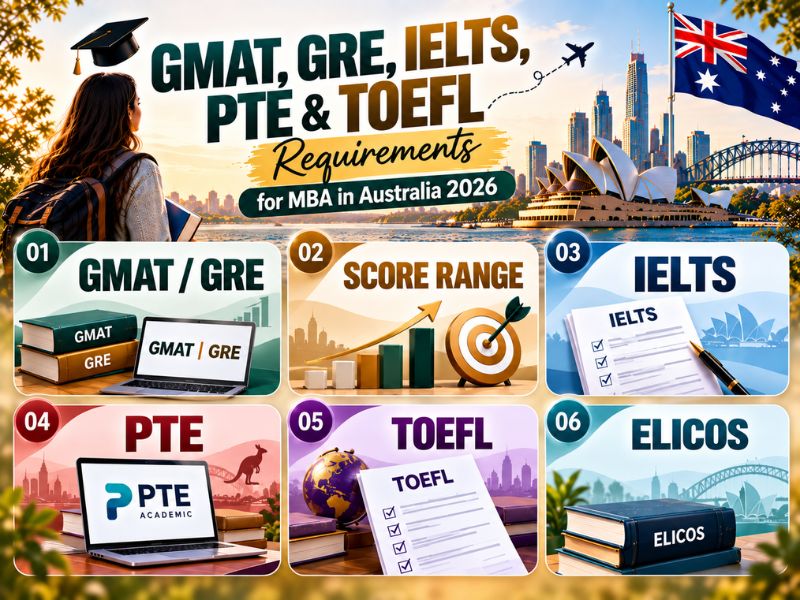
Here's what you need to know about standardised testing and English proficiency for MBA programs in Australia in 2026.
GMAT/GRE requirements genuinely vary by school
Most Australian universities and colleges accept GMAT scores for admission, though GMAT or GRE scores may be required, but not always — this remains genuinely institution-dependent rather than a fixed nationwide rule.
Typical competitive score ranges
GMAT scores ranging from 550-600 are commonly cited as optional but recommended, while some programs specify a GMAT score of 600-680, also treated as optional.
English proficiency — IELTS as the primary benchmark
Students must secure a good IELTS score to get an Australian visa, since students from non-native English-speaking countries must demonstrate English language proficiency for university admission. A minimum IELTS Academic score of 6.5 bands is required at several top institutions, though some programs accept a slightly lower 6.0 minimum.
PTE as a genuine alternative
PTE Academic is increasingly accepted across Australian universities as a faster-turnaround alternative to IELTS, with equivalent score bands generally mapped against IELTS requirements by each specific institution.
TOEFL acceptance
TOEFL is accepted as a valid alternative to IELTS across many Australian MBA programs.
ELICOS as a genuine pathway option
Students who need to prove English language proficiency to study at a university or vocational college, or who want to work, can pursue any course under ELICOS (English Language Intensive Courses for Overseas Students) — a useful bridge option if your current English test scores fall short of your target program's requirement.
Our advice: Since IELTS/PTE requirements genuinely vary between 6.0 and 6.5 (IELTS equivalent) depending on your target university, and this score also directly affects your visa eligibility (not just admission), aim for the higher benchmark where possible to keep both your university and visa applications comfortably covered.
Top MBA Colleges in Australia for Indian Students
Here's a rundown of Australia's leading MBA institutions genuinely well-suited to Indian applicants in 2026.
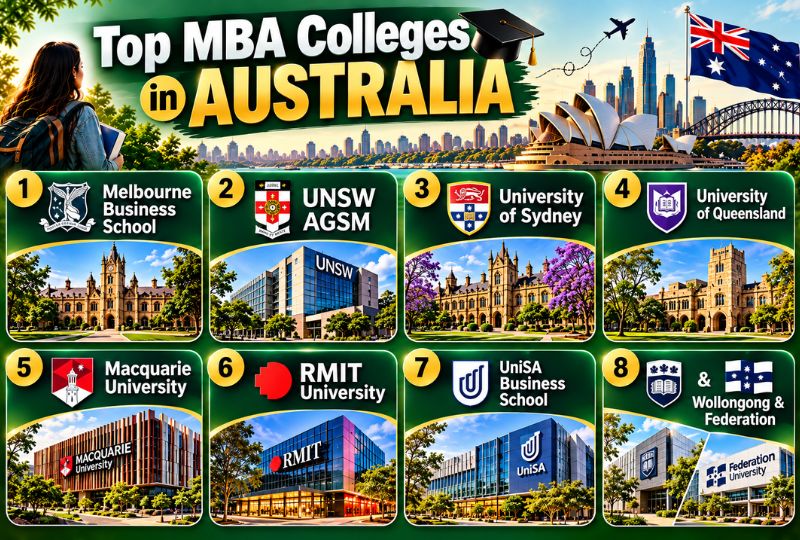
1. Melbourne Business School (University of Melbourne)
Australia's most prestigious MBA program, offering a fast one-year full-time format with strong global brand recognition — a genuine draw for Indian applicants targeting consulting and finance careers.
2. UNSW Business School's AGSM
A premier Sydney-based option with strong industry connections into Australia's financial hub, backed by a compact one-year MBA structure.
3. University of Sydney Business School
Offers strong global rankings alongside genuine scholarship support specifically for international students, easing the total cost burden for Indian applicants.
4. University of Queensland (UQ Business School)
A well-regarded, research-strong option in Brisbane, appealing to Indian students seeking a Triple Crown-accredited program outside the Sydney/Melbourne premium.
5. Macquarie University
Known for practical, industry-aligned coursework and genuine flexibility in program structure, popular among Indian students balancing part-time work with study.
6. RMIT University
A technology-and-innovation-focused business school in Melbourne, appealing to Indian applicants with engineering or IT backgrounds transitioning into management.
7. UniSA Business School
A genuinely affordable, AACSB-accredited option in Adelaide, offering strong value for Indian students prioritising budget without sacrificing quality.
8. University of Wollongong and Federation University
Among Australia's most budget-friendly MBA options, both maintaining solid accreditation while keeping total costs meaningfully lower than the Sydney/Melbourne premium tier.
Our advice: Indian applicants weighing prestige against budget should note that Australia's mid-tier and regional universities (UQ, UniSA, Wollongong) often deliver strong ROI without the AUD 90,000+ price tag of Melbourne Business School or AGSM — match your choice to your specific career goals and financial planning.
MBA Colleges in Australia: Rankings 2026
Here's how Australia's top MBA programs currently stack up for Indian applicants in 2026.
QS Global MBA Rankings 2026 presence
Several Australian business schools feature prominently, evaluated on Academic Reputation, Employer Reputation, Faculty/Student Ratio, and International Faculty Ratio — genuinely relevant metrics for Indian students weighing global degree recognition.
Shiksha Popularity Rankings
A useful supplementary source specifically tracking application trends and genuine interest among Indian students, offering an India-specific lens beyond global academic rankings alone.
Consistent top performers
The University of Melbourne, University of Sydney, UNSW, Macquarie University, University of Queensland, and RMIT University consistently rank among Australia's strongest MBA programs across multiple ranking methodologies.
Fee-tier alignment with ranking position
Top-ranked programs (Melbourne Business School, UNSW's AGSM, University of Sydney) also carry the highest fees, while mid-tier ranked universities cost meaningfully less, and accessible institutions (Federation University, Victoria University, UniSA) fall at the most affordable end.
Our advice: For Indian applicants, cross-reference QS rankings with Shiksha's popularity data specifically — a program popular among Indian students often signals stronger peer networks, alumni support, and community familiarity, which can matter as much as raw academic ranking for your experience.
MBA Specialisations Offered in Australia
Here's what specialisation options genuinely resonate with Indian applicants' career backgrounds in 2026.

1. Finance
Strong given Sydney's status as Australia's financial hub — particularly relevant for Indian applicants with prior banking or financial services experience.
2. Technology Management
Well-supported at RMIT and other innovation-focused schools, genuinely aligned with common Indian applicant backgrounds in engineering and IT.
3. Marketing
Widely offered across nearly every Australian business school, providing strong branding and strategic marketing foundations.
4. Entrepreneurship
Popular given Australia's active startup ecosystem, appealing to Indian applicants with entrepreneurial ambitions or startup experience.
5. Healthcare Management
An increasingly in-demand specialisation reflecting Australia's robust healthcare industry and genuine skills shortage in this sector.
6. International Business
Well-suited to Australia's strong Asia-Pacific trade connections, appealing to Indian applicants interested in cross-border business strategy spanning both regions.
Our advice: Indian applicants from technical or engineering backgrounds often find Technology Management or International Business specialisations deliver stronger ROI than generic tracks, since they build directly on existing skills while adding genuine business leadership training.
MBA Fees in Australia for Indian Students
Here's a realistic fee breakdown specifically for Indian applicants planning their 2026 MBA budget.
Top-tier programs
Melbourne Business School, UNSW's AGSM, and the University of Sydney typically cost AUD 90,000-125,000 (₹61-85 Lakhs) for the complete program.
Mid-tier programs
Most mid-tier Australian MBA universities charge around AUD 55,000-85,000 (₹37-58 Lakhs), depending on program structure and city.
Affordable options for Indian students
Federation University, Victoria University, and UniSA Business School offer tuition starting from AUD 30,000-39,000 (₹20-27 Lakhs) — genuinely accessible for Indian families weighing education loan capacity.
Total program cost including living expenses
The complete cost — tuition, living expenses, health insurance (OSHC), and visa costs — ranges from AUD 75,000 to AUD 1,65,000 (₹51 Lakhs-1.12 Crore) depending on your chosen tier and city.
Currency planning for Indian families
Since fees are quoted in AUD, factor in currency exchange fluctuations when planning your education loan — even modest INR-AUD rate shifts can meaningfully affect your actual rupee outlay over a 1-2 year program.
Our advice: Indian applicants should specifically compare total cost (not just tuition) across Sydney/Melbourne versus Adelaide/Brisbane-based programs — the living cost difference between these city tiers can offset a significant portion of any tuition savings, so calculate both together before deciding.
Cost of Living in Australia for Indian Students
Here's a realistic breakdown of monthly living expenses for Indian students across Australia's major MBA cities in 2026.
National visa minimum benchmark
Australia's Department of Home Affairs requires student visa (subclass 500) applicants to demonstrate proof of at least AUD 29,710 per year (roughly AUD 2,475/month) in living expense funds before visa approval.
Overall national range
Living costs range from AUD 1,500 to AUD 3,500 per month, covering accommodation, food, transport, OSHC health insurance, and personal expenses.
City-by-city breakdown
- Sydney: AUD 1,800-3,500/month — among the most expensive, though shared accommodation in outer suburbs can bring this down meaningfully
- Melbourne: AUD 1,340-2,780/month
- Brisbane, Adelaide, Perth: Generally more affordable, typically AUD 1,500-1,700/month
Food and cultural familiarity for Indian students
Major Australian cities — particularly Sydney, Melbourne, and Brisbane — have large, established Indian communities with genuine access to Indian groceries, restaurants, and cultural events, easing daily adjustment significantly.
Part-time work as a cost offset
International students can work up to 24 hours per week while studying, with no work limit for Master's research or doctoral degree students — a meaningful way for Indian students to offset living expenses during their MBA.
Our advice: If minimising costs matters, prioritise Adelaide, Perth, or Brisbane over Sydney/Melbourne — the living cost difference compounds significantly over your program duration, and combined with part-time work rights and Australia's large Indian community, can substantially ease your budget and adjustment for 2026.
Scholarships for MBA in Australia for Indian Students
Good news for Indian applicants — Australia offers genuinely diverse scholarship pathways for MBA students in 2026, spanning government, university, and independent funding.
University-specific scholarships
The ANU MBA scholarship can cover up to 100% of tuition fees, applicable whether you're joining full-time or balancing work and studies part-time, while Melbourne Business School has rolled out a range of scholarships to help students focus on their studies rather than financial stress. Top institutions like the University of Melbourne, University of Sydney, and UNSW all offer various scholarships specifically targeting ambitious international students.
Government support
The Australian government provides strong support through scholarships and welfare services for international students.
India-specific scholarship options
The Higher Education Scholarship Test for Indian Students (HEST) offers partial funding for Indian nationals pursuing any course except Medicine/MBBS, with the 2026 application deadline set at 20 August 2026. The Nehru Study Abroad Scholarship (NSAS) similarly offers partial funding for Indian nationals across any discipline, applicable to any university globally, with the same 20 August 2026 deadline.
Scale of Indian interest in Australia
Australia recorded over 64,000 student visa applications from Indian students in 2023 alone, reflecting genuinely strong and growing demand that has pushed universities to expand scholarship offerings specifically for this applicant pool.
Our advice: Since scholarship competition is genuinely high given Australia's popularity among Indian applicants, apply to multiple scholarship types simultaneously — university-specific awards alongside broader options like HEST and NSAS — rather than relying on a single source, and build your profile (academics, essays, extracurriculars) to stand out given the competitive applicant pool.
MBA Colleges in Australia: Placements
Here's what employment outcomes genuinely look like after completing an MBA in Australia in 2026.
Strong overall employment rate
Over 91% of MBA graduates in Australia secure full-time jobs and get a handsome amount, reflecting genuinely strong placement infrastructure across the country's top business schools.
What drives strong placement outcomes
University career services teams support job placements, internships, and career coaching, while strong alumni networks provide meaningful reach for graduates entering the job market. University career teams, mentorship, and internships drive high job placement rates for graduates, with graduates entering industries spanning consulting, finance, technology, health, and government.
Career trajectory after graduation
MBAs routinely move into roles with immediate responsibility and growth potential, given strong demand for leadership talent across Australia's business ecosystem.
Intake timing affects placement outcomes.
The intake that corresponds with Australia's hiring and internship season has the best placement rate, making your choice of intake genuinely relevant to your eventual job search timeline, not just your academic start date.
Our advice: Since career services quality and alumni network strength genuinely drive placement outcomes more than program prestige alone, specifically evaluate each shortlisted school's career support infrastructure and alumni reach before committing — and consider timing your intake to align with Australia's peak hiring season for stronger placement odds.
Top Recruiters Hiring MBA Graduates in Australia

Curious which companies actively hire MBA graduates from Australia's business schools? Here's a look at major employers for 2026.
Consulting firms
- BCG (Boston Consulting Group)
Technology companies
- Microsoft, Amazon Web Services (AWS), Google Australia
Financial services
- Macquarie Group
- JP Morgan, Barclays
FMCG and consumer companies
- Johnson & Johnson, Coca-Cola Europacific Partners, Nestlé, Unilever
Mining and resources
- BHP
Telecommunications and retail
- Telstra, Woolworths
Sector breadth
Graduates enter industries from consulting and finance to technology, health, and government, reflecting genuinely broad employer demand across Australia's diverse economy rather than concentration in just one sector.
Our advice: Given the genuine breadth of recruiters — spanning consulting, tech, finance, FMCG, and mining — research which specific companies actively recruit from your shortlisted business school's campus, since not every recruiter visits every university equally, and this data point matters more than the general "top recruiters in Australia" list alone.
Average Salary After MBA in Australia
Here's a realistic breakdown of what you can expect to earn after completing an MBA in Australia in 2026.
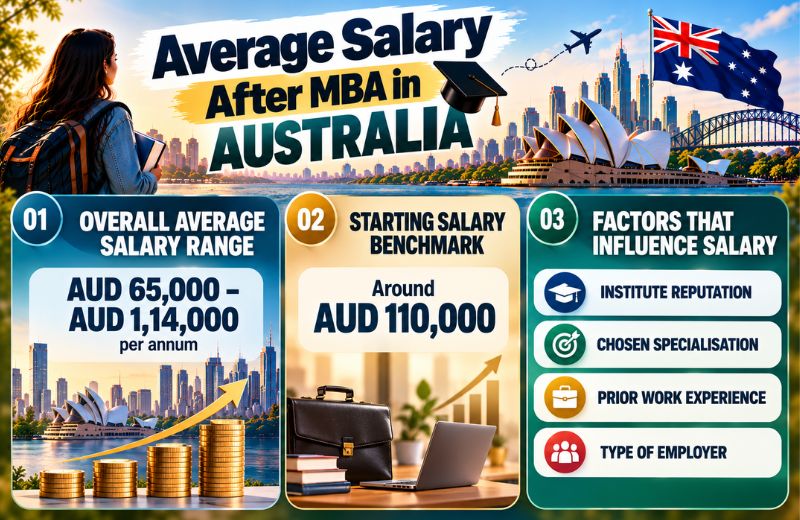
Overall average salary range
The average salary of an MBA graduate in Australia ranges between AUD 65,000 and AUD 1,14,000 per annum, though other sources cite graduates earning between AUD 100,000-130,000 annually (₹55-71 Lakhs) depending on job roles and industries.
Starting salary benchmark
Average starting salaries hover around AUD 110,000, with packages for experienced professionals or specialists reaching AUD 145,000-200,000, particularly in fields like analytics, product management, and consulting.
What influences your salary?
- Institute reputation and specific program strength
- Chosen specialisation (analytics, product management, and consulting typically command premium salaries)
- Prior work experience before pursuing the MBA
- Whether you land roles at named premium employers (JP Morgan, BCG) vs. broader industry positions
Salary range reconciliation
Since figures genuinely vary across sources — from a broader AUD 65,000-114,000 range to a narrower, higher AUD 100,000-200,000 range for specialized/experienced roles — treat AUD 100,000-130,000 as a realistic mid-range planning benchmark, with genuine upside for specialised, high-demand roles.
Our advice: Since salary outcomes vary meaningfully by specialisation and role type, prioritise researching your specific target school's salary report broken down by function (consulting vs. general management vs. analytics) rather than relying on a single blended "average MBA salary" figure for your 2026 planning.
Australia Student Visa Requirements for Indian Students
Here's what Indian students need to prepare for their Australia student visa application in 2026.
Visa type
Indian students pursuing an MBA in Australia apply for the Subclass 500 Student Visa.
Application fee
The Subclass 500 Student Visa application fee, or Base Application Charge, is AUD 2,000.
Financial capacity requirement
International students should be prepared to spend between AUD 90,000 and AUD 145,000 annually to cover living expenses and tuition fees for a full-time, high-cost, one-year program, with annual expenditure potentially lower in the second year of a two-year MBA after the major tuition payment is made.
Application process overview
Once your admission is confirmed, applying for the Subclass 500 Student Visa is the next step, functioning as your legal permit to study in Australia.
English proficiency and financial documentation
Beyond the core visa application, you'll need proof of English proficiency (IELTS/PTE/TOEFL scores), evidence of sufficient funds to cover tuition and living costs, health insurance (OSHC), and your university's Confirmation of Enrolment (CoE).
Post-study work visa pathway (separate from the student visa)
If you want to work in Australia after completing your degree, you'll need a Temporary Graduate visa (subclass 485), and to be eligible, you must have applied to a 2-year full-time MBA program — a genuinely important distinction, since a 1-year MBA may not automatically qualify you for this post-study work pathway. The post-study work visa allows graduates to stay in Australia for up to three years, supporting job search efforts and offering pathways to permanent residency. Some sources cite the Subclass 500 visa itself allowing MBA graduates to work in the country for at least 4 years, though this figure appears to reflect a combined study-plus-work-rights context rather than the standalone post-study visa duration — always verify current, exact durations directly with official Australian immigration sources given how frequently these policies can shift.
Special provision for Indian students specifically
Under the Australia-India Economic Cooperation and Trade Agreement (AI-ECTA), the Department of Foreign Affairs and Trade (DFAT) states that Indian students completing their Master's in Australia, whether by research or coursework, enjoy a stay-back period of 3 years — a genuinely valuable, India-specific bilateral benefit worth confirming applies to your specific MBA program.
Post-Study Work Visa After MBA in Australia
Here's what your post-graduation work options genuinely look like after completing an MBA in Australia in 2026.
The Temporary Graduate Visa (Subclass 485)
If you want to work in Australia after completing your degree, you'll need a Temporary Graduate Visa (subclass 485), and to be eligible, you must have applied to a 2-year full-time MBA program — a genuinely important eligibility trigger tied specifically to program length, not just graduation itself.
Duration of stay
The post-study work visa allows graduates to stay in Australia for up to three years, supporting job search efforts and offering pathways to permanent residency.
Genuine work flexibility during this period
Once on the subclass 485 visa, graduates can work full-time in any role, switch employers freely, and use this window to build local Australian work experience before pursuing longer-term residency options.
Special provision for Indian students specifically
Under the Australia-India Economic Cooperation and Trade Agreement (AI-ECTA), Indian students completing their Masters in Australia by both Research and Coursework enjoy a stay-back period of 3 years — a genuinely valuable bilateral benefit specifically negotiated for Indian applicants.
The 1-year vs. 2-year MBA distinction matters here
Since post-study work visa eligibility is specifically tied to 2-year full-time programs, students choosing the popular 1-year MBA format (offered at schools like Melbourne Business School and AGSM) should verify exactly how this affects their post-study work rights — this is genuinely one of the most important practical decisions in your program selection.
Our advice: If long-term work experience in Australia is central to your career plan, prioritise confirming your specific program's length against subclass 485 eligibility requirements before enrolling — choosing between a faster 1-year MBA and a 2-year program that unlocks post-study work rights is a genuine trade-off worth weighing carefully for 2026.
Career Opportunities After MBA in Australia
Once you've completed your MBA in Australia, here's what your career path can genuinely look like in 2026.

Strong overall employability
MBA graduates from Australia's leading universities are consistently among the most employable, entering industries from consulting and finance to technology, health, and government.
Direct access to major global employers
Companies like JP Morgan, Woolworths, Barclays, and Telstra offer attractive packages and career progression opportunities to Australian MBA graduates, alongside tech giants like Microsoft, AWS, and Google Australia, and consulting firms like BCG.
Career progression path
- 0-3 years: Analyst/Associate roles across consulting, finance, or technology management
- 3-6 years: Manager-level positions, often within multinational corporations' Australia-Pacific operations
- 6-10 years: Senior Manager or Director roles, potentially across broader Asia-Pacific operations
- 10+ years: VP/Executive leadership, particularly valuable given Australia's strategic position bridging Western and Asian business practices
Strong demand for leadership talent
With strong demand for leadership talent, MBAs routinely move into roles with immediate responsibility and growth potential — genuinely faster career acceleration compared to entry-level hires without postgraduate management training.
A genuinely distinctive value proposition
Beyond salary, an Australian MBA opens doors to a stable, high-quality-of-life country with a straightforward path to permanent residency through the post-study work visa pathway, combined with genuine Asia-Pacific business connectivity valuable for careers spanning both Eastern and Western markets.
Our advice: If your priority is a global career with genuine long-term settlement potential, Australia's combination of strong employer access, the subclass 485 post-study visa, and PR pathways makes it a genuinely compelling choice — but weigh this against your specific program's length, since 2-year programs unlock stronger post-study work rights than the popular 1-year format.
ROI of MBA Colleges in Australia (Fees vs Salary)
Is your Australia MBA investment genuinely worth it? Let's break down realistic ROI for 2026.
Top-tier program ROI (Melbourne Business School, UNSW AGSM)
At AUD 90,000-125,000 total tuition, against average starting salaries of AUD 110,000 (with specialised roles reaching AUD 145,000-200,000), strong performers can recover their investment within 1-2 years of working — a genuinely fast payback period given the premium price tag.
Mid-tier program ROI
At AUD 55,000-85,000 tuition against solid salary outcomes in the AUD 100,000-130,000 range, these programs offer meaningfully balanced ROI without the premium fees of Melbourne Business School or AGSM.
Budget-friendly program ROI (Federation University, Victoria University, UniSA)
At AUD 30,000-39,000 tuition, these programs offer some of the strongest ROI in the country — especially notable given many students recover their MBA investment within 2-4 years even at premium tuition levels, meaning budget-tier programs recover investment considerably faster.
Scholarship-adjusted ROI
For students who secure scholarships like ANU's up to 100% tuition coverage, or partial funding through HEST/NSAS, your effective investment drops meaningfully, further improving already-strong ROI outcomes.
What genuinely affects your real-world ROI
- Your specific specialisation (analytics, product management, and consulting typically outperform generalist tracks)
- Whether you secure scholarship support
- Program length (1-year vs. 2-year) and its effect on post-study work visa eligibility
- Whether you remain in Australia, move elsewhere, or return to India
The honest overall calculation
Total program investment (tuition plus living expenses) ranges from AUD 75,000-165,000 depending on tier, against average salaries of AUD 100,000-130,000 — with over 91% of graduates securing full-time employment, this represents genuinely strong odds of a positive ROI outcome across most program tiers.
Our advice: Don't automatically assume the most expensive school delivers the best ROI — budget-friendly, accredited options like UniSA or Federation University can deliver comparable long-term career value at a meaningfully lower upfront investment, especially when combined with scholarship support.
Compare the Best MBA Colleges in Australia
Comparing your top options side by side makes decision-making easier for 2026.
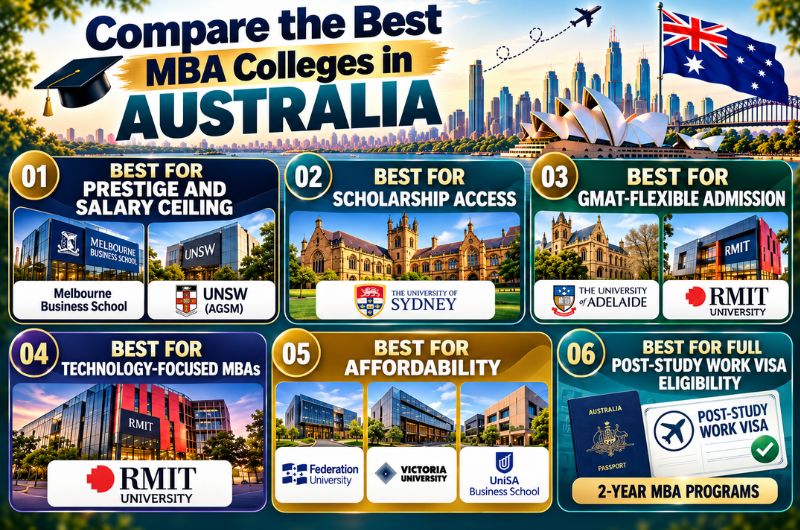
Best for absolute prestige and salary ceiling
Melbourne Business School and UNSW's AGSM lead decisively — strongest global brand recognition, direct access to top-tier recruiters like BCG and JP Morgan, though at the highest tuition tier (AUD 90,000-125,000).
Best for scholarship access alongside strong ranking
University of Sydney offers strong global rankings combined with genuine scholarship support specifically for international students, easing the total cost burden.
Best for GMAT-flexible admission
University of Adelaide and RMIT University specifically waive GMAT scores for MBA admission, making them genuinely accessible options for strong candidates without competitive standardised test scores.
Best for technology-focused MBAs
RMIT University stands out for students interested in technology management, given its innovation-focused curriculum and Melbourne tech ecosystem connections.
Best for absolute affordability
Federation University, Victoria University, and UniSA Business School offer the lowest tuition (AUD 30,000-39,000) while maintaining solid accreditation.
Best for full post-study work visa eligibility
Any 2-year full-time MBA program genuinely stands out here, since this length specifically unlocks subclass 485 post-study work visa eligibility — verify this against your shortlisted 1-year programs before assuming automatic eligibility.
Our advice: If pure prestige and salary ceiling matter most, Melbourne Business School or AGSM remain the clear top choices. If GMAT flexibility or budget matters more, Adelaide, RMIT, UniSA, or Federation University offer genuinely strong, more accessible alternatives.
How to Choose the Best MBA College in Australia
With Australia's mix of premium and accessible options, here's a practical framework for making this decision in 2026.
Step 1: Define your career goals and target specialisation
Decide whether Finance, Technology Management, Marketing, Entrepreneurship, Healthcare Management, or International Business aligns best with your career direction, then match this to each school's specific industry strength.
Step 2: Decide between a 1-year and 2-year program based on post-study work priorities
If long-term Australian work experience matters to your career plan, prioritise 2-year programs that unlock subclass 485 eligibility over the faster but visa-limited 1-year format.
Step 3: Honestly assess your budget against program tiers
Elite programs (Melbourne Business School, AGSM) run AUD 90,000-125,000, while accessible options (UniSA, Federation University) run AUD 30,000-39,000 — be realistic about which tier genuinely fits your financial planning, including education loan capacity.
Step 4: Verify GMAT requirements per school
Since policies range from mandatory-but-flexible to fully waived (Adelaide, RMIT), match your target schools to your actual test-prep readiness and timeline.
Step 5: Calculate realistic total costs including scholarships
Factor in tuition, city-specific living costs, and actively research ANU, Melbourne Business School, HEST, and NSAS scholarship eligibility before finalising your budget.
Step 6: Consider city-lifestyle fit and cost of living
Decide whether Sydney/Melbourne's networking intensity and higher costs suit you better, or whether Adelaide, Perth, or Brisbane offer lower expenses meaningfully while still providing strong program quality.
Step 7: Verify career services and alumni network strength
Since these factors genuinely drive the 91%+ employment rate more than program prestige alone, specifically evaluate each school's career support infrastructure before committing.
Step 8: Talk to current students or recent Indian alumni
Reach out through LinkedIn or university alumni networks to get genuine, unfiltered insight into program quality and day-to-day student experience from an Indian applicant's perspective.
Our advice: Create a simple scoring system weighing career goal alignment, post-study work visa eligibility (1-year vs. 2-year), and realistic budget fit most heavily — these three factors combined will determine both your genuine admission strategy and your actual long-term ROI for your 2026 Australia MBA journey.
Frequently Asked Questions (FAQs)
1. Is GMAT mandatory for MBA admission in Australia?
It varies by school. Some universities, such as the University of Adelaide and RMIT University, waive GMAT scores entirely, while others treat GMAT/GRE as optional but recommended, typically in the 550-680 range.
2. What is the total cost of an MBA in Australia for Indian students?
Total costs range from AUD 75,000 to AUD 1,65,000 (₹51 Lakhs-1.12 Crore) including tuition, living expenses, health insurance, and visa costs, depending on your chosen program tier and city.
3. What is the average salary after an MBA in Australia?
Average starting salaries hover around AUD 110,000, with specialised or experienced professional packages reaching AUD 145,000-200,000, particularly in analytics, product management, and consulting.
4. Can I work in Australia after completing my MBA?
Yes, through the Temporary Graduate Visa (subclass 485), which allows up to three years of stay — though eligibility specifically requires a 2-year full-time MBA program rather than the popular 1-year format.
5. Are scholarships genuinely available for Indian students?
Yes, including university-specific awards like ANU's up to 100% tuition coverage and Melbourne Business School's scholarship range, alongside India-specific options like HEST and NSAS offering partial funding.
6. Which is the best MBA college in Australia?
Melbourne Business School and UNSW's AGSM lead on prestige and salary outcomes, though "best" ultimately depends on your priorities — GMAT-free options like Adelaide and RMIT, or budget-friendly choices like UniSA and Federation University, may suit different applicant profiles better.
7. What is the employment rate for MBA graduates in Australia?
Over 91% of MBA graduates in Australia secure full-time jobs, reflecting genuinely strong placement infrastructure supported by university career services and alumni networks.
8. Do Indian students get any special visa benefits in Australia?
Yes, under the Australia-India Economic Cooperation and Trade Agreement (AI-ECTA), Indian students completing their Master's in Australia enjoy a stay-back period of 3 years — a genuinely valuable, India-specific bilateral provision.
Conclusion
Australia offers Indian students a genuinely compelling MBA proposition for 2026 — combining globally recognised business schools, strong employment outcomes (91%+ placement rate), and a clear, if program-length-dependent, pathway to post-study work rights and permanent residency. From Melbourne Business School's premium prestige to UniSA and Federation University's genuinely accessible entry points, Australia's MBA landscape offers real variety to match different career ambitions and budgets.