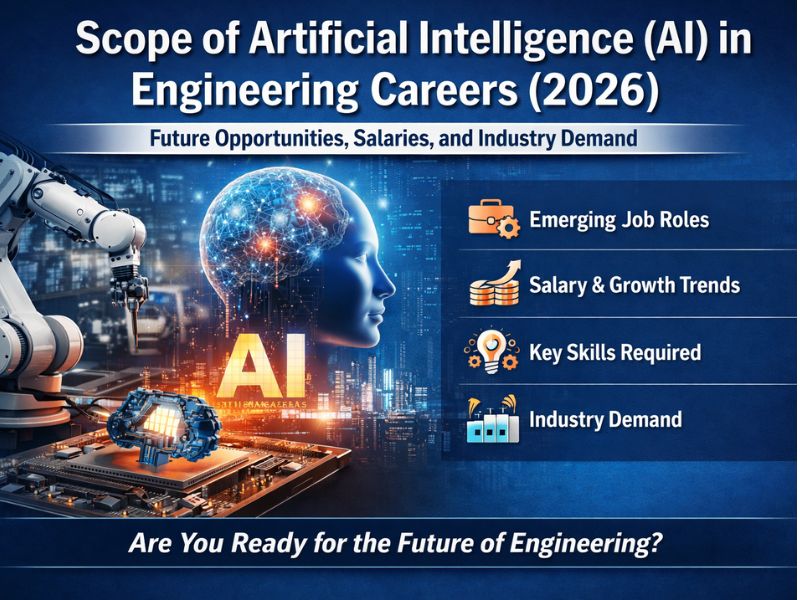
Artificial Intelligence is no longer a futuristic concept — it is reshaping engineering careers in real time. This blog is for engineering students, graduates, and professionals who want to understand the real scope of AI in 2026 and beyond, not just trends but actual career pathways and earning potential.
By the end of this guide, you will clearly understand where AI fits into engineering disciplines, what skills are required, and how to position yourself for long-term growth.
What Artificial Intelligence Means for Engineers in 2026
Why AI is Becoming Core to Every Engineering Discipline
Top Engineering Branches Impacted by AI
AI Job Roles Engineers Can Target in 2026
Salary Trends & Career Growth in AI Engineering
Skills Required to Build a Career in AI
AI in Core Engineering Sectors (Mechanical, Civil, Electrical, Computer Science)
The days of manual, repetitive tasks—like writing boilerplate code or performing standard structural calculations—are over. AI agents now handle the "execution," while engineers focus on high-level design, system architecture, and strategic intent. You define the what and why; AI figures out the how.
Whether it's a circuit board, a bridge, or a software module, Generative Design is the standard. Engineers input constraints (e.g., "minimum weight, maximum 500kg load, 15% cost reduction"), and AI generates thousands of optimised blueprints in seconds. Your job is now to curate and validate the best solution.
In 2026, engineers don't wait for things to break. AI-powered Digital Twins simulate real-world stress in real-time. This allows Civil and Mechanical engineers to predict a failure months before it happens, shifting the focus from "fixing" to "preventing."
In 2026, AI is no longer a "plugin" or a "bonus feature" for engineers; it is the computational engine that drives every discipline. Whether you are building a skyscraper, a microprocessor, or a neural network, AI is the common thread.
Here is why AI has become the core of modern engineering:
Traditional engineering follows a linear path: design, test, fail, repeat. AI has replaced this with Generative Design. An engineer now inputs "constraints" (e.g., maximum weight, budget, or thermal limits), and AI generates thousands of optimised solutions that a human might never conceive.
In 2026, no physical asset—be it a jet engine or a city’s power grid—exists without its digital counterpart. AI processes real-time sensor data to create a Digital Twin, allowing engineers to:
Predict Failures: Spot a hairline fracture in a turbine weeks before it breaks.
Stress Test: Simulate a 100-year flood on a bridge design in seconds.
The most significant bottleneck in engineering used to be discovering new materials. AI-driven Molecular Modeling has changed that. Civil and Chemical engineers now use AI to "invent" sustainable concrete or high-density battery materials by simulating atomic structures at light speed, bypassing years of trial-and-error in the lab.
AI acts as the "Universal Translator" between different engineering branches:
Software + Mechanical: AI manages the complex interplay in robotics.
Data + Ethics: Engineers now spend more time on Safety Governance—ensuring the AI's "optimised" solution doesn't violate human safety or environmental laws.
Manual coding has shifted to "Intent-based Development." AI agents now write, test, and debug boilerplate code. Engineers have evolved into System Architects who focus on logic and security rather than syntax.
Generative Design is the new standard. AI generates ultra-lightweight, high-strength parts that human designers couldn't imagine. Digital Twins also allow engineers to predict engine failures months before they happen.
AI is the brain behind Smart Cities. It optimises traffic flow, reduces energy waste in buildings, and discovers New Sustainable Materials (like carbon-absorbing concrete) through molecular simulations.
Generative Design is the new standard. AI generates ultra-lightweight, high-strength parts that human designers couldn't imagine. Digital Twins also allow engineers to predict engine failures months before they happen.
AI is the brain behind Smart Cities. It optimises traffic flow, reduces energy waste in buildings, and discovers New Sustainable Materials (like carbon-absorbing concrete) through molecular simulations.
Salaries in 2026 are heavily influenced by your ability to move a model from a "notebook" to a "production-ready" system.
Entry-Level (0–2 Years): In India, freshers with strong AI projects typically start between ₹6 LPA and ₹12 LPA. In the US, entry-level total compensation averages around $113,000.
Mid-Level (3–6 Years): This is where the biggest jump occurs as you prove you can handle real-world data. Salaries in India range from ₹15 LPA to ₹30 LPA, while global roles often exceed $140,000.
Senior & Leadership (7+ Years): Roles like AI Architect or Head of AI command premium pay. In India, these roles earn ₹35 LPA to ₹1 Cr+, and in the US, salaries for senior specialists can reach $270,000+.
Not all AI skills are paid equally. In 2026, these four areas offer the highest Return on Investment (ROI):
Generative AI & LLM Engineering: Engineers who can fine-tune Large Language Models or build RAG (Retrieval-Augmented Generation) systems earn 30–35% more than general software engineers.
MLOps & AI Infrastructure: Since only about 5% of engineers master the deployment side (Docker, Kubernetes for AI), MLOps roles are currently the most stable and high-paying.
AI in Finance (FinTech): Working on high-frequency trading or fraud detection, AI pays significantly higher due to the direct impact on company revenue.
AI Product Management: For those who blend technical knowledge with business strategy, this role offers some of the highest non-coding salaries in the industry (₹20–45 LPA in India).
Career growth in 2026 is no longer a slow ladder; it is afast trackk for those who keep building.
Phase 1: The Specialist (Years 1–3): Your focus is on mastering frameworks like PyTorch, TensorFlow, and specific domains like Computer Vision or NLP.
Phase 2: The Orchestrator (Years 4–7): You move from building models to building AI Systems. You learn to integrate multiple AI agents, manage data pipelines, and ensure system security.
Phase 3: The Strategic Leader (Years 8+): You transition into roles like Chief AI Officer (CAIO) or AI Transformation Lead, where you decide how a whole company uses AI to stay competitive.
The bedrock of AI remains the same, but the tools have become more advanced.
Python & Specialised Libraries: Python is non-negotiable. You must master libraries like PyTorch and TensorFlow for deep learning, Pandas and Polars for fast data handling, and NumPy for numerical computing.
Mathematics for ML: You don't need to be a mathematician, but you must understand Linear Algebra (for data structures), Calculus (for model optimisation/backpropagation), and Probability & Statistics (to handle uncertainty and validate results).
In 2026, this is the most in-demand skill set.
LLMs & Retrieval-Augmented Generation (RAG): You need to know how to connect Large Language Models (like GPT-4, Claude, or Gemini) to private data using Vector Databases (like Pinecone, Milvus, or Weaviate) to prevent "hallucinations."
Building AI Agents: Learning frameworks like LangChain, CrewAI, or LangGraph are crucial. You must be able to design autonomous agents that don't just "talk" but can "act"—like an agent that can browse the web, write code, and execute a SQL query to solve a problem.
An AI model is useless if it stays on your laptop. Companies want engineers who can put AI into production.
Deployment & Containerization: Mastering Docker and Kubernetes to package and scale AI models is essential. You should also know how to use FastAPI to turn your models into usable APIs.
Cloud Platforms: Familiarity with AI-specific cloud services like AWS Bedrock, Google Vertex AI, or Azure AI Studio is required to manage the massive computing power AI needs.
AI is only as good as the data it eats.
Data Pipelines & SQL: You must be able to build ETL (Extract, Transform, Load) pipelines to clean and move data. Proficiency in SQL remains a top requirement for any AI role.
In 2026, AI has moved from being an "experimental tool" to the essential infrastructure of every engineering branch. It doesn't replace the engineer; it amplifies their ability to handle complexity.
Here is how AI is specifically being used in the core sectors, listed one after another:
The focus has shifted from simple CAD (Computer-Aided Design) to AI-Native Engineering Platforms.
Generative Design: Engineers no longer draw every line. They input performance goals (e.g., "reduce weight by 30% while maintaining 500kg load capacity"), and AI generates thousands of non-intuitive, high-performance geometries.
Predictive Maintenance: Using AI-powered Digital Twins, mechanical engineers can predict a machine's part failure with 95% accuracy weeks before it happens, reducing unplanned downtime by nearly 45%.
AI is now the primary "technical decision-support system" for infrastructure and urban planning.
Structural Health Monitoring: Computer vision and sensors on bridges and dams detect micro-cracks or stress patterns invisible to the human eye. AI then calculates the Remaining Useful Life (RUL) of the structure.
Smart Construction & Site Safety: Autonomous bulldozers and bricklaying robots use AI to work with centimetre-level precision. AI-powered cameras monitor construction sites in real-time to ensure every worker is wearing safety gear and to spot potential hazards.
AI is revolutionising how we generate, distribute, and consume power.
Smart Grid & Load Management: AI algorithms forecast energy demand with extreme precision, allowing grids to balance traditional power with volatile renewable sources like wind and solar without causing outages.
AI-Optimised Chip Design (VLSI): Designing modern microprocessors is too complex for humans alone. AI now handles the placement of billions of transistors to ensure maximum speed with minimum heat generation, which is critical for 2026's high-performance computing needs.
The paradigm has shifted from "Writing Code" to "Expressing Intent."
Agentic AI Systems: Developers now build "Agents" rather than just "Apps." These are intelligent systems capable of setting their own goals and executing multi-step tasks independently, such as self-healing cloud infrastructure or autonomous QA testing pipelines.
In 2026, AI has moved beyond general-purpose automation to domain-specific execution. Industries are no longer just "using" AI; they are rebuilding their core workflows around it.
Here is how AI is being applied across key industries, listed one after another:
The focus has shifted from "Self-Driving Cars" to AI-Defined Vehicles (ADV).
Predictive Co-pilots: In-car AI assistants now use domain-specific Large Language Models (LLMs) to provide real-time maintenance guidance, energy management, and proactive safety alerts based on driver behaviour.
In-Cabin Intelligence: AI-powered cameras and sensors now perform real-time alcohol detection, health monitoring, and iris authentication to meet strict 2026 safety regulations.
Fleet Load Balancing: For electric vehicle (EV) fleets, AI dynamically adjusts power across charging stations tooptimisee grid load and reduce charging time.
Manufacturing is leading in ROI (Return on Investment) through Tangible Operational Gains.
Computer Vision Quality Control: AI systems now perform panoptic segmentation on assembly lines to detect microscopic defects in high-strength steel or complex electronics that the human eye would miss.
Autonomous Supply Chains: AI agents now coordinate price and stock decisions in real-time, adjusting for global shipping delays or sudden raw material shortages without human intervention.
Digital Twin Optimisation: Real-time digital twins of entire factories allow engineers to simulate "what-if" scenarios (like changing a production line's speed) to see the impact on energy and wear before making the change.
AI in 2026 is a critical tool for both Discovery and Diagnostics.
Clinical Trial Automation: AI agents match participants to clinical trials and automate regulatory documentation, cutting months off the drug approval process.
Medical Imaging Triage: AI-assisted radiology tools automatically prioritise urgent cases (like a potential stroke or sepsis) for doctors, ensuring high-risk patients are treated first.
Personalised Treatment Plans: By analysing a patient’s genetic data alongside real-time vital signs, AI generates customised medicine dosages and nutrition plans.
The energy sector uses AI to manage the complexity of Renewable Integration.
Smart Grid Management: AI forecasts volatile wind and solar energy production and balances it with consumer demand to prevent grid instability.
Carbon-Capture Optimisation: In chemical engineering, "Self-Driving Labs" use AI to discover and test new materials for CO2 electrolysers and high-density batteries 10x faster than traditional methods.
Predictive Infrastructure Health: AI monitors the structural integrity of power plants and pipelines, predicting the Remaining Useful Life (RUL) of critical components to prevent disasters.
Finance is the most "AI-ready" sector due to the high volume of structured data.
Real-time Fraud Prevention: AI monitors millions of transactions per second to catch anomalous patterns and security threats instantly.
In 2026, the phrase "Visit GATE" or "GATE Your College" typically refers to utilising the Graduate Aptitude Test in Engineering as a strategic bridge between your current college life and your future career. In today's AI-driven landscape, it is no longer just an exam—it is a comprehensive career ecosystem.