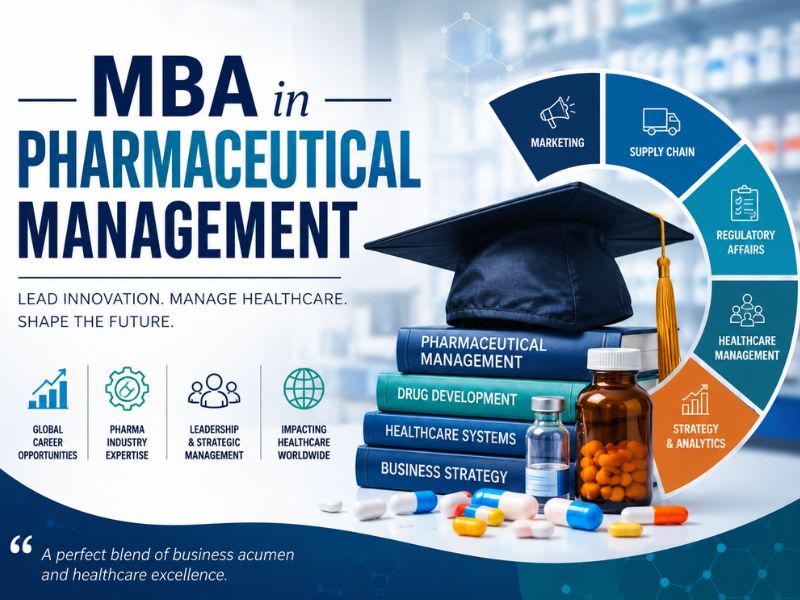
India has earned a title that few countries can claim: the "Pharmacy of the World." By 2026, India's pharmaceutical industry will have strengthened its position as the Pharmacy of the World, supplying medicines to more than 200 countries and providing nearly 20% of global generics and vaccines. This is not a small industry quietly growing in the background - it is one of India's most significant economic and strategic assets.
This is precisely the skill set that an MBA in Pharmaceutical Management is designed to build. As the industry shifts from volume-driven generic manufacturing toward biosimilars, biologics, and speciality medicines, supported by government initiatives, AI-driven research and development, and a rapidly expanding biotechnology ecosystem, the demand for managers who understand both the science and the business of pharma has never been higher.
Students aspiring to pursue an MBA in Pharma or Pharmaceutical Management in 2026 must meet specific eligibility criteria set by universities and business schools. Generally, candidates should have completed a bachelor's degree in Pharmacy (B.Pharm), Life Sciences, Biotechnology, Medicine, Nursing, Chemistry, or any recognized discipline from a UGC-approved institution. Most colleges require a minimum aggregate score of 50% to 60%, while reserved category candidates may receive relaxation as per institutional norms.
Admission to MBA in Pharma programs in 2026 is primarily based on entrance examination scores such as CAT, MAT, XAT, CMAT, ATMA, GMAT, or university-specific entrance tests. Several private universities also offer direct admission based on academic performance and personal interviews. The admission process typically includes online registration, application submission, entrance exam qualification, group discussion (GD), personal interview (PI), and final merit list selection.
Candidates with prior experience in the pharmaceutical, healthcare, biotechnology, or medical sectors may have an added advantage during the selection process. Before applying, students should carefully review the eligibility requirements, admission deadlines, entrance exam criteria, and fee structure of their preferred MBA in Pharma colleges to ensure a smooth admission process.

An MBA in Pharma offers excellent career opportunities in the pharmaceutical, healthcare, biotechnology, medical devices, and life sciences sectors. With the rapid growth of India's pharmaceutical industry and increasing global demand for healthcare professionals, MBA in Pharma graduates can secure managerial, marketing, sales, operations, and regulatory roles across various organizations.
The pharmaceutical industry in India continues to expand due to increased healthcare spending, medical innovations, and global pharmaceutical exports. Graduates with an MBA in Pharmaceutical Management can work in pharmaceutical companies, hospitals, healthcare consultancies, biotechnology firms, clinical research organizations (CROs), and medical device companies.
Some of the most popular job roles available after completing an MBA in Pharma include:
Pharmaceutical Marketing Manager
Product Manager
Medical Sales Manager
Business Development Manager
Healthcare Consultant
Pharmaceutical Brand Manager
Regulatory Affairs Manager
Clinical Research Manager
Supply Chain Manager
Hospital Administrator
The salary package after an MBA in Pharma depends on factors such as college reputation, skills, experience, and job profile. Fresh graduates can expect an average salary ranging from ₹4 LPA to ₹8 LPA, while experienced professionals can earn ₹10 LPA to ₹20 LPA or more in senior management positions.
| Job Profile | Average Annual Salary |
|---|---|
| Pharmaceutical Marketing Manager | ₹6–12 LPA |
| Product Manager | ₹7–15 LPA |
| Business Development Manager | ₹5–10 LPA |
| Regulatory Affairs Manager | ₹6–14 LPA |
| Clinical Research Manager | ₹5–12 LPA |
| Healthcare Consultant | ₹6–15 LPA |
Leading pharmaceutical and healthcare companies actively recruit MBA in Pharma graduates. Some of the top recruiters include:
Sun Pharma
Cipla
Dr. Reddy's Laboratories
Lupin
Zydus Lifesciences
Abbott India
Pfizer
Glenmark Pharmaceuticals
Johnson & Johnson
Novartis
Biocon
Alkem Laboratories
An MBA in Pharma provides a strong combination of management knowledge and pharmaceutical industry expertise, making it one of the most promising career options for students interested in healthcare and business management.
To secure admission to a top MBA in Pharma program in 2026, candidates must qualify for a recognized management entrance examination. Most universities and business schools accept national-level MBA entrance tests, while some institutions conduct their own admission tests and interviews.
CAT (Common Admission Test) – Accepted by top management institutes across India.
CMAT (Common Management Admission Test) – Popular among government and private MBA colleges.
XAT (Xavier Aptitude Test) – Accepted by leading business schools.
MAT (Management Aptitude Test) – Conducted multiple times a year with wide acceptance.
NMAT – Preferred by several private universities and business schools.
ATMA – Accepted by many AICTE-approved institutions.
GMAT – Accepted by select Indian and international universities.
The admission process for MBA in Pharmaceutical Management generally includes:
Registration for the entrance examination
Submission of the college application form
Entrance exam score evaluation
Group Discussion (GD) and Personal Interview (PI)
Final merit list and admission confirmation
For admission to top-ranked MBA in Pharma colleges, CAT, XAT, and CMAT remain the most preferred entrance examinations in 2026. However, students seeking admission to private universities can also consider MAT, NMAT, and ATMA due to their broader acceptance.
Candidates should start their preparation at least 6 to 12 months before the examination date and focus on quantitative aptitude, logical reasoning, verbal ability, and general awareness to maximize their chances of securing admission to the best MBA in Pharma colleges in India.
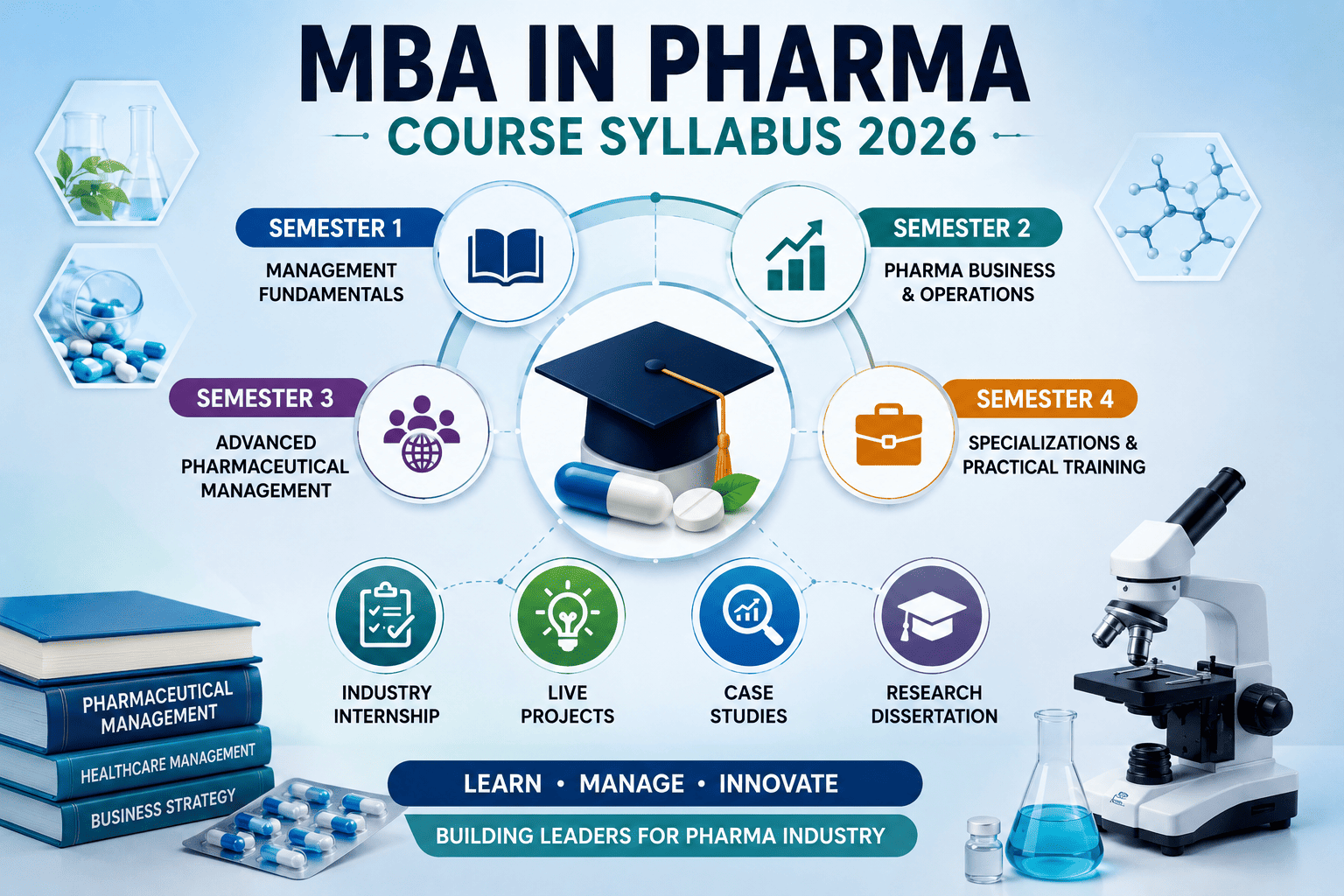
The MBA in Pharma (Pharmaceutical Management) syllabus is designed to provide students with a strong foundation in business management while developing specialized knowledge of the pharmaceutical and healthcare industries. The two-year program is generally divided into four semesters and includes classroom learning, industry projects, internships, and practical training.
Semester 1: Management Fundamentals
Principles of Management
Managerial Economics
Financial Accounting
Business Communication
Organizational Behavior
Pharmaceutical Industry Overview
Quantitative Techniques
Marketing Management
Human Resource Management
Financial Management
Pharmaceutical Marketing
Research Methodology
Operations Management
Supply Chain Management
Drug Regulatory Affairs
Pharmaceutical Sales Management
Product & Brand Management
Intellectual Property Rights (IPR)
Clinical Research Management
Strategic Management
International Pharmaceutical Business
Pharmacoeconomics
Quality Management in Pharma
Healthcare Management
Pharmaceutical Production Management
Business Ethics & Corporate Governance
Industry Internship
Major Project/Dissertation
An MBA in Pharma curriculum helps students develop expertise in pharmaceutical marketing, healthcare management, regulatory compliance, supply chain operations, product management, strategic decision-making, and leadership skills. These competencies prepare graduates for careers in pharmaceutical companies, healthcare organizations, biotechnology firms, and regulatory agencies.
The MBA in Pharmaceutical Management is typically a two-year, full-time postgraduate program, structured across four semesters, that combines general management education with subjects specific to the pharmaceutical and healthcare industry. Some institutes, such as NMIMS Mumbai's Shobhaben Pratapbhai Patel School of Pharmacy and Technology Management, even offer it as a dual three-year integrated program combining MBA Pharmaceutical Management with MPharm, allowing students to save a year while earning two postgraduate degrees - one technical/research-focused and one managerial.
Principles of Management and Organisational Behaviour
Financial and Managerial Accounting
Marketing Management
Human Resource Management
Business Statistics and Research Methods
Operations and Supply Chain Management
Business Law and Corporate Ethics
Pharmaceutical Marketing and Brand Management
Drug Regulatory Affairs (CDSCO, US FDA, EMA frameworks)
Pharmaceutical Supply Chain and Distribution Management
Clinical Trial Management and Research Operations
Intellectual Property Rights and Patent Law in Pharma
Pharmacoeconomics and Pricing Strategy
Biotechnology and Biosimilars Business Strategy
Hospital and Healthcare Management Linkages
A defining strength of well-designed programs in this space is their mandatory industry internship, typically with a pharmaceutical company, CRO (Contract Research Organisation), or hospital pharmacy division, during the third semester. This gives students direct exposure to how regulatory approvals, product launches, and distribution networks actually function - knowledge that simply cannot be taught from a textbook alone.
Programs increasingly integrate digital and AI-driven coursework too, reflecting how digital technologies such as enhanced clinical trial analytics and AI-driven drug discovery are becoming increasingly popular among companies across the sector.
It's important to understand exactly what this degree is - and isn't. This is not a pharmacy degree, and it does not qualify you to formulate or dispense medication. Rather, it trains graduates - many of whom already hold a B. Pharm, D. Pharm, or life sciences degree - to step into the business, regulatory, and strategic side of the pharmaceutical world.
This makes the degree particularly valuable for two distinct groups of students:
Pharmacy and life sciences graduates who want to move beyond the lab or pharmacy counter into management, marketing, regulatory affairs, or business strategy roles
Commerce, engineering, or general graduates with a genuine interest in the pharma and healthcare business, who want formal business training layered onto a high-growth, recession-resilient industry.
The degree sits at a fascinating intersection of science and commerce. A pharmaceutical company doesn't just need chemists and researchers - it needs people who understand how to price a new biosimilar competitively, how to navigate FDA and CDSCO approval timelines, how to manage a national distribution network, and how to position a drug in both Indian and export markets. With India among the top 12 destinations for biotechnology globally and ranking third in Asia Pacific, and the biosimilars market growing at a CAGR of 22%, representing nearly 20% of India's total pharmaceutical market, this strategic layer of management has become mission-critical for every major pharma company operating in India.
This is also a degree built for the long term. The industry is anticipated to continue growing at a rate of 7 to 9% due to robust domestic demand and consistent exports, giving graduates a career runway that few other specialisations can match in terms of stability.
Eligibility Criteria:
A bachelor's degree in any discipline from a recognised university, generally with a minimum of 50% aggregate marks in their bachelor's degree (some institutes set this requirement slightly lower, depending on category and entrance exam performance).
Candidates must have a minimum aggregate score of 50%, along with a valid score in national-level management entrance exams such as CAT, MAT, or CMAT at most reputed institutes.
Commonly accepted entrance exams across the country include CAT, MAT, XAT, NMAT, and CMAT, along with ATMA at several private universities.
Most institutes follow entrance scores with a Group Discussion (GD) and Personal Interview (PI) round before finalising admission. This is typically followed by the institute's own admission process involving a group discussion and personal interview.
Candidates with a B. Pharma, D. Pharm, or life sciences background are often given preference or additional weightage at institutes affiliated with pharmacy schools, though the program remains open to graduates of any stream.
Fee Structure Overview:
Fees for this specialisation vary widely between government and private institutes, and even among private universities themselves:
Institute Type | Approximate Total Fee Range (2026-27) |
Government Universities (NIPER, DPSRU) | INR 1.1 lakhs - 3.12 lakhs |
Mid-tier Private Universities | INR 80,000 - 2 lakhs |
Premium Private B-Schools | INR 3 lakhs - 9 lakhs |
There are nearly 28 MBA Pharmaceutical Management colleges in India, with the overall fee range falling anywhere between INR 1,00,000 and INR 9,00,000. On the more affordable end, IEC University's MBA in Pharmaceutical Management is priced at approximately INR 80,000 for the full program, while Delhi Institute of Pharmaceutical Sciences and Research charges around INR 1,60,000. Government institutes such as NIPER Mohali, Hyderabad, and Ahmedabad charge fees of around INR 3.12 lakhs, while Delhi Pharmaceutical Sciences and Research University charges approximately INR 1.10 lakhs for the entire course.
As always, fee structures and entrance exam patterns are revised almost every academic cycle, so applicants should verify the latest figures directly on each institute's official admissions page before applying.
MBA in Pharma graduates are highly sought after by pharmaceutical companies, healthcare organizations, biotechnology firms, clinical research companies, and medical device manufacturers. These organizations recruit professionals for roles in pharmaceutical marketing, business development, product management, regulatory affairs, supply chain management, and healthcare consulting.
Sun Pharma
Cipla
Dr. Reddy's Laboratories
Lupin
Zydus Lifesciences
Abbott India
Pfizer
Novartis
Glenmark Pharmaceuticals
Biocon
Johnson & Johnson
Alkem Laboratories
Torrent Pharmaceuticals
Aurobindo Pharma
Mankind Pharma
Cadila Pharmaceuticals
Merck
Sanofi
Bayer
IQVIA
MBA in Pharma professionals can find employment opportunities across various industries, including:
Pharmaceutical Manufacturing
Healthcare Management
Biotechnology Companies
Clinical Research Organizations (CROs)
Medical Device Companies
Hospital Administration
Healthcare Consulting Firms
Pharmaceutical Sales and Marketing
Drug Regulatory Affairs
Supply Chain and Logistics Management
Top recruiters offer competitive salary packages, career growth opportunities, leadership roles, international exposure, and specialized training programs, making MBA in Pharma one of the most promising management specializations in the healthcare sector.
MBA in Pharmaceutical Management offers several specializations that help students develop expertise in different areas of the pharmaceutical and healthcare industry. These specializations are designed to meet the growing demand for skilled professionals in pharmaceutical marketing, healthcare management, regulatory affairs, and business operations.
Pharmaceutical Marketing Management – Focuses on brand management, product promotion, and pharmaceutical sales strategies.
Healthcare and Hospital Management – Covers healthcare administration, hospital operations, and patient management systems.
Pharmaceutical Supply Chain Management – Deals with procurement, logistics, inventory management, and distribution of pharmaceutical products.
Drug Regulatory Affairs – Focuses on pharmaceutical laws, drug approvals, and regulatory compliance.
Clinical Research Management – Covers clinical trials, research methodologies, and drug development processes.
Pharmaceutical Production Management – Emphasizes manufacturing processes, quality control, and production planning.
International Pharmaceutical Business – Focuses on global pharmaceutical markets, exports, and international business strategies.
Pharmacoeconomics and Health Economics – Studies the economic impact of medicines and healthcare policies.
Pharmaceutical Product and Brand Management – Covers product lifecycle management and marketing strategies for pharmaceutical brands.
Healthcare Analytics and Business Intelligence – Focuses on data-driven decision-making and healthcare market analysis.
The best specialization depends on your career goals. Students interested in marketing and business growth can choose Pharmaceutical Marketing Management, while those interested in compliance and regulations may opt for Drug Regulatory Affairs. Similarly, candidates looking for opportunities in hospitals and healthcare organizations can pursue Healthcare and Hospital Management.
Choosing the right specialization can significantly improve career prospects and open doors to leadership roles in the pharmaceutical and healthcare industries.
The career outlook for MBA Pharmaceutical Management graduates is closely tied to the extraordinary trajectory of India's pharma sector itself. The Indian hospital market was valued at USD 98.98 billion in FY23 and is projected to grow at a CAGR of 8%, reaching USD 193.59 billion by FY32 — and pharmaceutical management graduates sit right at the intersection of this hospital growth and the pharma supply chain feeding it.
Career Roles After the MBA:
Pharmaceutical Brand/Product Manager
Regulatory Affairs Manager
Pharmaceutical Supply Chain Manager
Clinical Research Operations Manager
Pharmaceutical Sales and Marketing Manager
Pharmacoeconomics and Market Access Analyst
Business Development Manager (Biotech/Biosimilars)
Top Recruiters:
Major pharmaceutical companies actively recruiting MBA Pharma graduates include Sun Pharma, Cipla, DDrReddy's, Lupin, Biocon, and global players with Indian operations, alongside contract research organisations (CROs), pharmaceutical distribution companies, and healthcare consulting firms.
Salary Expectations in India (2026):
Average placement packages for graduates of top government pharmaceutical management institutes range from approximately INR 5 LPA to 12 LPA, depending on the institute and the student's prior academic and industry background. Graduates from premium private B-schools with strong pharma-industry tie-ups, particularly those with prior pharmacy or science backgrounds, often command higher starting packages, especially in regulatory affairs, brand management, and biosimilars-focused roles — segments seeing outsized growth as pharmaceutical exports reached USD 30,466.9 million during April-March FY25, marking a 9.4% increase from the previous fiscal year.
With India targeting USD 350 billion in pharmaceutical exports by 2047 and the industry steadily shifting toward innovation-driven growth focused on biosimilars, biologics, and speciality medicines, the long-term career runway for skilled pharma management professionals looks exceptionally strong.
1. National Institute of Pharmaceutical Education and Research (NIPER), Mohali
NIPER Mohali is among the best government pharmaceutical management colleges in India, with fees of around INR 3.12 lakhs, strong CAT-based admission, and excellent industry linkages with major pharma manufacturers.
2. NIPER Hyderabad
A sister institute to NIPER Mohali under the same government umbrella, also charging fees of around INR 3.12 lakhs, with strong placement ties to South India's pharma manufacturing hubs.
3. NIPER Ahmedabad
Completing the NIPER trio, this institute also offers the program at approximately INR 3.12 lakhs, leveraging Gujarat's position as one of India's largest pharmaceutical manufacturing clusters, which drew INR 4,200 crore in PLI investment as part of the West India region leading 32.24% of 2025 pharma revenue.
4. Delhi Pharmaceutical Sciences and Research University (DPSRU), New Delhi
DPSRU offers the program at fees of approximately INR 1.10 lakhs, making it one of the most affordable government options, with eligibility requiring a valid CAT score and strong placement support across Delhi-NCR's pharma corridor.
5. Jamia Hamdard, New Delhi
Jamia Hamdard holds an NIRF 2025 ranking of 87 and is ranked #1 nationally in Pharmacy by NIRF 2024 and 2025, with 30+ MoUs with international universities and national bodies like CSIR, ICMR, and DRDO, making it a strong government choice with deep research credibility.
1. NMIMS School of Pharmacy and Technology Management, Mumbai
NMIMS is consistently named among the top MBA Pharma colleges in India, and uniquely offers a 3-year dual-degree program combining MBA Pharmaceutical Management with M.Pharm, giving graduates both a research and managerial qualification.
2. Shoolini University, Solan
Shoolini University features among the top MBA Pharmaceutical Management colleges based on NIRF rankings, with strong biotech and pharma research infrastructure based in Himachal Pradesh's growing pharma corridor.
3. IIHMR University, Jaipur
IIHMR University is recognised among the top MBA Pharmaceutical Management institutes in India, building on its established reputation in health and hospital management to offer strong pharma-sector placement linkages.
4. Chitkara University, Punjab
Chitkara University's MBA in Pharmaceutical Management spans 2 years and is open to graduates from any discipline with a minimum of 50% aggregate marks, with admission based on CAT, MAT, XAT, NMAT, CMAT, or the university's own entrance test, followed by a group discussion and personal interview.
5. IEC University, Solan
IEC University offers one of the most affordable MBA Pharmaceutical Management programs in India at approximately INR 80,000, with a strong placement record of 90% in 2023 and recruiters spanning manufacturing giants like Cipla and L&T Technology.
Conclusion
The MBA in Pharmaceutical Management is built for a very specific kind of ambition - the desire to combine scientific or commercial curiosity with leadership in one of India's most strategically important and fastest-evolving industries. If you already hold a pharmacy, life sciences, or biotechnology background and want to move from research or clinical roles into business strategy, regulatory affairs, or brand management, this degree offers a natural and highly rewarding next step. Equally, if you're a commerce or engineering graduate fascinated by how a single new biosimilar approval can reshape pricing and market access for millions of patients, this specialisation gives you direct entry into that world.