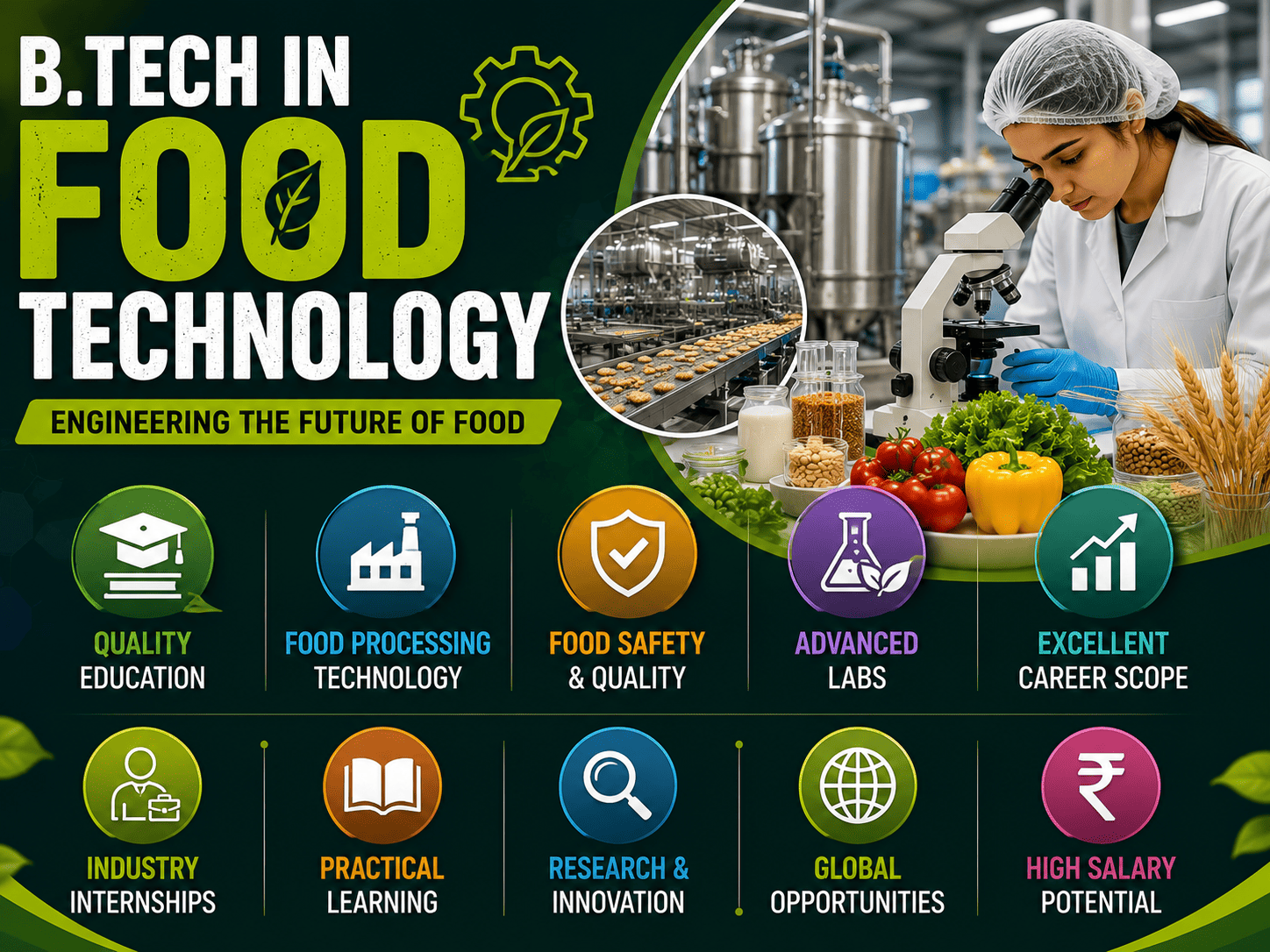
B.Tech in Food Technology is a four-year engineering programme that combines food science, processing, and quality control with core engineering principles. With India's food processing industry expanding rapidly, driven by changing consumption patterns and export demand, this degree is becoming a strong, practical choice for science students. Here's a complete breakdown of the course, colleges, fees, and career scope for 2026-2027.
B.Tech in Food Technology is a four-year undergraduate course that equips students with the knowledge and skills required to enhance food production, packaging, and safety. The programme focuses on the various systems of food engineering used in the food industry to enhance the shelf life of edible products, alongside preservation techniques and food processing methods.
The curriculum typically includes food chemistry, microbiology, food processing, preservation techniques, and quality control, with subjects like food engineering and process calculations requiring a solid grounding in mathematics. The course is spread across eight semesters and blends theoretical learning with lab-based, hands-on training — students work directly with food processing equipment, quality testing instruments, and packaging technology to prepare them for real-world roles in food manufacturing and safety.
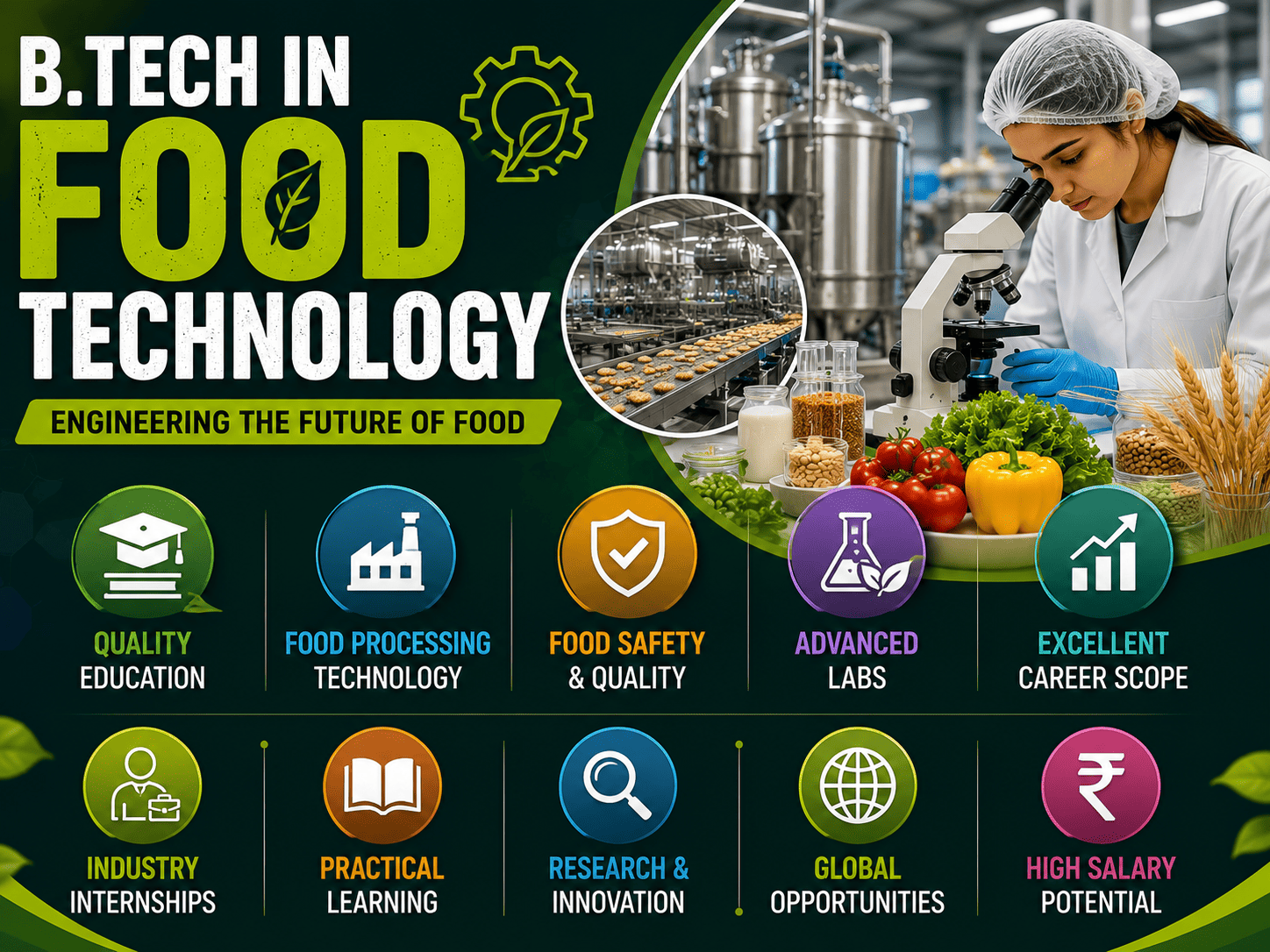
Course Details at a Glance
Particular | Details |
Full Form | Bachelor of Technology in Food Technology |
Duration | 4 years (8 semesters) |
Level | Undergraduate |
Eligibility | 10+2 with PCM/PCB, minimum 50-60% |
Admission Mode | Entrance exam + merit, or direct merit-based |
Common Entrance Exams | JEE Main, ICAR AIEEA, CUET UG, WBJEE, state CETs, university-level tests |
Average Fees | ₹40,000 – ₹6 lakh per year (varies widely by institute) |
Average Starting Salary | ₹2.5 LPA – ₹6 LPA |
Top Recruiters | Nestlé, Amul, ITC, Britannia, HUL, Dabur, PepsiCo |
Key Highlight
A four-year, eight-semester undergraduate engineering programme combining food science with engineering principles
Strong lab component: food chemistry, microbiology, processing, and quality-testing laboratories
High industry demand as the food processing sector grows, especially around plant-based products, dairy, and sustainable packaging.
Versatile career paths including Food Technologist, Quality Assurance Manager, Production Supervisor, and Food Safety Officer
Specialised lateral entry route available for diploma holders in Food Technology directly into the second year
Strong placement pull from FMCG, dairy, and food export sectors, with growing scope in food safety regulation and R&D
Higher education pathways open into MTech Food Technology, M.Tech Dairy Technology, MBA, and PhD.
Here's the truth: BTech Food Technology is one of the smartest engineering choices you can make in 2026.
Why? Because it sits at the intersection of two massive industries: engineering and food.
This four-year undergraduate program teaches you how to turn raw food into safe, packaged, market-ready products — using real engineering principles.
Here's what you'll study:
But it's not just theory. You'll get hands-on experience through:
Getting in? Most colleges require JEE Main or state-level engineering entrance exam scores. Some offer direct merit-based admission too.
The payoff? Career opportunities in food manufacturing, quality assurance, R&D labs, and government bodies like FSSAI.
Bottom line: with consumers caring more than ever about food safety and packaged nutrition, 2026 is a great time to jump into this field.
Let's break it down simply.
BTech Food Technology = Engineering + Food Science.
It's a degree that teaches you how to safely produce, process, preserve, and package food — at scale.
Think about it: every packaged snack, every preserved product, every food item on a supermarket shelf went through a process designed by someone like a food technologist.
This four-year program covers:
You'll learn preservation techniques, processing technologies, and quality control systems used by real food companies.
And it's not all classroom learning. Labs, industrial training, and research projects make sure you actually understand how raw ingredients become finished products.
Here's the interesting part: the course also covers modern trends like sustainable packaging, food biotechnology, and automation in processing plants.
By the end, you'll understand the entire food supply chain — from farm to package.
That's why BTech Food Technology matters so much right now: it directly supports food security and safety standards.
Still on the fence? Here's why this course deserves your attention.
1. Massive demand.
Packaged and processed foods are everywhere now. That means companies need skilled professionals who can manage food production — and there aren't enough of them.
2. Government backing.
India's food processing industry is growing fast, supported by government initiatives focused on food safety and infrastructure. Translation: more jobs, more funding, more opportunities.
3. Career variety.
You're not locked into one path. Graduates work in:
4. Skill versatility.
This course blends chemistry, biology, and engineering. That interdisciplinary mix makes you valuable across multiple industries — not just food.
5. Room to grow.
Want to specialise further? You can pursue an MTech or even an MBA afterwards. Plus, food technology skills are in demand globally, not just in India.
The bottom line: BTech Food Technology gives you job security, flexibility, and relevance in a fast-growing industry. Hard to beat that combination in 2026.
So you've finished 12th grad,e and you're interested in food technology. Good news — you've got options.
Option 1: BTech/BE in Food Technology
The most popular choice. A four-year engineering degree that requires JEE Main or state-level entrance exam scores. This gives you the most comprehensive training in food processing, engineering, and quality control.
Option 2: BSc in Food Technology
A three-year degree with more focus on the science side — food science, nutrition, and processing techniques. Entrance requirements are typically easier than BTech programs.
Option 3: Diploma in Food Technology
Looking for something quicker? This 2-3 year program is skill-focused and practical. Perfect if you want to enter the workforce faster or study further later.
Option 4: BTech in Food Engineering or Dairy Technology
Want to specialise early? These programs focus on specific niches within the food science field.
So which one should you pick?
It depends on:
That said, if you want the most well-rounded, industry-preferred qualification, BTech Food Technology is still your best bet heading into 2026.
Eligibility criteria:
Candidates must have passed 10+2 in the Science stream with Physics, Chemistry, and Mathematics/Biology as compulsory subjects, securing at least 50-60% aggregate marks
Most colleges accept both PCM and PCB backgrounds, though preference is sometimes given to Mathematics students for programmes with heavier process-engineering content
A 5% relaxation in the minimum percentage is generally available for SC/ST/OBC/PwD candidates
There is generally no upper age limit, though admission trends show most applicants are between 17 and 25 years old
Lateral entry is available for candidates who have completed a 3-year Diploma in Food Technology or a related field with at least 50% marks, allowing direct entry into the second year
Fee structure: Fees vary quite significantly depending on the type of institute:
Government colleges/central universities: Total course fees can range from roughly ₹40,000 to ₹5 lakh for the entire programme — for instance, a central university like BHU charges around ₹4.8 lakh for the full 4-year programme, while AMU's total fees are closer to ₹2 lakh
Private universities: Fees typically range from ₹50,000 to ₹1.5 lakh per semester, translating to roughly ₹4-8 lakh for the complete course at most private institutions
Additional costs include hostel and mess fees, lab/material fees, and a one-time admission/application fee
Scholarships based on merit, entrance exam rank, or family income (including state and central government schemes) are available at most institutions
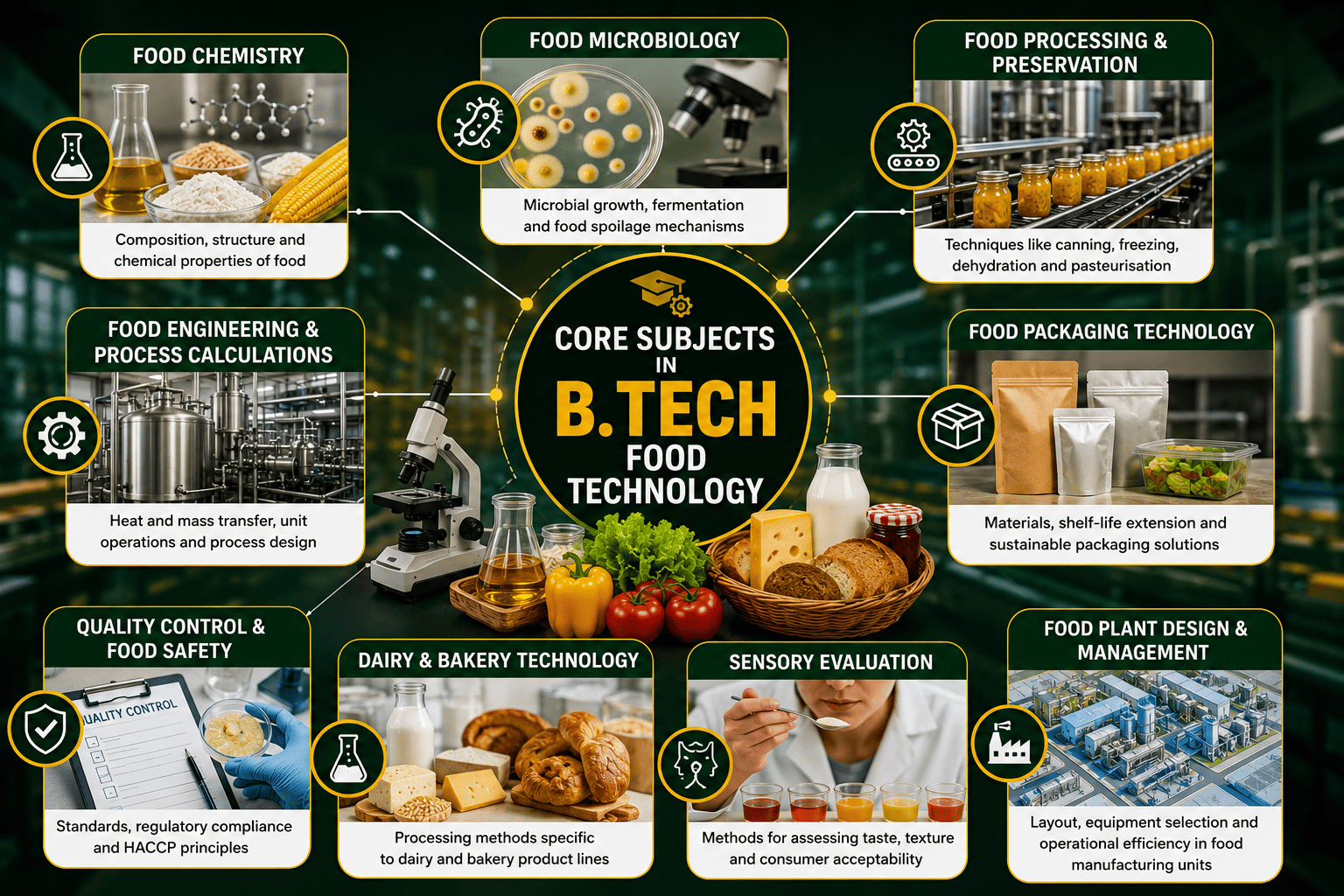
The general admission journey looks like this:
Check eligibility — Confirm your 10+2 PCM/PCB percentage meets the cutoff (usually 50-60%).
Register for entrance exams — Apply for JEE Main, CUET UG, ICAR AIEEA, or the relevant state-level CET depending on your target colleges.
Appear for the exam — Most exams test Physics, Chemistry, and Mathematics/Biology at a Class 12 level.
Application to colleges — Many private universities also run direct, merit-based admission alongside entrance scores, sometimes with an added GD/PI round.
Counselling and seat allotment — Candidates register for counselling, fill in their preferences, and lock Food Technology as their preferred branch.
Document verification — Submit Class 10 and 12 mark sheets, entrance scorecards, category certificates, and photographs.
Fee payment and confirmation — Visit the allotted institute, complete verification, pay fees, and confirm the seat.
A few colleges also give 50-50 weightage to both Class 12 marks and entrance exam scores, so it's worth checking the specific admission policy of each target college.
Several national, state, and university-level exams serve as gateways to top Food Technology colleges in India:
JEE Main — Accepted by many engineering colleges and universities offering this branch
CUET UG — Used by central universities like BHU for admission to their Food Technology programmes
ICAR AIEEA — Relevant for agricultural universities offering food technology and food engineering courses
State-level CETs — Such as MHT CET, KCET, WBJEE, and TS EAMCET
University-specific exams — Including AMEEE (Aligarh Muslim University), VITEEE, SRMJEEE, and LPUNEST, depending on the institute
Competition for popular Food Technology colleges can be high, so scoring well in your chosen entrance exam matters. Some colleges also accept direct admission based on Class 12 merit alone, often followed by a brief interview or group discussion round.
Entrance exam rank/score — JEE Main, CUET UG, or the relevant state/university exam score
Class 12 marks — Used as a baseline eligibility filter, and at several institutes, contributes directly to the final merit list.
Category-based reservation — Quotas for SC/ST/OBC/EWS/PwD candidates as per government norms
Additional rounds — Some private colleges conduct a Personal Interview (PI) or Group Discussion (GD) after the entrance results to assess suitability for the course
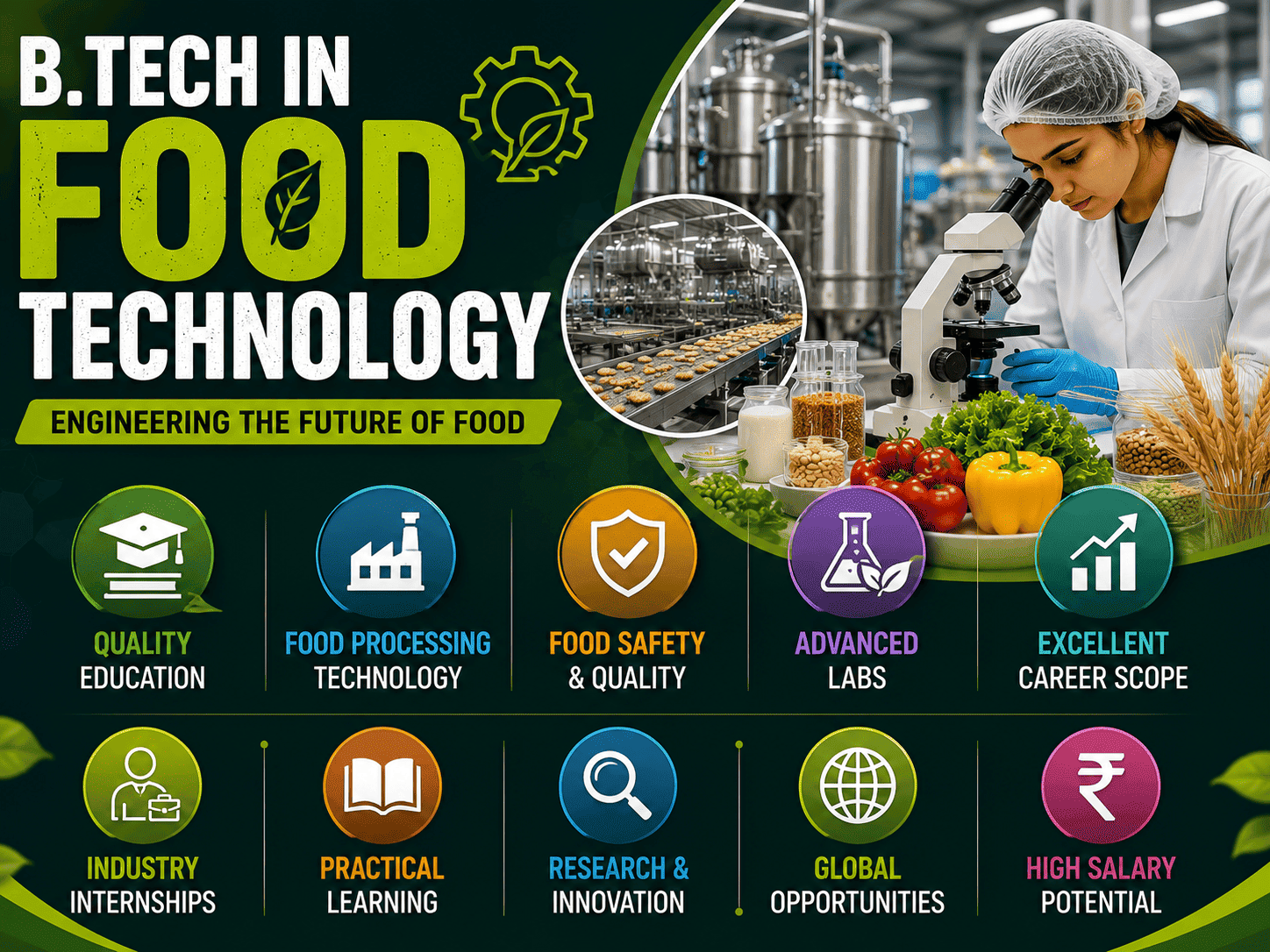 Core Subjects Covered in B.Tech in Food Technology
The B.Tech in Food Technology syllabus is a combination of mandatory core subjects and elective options, including:
Food Chemistry — Composition, structure, and chemical properties of food components
Food Microbiology — Microbial growth, fermentation, and food spoilage mechanisms
Food Processing and Preservation — Techniques like canning, freezing, dehydration, and pasteurisation
Food Engineering and Process Calculations — Heat and mass transfer, unit operations, and process design
Food Packaging Technology — Materials, shelf-life extension, and sustainable packaging solutions
Quality Control and Food Safety — Standards, regulatory compliance, and HACCP principles
Dairy and Bakery Technology — Processing methods specific to dairy and bakery product lines
Sensory Evaluation — Methods for assessing taste, texture, and consumer acceptability of food products
Food Plant Design and Management — Layout, equipment selection, and operational efficiency in food manufacturing units
B.Tech in Food Technology is taught through a structured mix of classroom learning and hands-on practical exposure:
Lecture-based theory covering food chemistry, microbiology, and engineering fundamentals
Laboratory-intensive practicals in food processing, quality testing, and sensory evaluation — most reputed institutes maintain modern food processing labs equipped with advanced testing and analysis equipment
Industrial visits to food processing units, giving students real exposure to manufacturing operations
Internships with leading food companies, often starting from the 6th semester, where students gain practical, on-ground experience.
Capstone/major project in the final year, where students typically work on product development, process optimisation, or quality improvement initiatives
Industry collaboration through guest lectures and tie-ups with FMCG, dairy, and food processing companies
Skill-building activities like industry certifications, hackathons, workshops, and live projects, which several universities now integrate directly into the curriculum
Here's what you actually need to get into BTech Food Technology.
The basics first:
You need to have completed 12th grade with Physics, Chemistry, and Mathematics (PCM) as core subjects. Some colleges also accept Biology in place of Mathematics, so check individual college requirements before applying.
Minimum marks?
Most institutes require at least 50% aggregate marks in your 12th board exams. Reserved category students (SC/ST/OBC) usually get a relaxation of about 5%, bringing the requirement down to 45%.
What about entrance exams?
You'll need to qualify a recognised engineering entrance exam. This is non-negotiable for most reputed colleges — merit-based admission without an entrance exam is rare and usually limited to lesser-known private institutes.
Age limit?
Generally, there's no strict upper age limit, but you typically need to be at least 17 years old at the time of admission.
One more thing:
If you're a final-year 12th student waiting for results, you can still apply provisionally. Just make sure you submit your final marksheet before the admission deadline.
Bottom line: Strong PCM fundamentals, decent board exam scores, and a good entrance exam rank — that's your ticket into BTech Food Technology.
Getting into a good BTech Food Technology program starts with picking the right entrance exam. Here are your main options in 2026.
1. JEE Main
The big one. Accepted by NITs, IIITs, and many state and private engineering colleges offering Food Technology. A strong JEE Main rank opens doors to the best programs.
2. State-Level Engineering Entrance Exams
Most states run their own exams — like MHT CET (Maharashtra), WBJEE (West Bengal), or KCET (Karnataka). These are often easier to crack than JEE Main and give you access to state government colleges at lower fees.
3. University-Specific Entrance Tests
Many private universities conduct their own tests, such as SRMJEEE, VITEEE, or similar. If you're targeting a specific private university, check whether they need a dedicated exam.
4. BITSAT
For students aiming at BITS Pilani's food technology-adjacent programs, BITSAT is the exam to watch.
Here's the strategy:
Don't put all your eggs in one basket. Apply for JEE Main first since it's widely accepted, then back it up with your state-level exam and a couple of university-specific tests.
This way, you maximise your chances of landing in a good BTech Food Technology program in 2026.
Wondering what rank or score you actually need? Let's talk cutoffs.
Here's the truth: cutoffs vary massively depending on the college, exam, category, and year. There's no single number that applies everywhere.
What affects cutoffs?
College reputation and ranking
Number of seats available
Category (General, OBC, SC, ST)
State vs. all-India quota
Total number of applicants that year
General trend:
Top government colleges and NITs offering Food Technology typically have higher cutoffs, requiring competitive JEE Main ranks. State government colleges usually have moderate cutoffs, especially for candidates within their home state's quota.
Private colleges generally have more relaxed cutoffs, sometimes offering direct admission based on board exam marks alone for management quota seats.
Reserved category advantage:
SC, ST, and OBC candidates typically benefit from lower cutoff requirements compared to general category students, as per government reservation norms.
Our honest advice:
Instead of chasing a fixed cutoff number, check the previous year's cutoff trends on each college's official website or counselling portal. This gives you a realistic picture of where you stand.
Also, keep multiple options open — apply to a mix of government, semi-government, and private colleges to increase your chances of admission in 2026.
Let's talk about what really matters — job placements after graduation.
The good news? Food processing is a growing industry, and placement prospects for BTech Food Technology graduates are improving steadily.
Who's hiring?
Food manufacturing companies (Nestlé, ITC, Britannia, etc.)
FMCG companies
Quality assurance and testing labs
Government food safety bodies like FSSAI
Research and development organizations
Food packaging companies
What roles can you expect?
Fresh graduates typically start as:
Quality Control Officer
Food Technologist
Production Engineer
R&D Associate
Food Safety Officer
How do placements actually work?
Most reputed colleges have dedicated placement cells that organise campus recruitment drives, connecting students directly with food industry recruiters. Internships during the course also play a big role — many students receive job offers from companies where they interned.
One thing to keep in mind:
Placement records vary significantly by college. Top-tier institutes with strong industry connections and NBA accreditation generally see better placement percentages and higher-paying offers.
Our tip: Before choosing a college, actually check their placement reports from the last 2-3 years. Don't just trust brochure claims — look at real data on companies visited and average packages offered.
Here's what you can realistically expect to earn as a fresh BTech Food Technology graduate.
Average starting salary:
Most freshers can expect a starting package somewhere between ₹2.5 LPA and ₹5 LPA, depending on the college, company, and role.
What affects your salary?
College reputation: Graduates from top-tier institutes (NITs, well-ranked private universities) generally command higher starting packages.
Company type: Large FMCG and food manufacturing giants tend to pay more than smaller regional companies.
Location: Jobs in metro cities or industrial hubs often offer better compensation than smaller towns.
Specialisation: Roles in R&D or quality assurance sometimes offer slightly higher packages compared to standard production roles.
A realistic breakdown:
Entry-level roles (QC Officer, Production Trainee): ₹2.5–3.5 LPA
Roles in top FMCG companies: ₹4–6 LPA
Government positions (FSSAI, etc.): Pay scales as per government norms, often with added job security
The good news for your future:
Salaries in this field tend to grow steadily with experience. After 3-5 years, many food technologists move into managerial or specialised roles with significantly higher pay.
Let's cut straight to it — BTech Food Technology graduates have real, growing career options.
Career scope in a nutshell:
The food processing industry is one of the fastest-growing sectors in India, backed by government initiatives and rising consumer demand for packaged, safe food. That growth directly translates into more jobs for you.
Common job profiles include:
Who's actually hiring?
Top recruiters span multiple sectors:
Here's what makes this field interesting:
You're not limited to just manufacturing. You can move into R&D, regulatory compliance, quality testing, or even entrepreneurship by starting your own food processing business.
The bigger picture:
As India's food industry expands and export demands grow, skilled food technologists will only become more valuable. That's exactly why this field offers strong long-term career scope heading into 2026 and beyond.
Wondering what a food technology engineer actually does day-to-day? Here's the breakdown.
Core responsibilities include:
1. Quality Control
Testing raw materials and finished products to ensure they meet safety and quality standards before reaching consumers.
2. Process Development
Designing and improving food processing methods to increase efficiency, reduce waste, and maintain product consistency.
3. Food Safety Compliance
Ensuring production processes follow FSSAI regulations and international food safety standards like HACCP.
4. Product Development
Working on new food products — from ideation to formulation, testing, and scaling for commercial production.
5. Packaging Management
Selecting and testing packaging materials that preserve freshness and extend shelf life while meeting sustainability goals.
6. Plant Operations
Overseeing production lines, troubleshooting equipment issues, and ensuring smooth day-to-day manufacturing operations.
7. Research & Documentation
Researching new preservation techniques, ingredients, or processing technologies, and maintaining detailed records for regulatory audits.
The real takeaway?
A food technology engineer wears multiple hats — part scientist, part engineer, part quality inspector. That variety is exactly what makes this role both challenging and rewarding for those who enjoy hands-on, impact-driven work.
Not all food technology careers look the same. Here are the specialisations worth knowing about.
1. Food Processing & Preservation
Focuses on techniques like canning, freezing, drying, and fermentation to extend shelf life while retaining nutritional value.
2. Food Packaging Technology
Covers modern packaging materials, sustainable packaging solutions, and techniques to protect food quality during storage and transport.
3. Dairy Technology
Specialises in milk processing, dairy product development, and quality control specific to dairy manufacturing.
4. Food Biotechnology
Combines biotechnology with food science — think fermentation processes, enzyme applications, and genetically improved food products.
5. Nutrition & Dietetics Integration
Focuses on developing nutritionally enhanced food products, catering to health-conscious consumers and specific dietary needs.
6. Food Plant Engineering
Deals with designing and managing food processing plants, equipment selection, and production line optimisation.
7. Food Safety & Quality Assurance
Concentrates on regulatory compliance, quality testing protocols, and food safety management systems.
Why does specialisation matter?
Choosing a specialisation early helps you build focused expertise, making you more attractive to niche employers. Whether you're drawn to R&D, plant operations, or food safety regulation, picking the right specialisation can significantly shape your career trajectory in the food industry.
Here's why BTech Food Technology isn't just relevant today — it's set up for long-term growth.
1. Booming food processing industry
India's food processing sector continues expanding rapidly, driven by government initiatives like PLI schemes and rising urban demand for packaged foods.
2. Growing export opportunities
As Indian food products gain global recognition, companies need skilled professionals who understand international food safety standards and export regulations.
3. Rising health consciousness
Consumers increasingly demand nutritious, minimally processed, and sustainably packaged food — creating demand for technologists who can innovate in these areas.
4. Technology integration
Automation, AI-driven quality control, and smart packaging are transforming food manufacturing, opening new tech-focused roles within the industry.
5. Sustainability focus
Growing emphasis on eco-friendly packaging and reduced food waste means specialists in sustainable food technology will be in high demand.
6. Higher education & research opportunities
Graduates can pursue MTech, PhD, or MBA programs, opening doors to research, academia, or management roles within the food industry.
The bottom line:
With consistent industry growth, government support, and evolving consumer preferences, BTech Food Technology offers strong, future-ready career prospects well beyond 2026.
Thinking about which food technology course fits you best? Here's a quick rundown of the most sought-after options.
1. BTech in Food Technology
The most comprehensive four-year engineering program, covering food processing, engineering, and quality management. Ideal for students wanting in-depth technical training.
2. BSc in Food Technology
A three-year science-focused degree emphasising food chemistry, nutrition, and processing basics — a good alternative for students preferring a shorter, less engineering-heavy path.
3. MTech in Food Technology
A postgraduate option for BTech graduates wanting specialised knowledge in areas like food engineering, biotechnology, or quality assurance.
4. Diploma in Food Technology
A practical, skill-based program lasting 2-3 years, suited for students seeking quicker workforce entry.
5. MBA in Food & Agribusiness Management
Perfect for those wanting to combine technical food knowledge with business and management skills, especially useful for leadership roles.
6. BTech in Dairy Technology
A specialised program focusing exclusively on dairy processing and product development.
If you want maximum career flexibility and strong industry recognition, BTech in Food Technology remains the most popular and preferred choice among students planning their future in 2026.
Popular BTech Food Technology Specialisations
1. IIT Kharagpur — IIT Kharagpur offers a well-established B.Tech programme in Agricultural and Food Engineering, blending core engineering with food science. The institute is known for its strong research culture, advanced laboratories, and consistent industry tie-ups with major FMCG and food processing companies. Admission is through JEE Advanced, making it highly competitive but rewarding for students seeking top-tier research exposure and placement outcomes.
2. Banaras Hindu University (BHU), Varanasi — BHU's Department of Food Science and Technology offers a 4-year B.Tech programme under the Faculty of Agricultural Sciences, with a seat intake of around 30 students per batch. Admission is based entirely on CUET UG scores, with total fees around ₹4.8 lakh for the complete programme. The curriculum covers food processing, food safety, food engineering, and product development, supported by strong research infrastructure and industry linkages.
3. Aligarh Muslim University (AMU) — AMU's B.Tech Food Technology programme, offered through the Zakir Hussain College of Engineering and Technology, focuses on food processing, preservation, food safety, and quality control. With a total course fee of around ₹2.06 lakh for the full 4-year duration, admission is through the AMUEEE entrance exam. The programme has a strong placement record with dairy, beverage, and FMCG companies actively recruiting from this branch.
4. National Institute of Technology (NIT) Rourkela — NIT Rourkela offers B.Tech in Food Process Engineering, combining engineering rigour with applied food science. The institute's strong research infrastructure and industry connections make it a solid choice for students seeking both academic depth and reliable placement support, with admission through JEE Main.
5. Jadavpur University — Jadavpur University offers B.Tech in Food Technology and Biochemical Engineering, one of the more established programmes of its kind among government universities. Known for affordable fees and a reputed faculty base, the programme blends food engineering with biochemical processes, with admission through WBJEE for West Bengal domicile students and other relevant entrance routes.
1. Lovely Professional University (LPU), Punjab - LPU offers a well-recognised B.Tech in Food Technology programme with modern infrastructure and a dedicated placement cell. The university also offers M.Tech and M.Sc. programmes in the same field, creating a strong pipeline for students wanting to pursue further specialisation. Admission is through LPUNEST or direct merit-based entry, depending on the applicant's profile.
2. MIT School of Food Technology, MIT-ADT University, Pune - A dedicated school specialising entirely in food technology, offering modern processing labs and strong industry exposure. The institute has structured fee plans across categories, including EWS concessions, and provides hostel facilities alongside academic infrastructure tailored specifically to food science education.
3. Institute of Chemical Technology (ICT), Mumbai - ICT Mumbai offers a B.Tech in Food Engineering and Technology, known for its strong chemical and process engineering foundation applied to food systems. The institute has a solid reputation for research output and industry placements, particularly in the chemical, pharmaceutical, and food processing sectors.
4. SRM Institute of Science and Technology, Chennai - SRM offers Food Technology as part of its broader engineering and biotechnology cluster, with access to modern labs and consistent placement support from FMCG and food processing recruiters. Admission is via SRMJEEE or JEE Main scores, and the university's large infrastructure offers flexibility in elective choices.
5. Sharda University, Greater Noida - Sharda University's Food Technology programme integrates food science with engineering principles, supported by dedicated labs for food processing, quality testing, and product development. The university accepts JEE Main scores or direct merit-based entry through Class 12 marks, with strong interdisciplinary research support for students pursuing further studies.
Salary expectations vary based on institute tier, specialisation, and the specific role taken up after graduation:
Freshers (entry-level): Most graduates start in the range of ₹2.5-6 LPA, with several sources placing average entry-level Food Tech salaries around ₹4-6 LPA depending on the recruiting company and role
Mid-level (4-8 years): Salaries typically rise to ₹7-10 LPA for roles like Food Process Engineer or Senior Quality Assurance Manager
Senior level (10+ years): Experienced professionals in food technology and allied roles can earn ₹10-20 LPA and above, with niche roles like Food Scientist or Sensory Scientist commanding similarly competitive packages
Highest-paying roles: Senior positions such as Food Critic, Food Inspector, or Food Marketing Specialist can reach upwards of ₹18-20 LPA at the top end
Government roles: Food Inspector positions through government recruitment (e.g., Food Corporation of India) offer starting salaries around ₹34,800 per month, with strong job security
Salaries tend to be higher in metro cities and with multinational FMCG companies compared to smaller food processing units, and specialisation in food safety, R&D, or process engineering tends to command better pay than general production roles.
Career Options After B.Tech in Food Technology
Graduates can pursue a wide range of career paths across public and private sectors:
Food Technologist — Overseeing food processing, manufacturing, and safety standards
Quality Assurance Manager — Ensuring products meet regulatory and safety standards
Production Supervisor — Managing day-to-day operations in food manufacturing units
Food Safety Officer — Working with regulatory bodies like FSSAI to ensure compliance
Research Scientist — Conducting R&D on new food products, preservation techniques, or nutritional improvements
Process Engineer — Designing and optimising food processing systems
Regulatory Affairs Specialist — Managing compliance with food safety laws and export regulations
Food Policy Analyst / Nutritional Therapist — Working at the intersection of food science and public health policy
Major employers include dairy companies (Amul, HP Cooperative Milk), multinational food corporations (Nestlé, ITC, Britannia), FMCG companies, food processing units, quality control laboratories, and government food safety agencies like FSSAI. Graduates can also explore food export businesses, consultancy work, or start their own food processing ventures.
India's food processing sector is positioned for sustained growth, driven by rising demand for packaged and processed foods, increasing exports, and growing consumer focus on food safety and nutrition. The push toward plant-based products, sustainable packaging, and digital food management is opening newer, more specialised roles for graduates willing to combine traditional food science training with emerging technology skills.
Students who specialise early — in food safety regulation, sustainable packaging, or process automation — and combine their degree with internships or research exposure are likely to find stronger long-term career outcomes than those relying on the degree title alone.
Challenges:
Starting salaries can be modest compared to mainstream branches like CSE, which may be discouraging for students directly comparing offers
Compared to mass-recruiting branches, B.Tech in Food Technology often has a smaller number of dedicated recruiters visiting campus, especially at lower-tier colleges
Success often depends on internships and specialisation, since a general degree alone may not unlock the most competitive roles
The field requires consistent awareness of evolving food safety regulations and international export standards, demanding ongoing learning beyond the classroom
Opportunities:
Rapid growth in India's food processing and packaged foods sector is creating steady demand across FMCG, dairy, and export industries
Increasing consumer focus on health, nutrition, and sustainability is opening niche, higher-paying roles in product development and food safety.
Government schemes supporting food processing infrastructure and "Make in India" initiatives are expanding domestic opportunities.
Higher education routes (M.Tech, M.Sc., PhD, MBA) allow graduates to specialise further or pivot into research, management, or policy roles.s
International opportunities exist in countries with developed food industries, particularly for graduates with strong technical and regulatory expertise.
This course suits you if:
You enjoy chemistry and biology, but also want the structured, engineering-driven approach to solving real-world food production problems
You're comfortable with a curriculum that's lab-heavy and detail-oriented, involving consistent hands-on testing and process work.
You're interested in the intersection of science, health, and large-scale manufacturing.
You're patient with a career path where senior-level pay typically builds steadily over several years, rather than peaking immediately.
You want a stable, growing industry with diverse roles spanning production, research, regulation, and entrepreneurship.
It may not be the ideal fit if you're chasing the fastest, highest first-year salary — fields like CSE or AI/ML currently offer steeper starting packages. But for students who want a career rooted in applied science, with consistent demand from one of India's largest consumer industries, food technology offers a stable and meaningful path forward.
B.Tech in Food Technology offers a practical, science-driven career path at the intersection of engineering, food science, and one of India's largest consumer industries. While starting salaries may trail behind branches like CSE, the steady industry growth, diverse career options, and strong specialisation potential make it a solid choice for students genuinely interested in food science and manufacturing.
Frequently Asked Questions (FAQs) About B.Tech in Food Technology
Q1. What is the duration of B.Tech in Food Technology? The course runs for four years, divided into eight semesters.
Q2. What are the eligibility requirements? Candidates need 10+2 in the Science stream with Physics, Chemistry, and Mathematics/Biology, securing at least 50-60% aggregate marks, depending on the institute.
Q3. What are the common entrance exams for this course? JEE Main, CUET UG, ICAR AIEEA, and various state-level CETs like MHT CET, KCET, and WBJEE.
Q4. Is lateral entry available for this course? Yes, candidates with a 3-year Diploma in Food Technology or a related field with at least 50% marks can get direct lateral entry into the second year.
Q5. What is the average course fee? Government institutes typically charge ₹40,000 to ₹5 lakh for the full programme, while private universities range from roughly ₹4-8 lakh for the complete course.
Q6. What jobs can I get after B.Tech in Food Technology? Common roles include Food Technologist, Quality Assurance Manager, Food Safety Officer, Production Supervisor, Research Scientist, and Regulatory Affairs Specialist.
Q7. What is the starting salary for B.Tech Food Technology graduates? Most freshers start between ₹2.5-6 LPA, varying by company, role, and location.
Q8. Which industries hire B.Tech Food Technology graduates? FMCG, dairy, food processing, beverage, food export businesses, quality control laboratories, and government food safety agencies like FSSAI.